Home / Guides / Learning medicine
What to know before studying medicine
Eight things worth understanding before you apply: the workload, the timeline, the cost, and what the job is like day to day.
On this page (21 sections)
- 1. The volume is the hard part
- 2. Training is long
- 3. It can be expensive
- 4. Entry is competitive
- 5. Get close to real clinical work first
- 6. Communication is a core skill
- 7. The hours are real
- 8. Learning never stops
- What the application involves
- Subjects to take at school
- What daily life is like
- The emotional side
- Paying for it
- Myths and reality
- Other careers to weigh up
- A plan for the twelve months before you apply
- How to get clinical experience
- What doctors say they wish they had known
- Questions to ask at an open day
- Questions to ask yourself
- Common questions
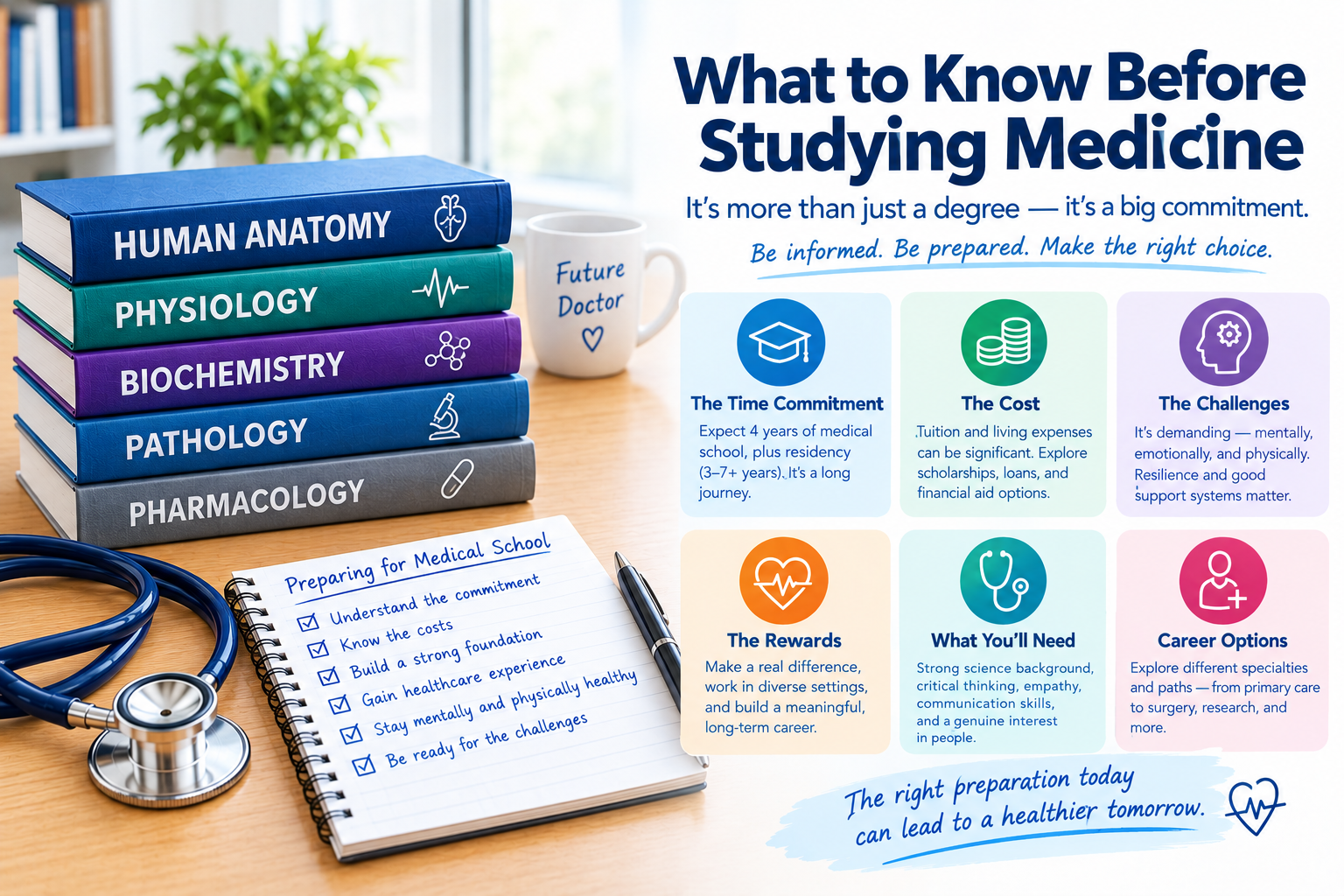
Medicine is a rewarding career and a demanding one. People who enjoy it most tend to be the ones who knew what they were choosing. These eight points are worth thinking through before you apply.
1. The volume is the hard part
Few single ideas in medicine are difficult. There are simply a great many of them. Students often compare the workload to drinking from a fire hose. Steady daily work beats cramming, and good study technique matters more than raw ability.
2. Training is long
In the United States it takes at least 11 years after high school to practise independently. In the United Kingdom or Pakistan the first degree takes five or six years, followed by years of supervised work. See how long it takes to be an MD for the detail.
3. It can be expensive
Costs differ widely between countries and between public and private schools. In the United States, many graduates finish with student debt of roughly 200,000 dollars, according to the Association of American Medical Colleges. Look up the tuition, the living costs and the scholarship options for each school you consider.
4. Entry is competitive
Most systems select on grades and an entrance test: the MCAT in the United States and Canada, the UCAT in the United Kingdom, and the MDCAT in Pakistan. Schools also look for evidence that you understand the job, usually through volunteering or work experience.
5. Get close to real clinical work first
Shadow a doctor, volunteer in a clinic or hospital, or work as a healthcare assistant. It is the most reliable way to find out whether the job suits you. It also gives you something true to say at interview.
6. Communication is a core skill
Much of a doctor's day is listening, explaining and working in a team. You will give bad news, deal with uncertainty, and make decisions with incomplete information. These skills are taught and examined alongside the science.
7. The hours are real
Training involves nights, weekends and holidays. Hours improve in many specialties once training ends, but they vary a great deal. Ask working doctors what their week looks like.
8. Learning never stops
Guidelines change every year. Practising doctors are required to keep learning for their whole careers, and many say it is one of the best parts of the job.
What the application involves
The details differ by country, but selectors look at the same five things.
- Academic record. Strong grades, especially in science.
- An admission test. The MCAT, UCAT or MDCAT, depending on where you apply.
- Experience. Time spent in clinical settings, volunteering, research or caring roles.
- Written statements and references. Why you want to do this, in your own words, and what teachers or supervisors say about you.
- Interview. Either a panel or a multiple mini interview, where you move through a series of short stations that test communication, ethics and judgement.
Competition is real. In the United States fewer than half of applicants are offered a place in any one year, and many successful applicants applied more than once.
Subjects to take at school
Chemistry and biology are required or strongly preferred almost everywhere. Physics and mathematics are useful and sometimes required. In Pakistan the pre-medical group at intermediate level, or A-levels in biology, chemistry and a third science, is the standard route. In the United States the choice of college major is free, as long as the pre-medical courses are completed.
What daily life is like
Pre-clinical years
Expect a full timetable of lectures, small-group work, laboratory sessions and anatomy teaching, followed by several hours of private study most evenings. Tests are frequent. The pace is the biggest shock for new students, including those who were top of their class at school.
Clinical years
You join hospital teams, start early, see patients, present cases to senior doctors and study in the gaps. The hours are less predictable. Most students find these years harder physically and far more rewarding.
The emotional side
Medicine brings you close to suffering earlier than most careers. Students dissect a human body, meet patients who are dying, and sooner or later make a mistake that matters. Schools now teach how to cope with this and provide counselling and mentoring. It helps to go in knowing that feeling upset is normal and that asking for support is expected.
Paying for it
- Loans and scholarships are the main sources in most countries. Apply for every scholarship you qualify for.
- Service-linked funding pays tuition in return for years of work. Examples in the United States include military scholarships and the National Health Service Corps.
- Public and private schools can differ greatly in cost. In Pakistan, fees at public medical colleges are a small fraction of those at private ones.
- Paid training begins after graduation. Residents and house officers receive a salary.
Myths and reality
| Myth | Reality |
|---|---|
| You have to be a genius. | You need to be capable and consistent. Work habits matter more than brilliance. |
| You must know your specialty before you start. | Most students decide during clinical rotations, and many change their minds. |
| Doctors are rich from the start. | Training is long and often funded by debt. Good income comes later. |
| You will have no life. | Time is tight, but students still play sport, keep friendships and have families. |
| Medicine is all science. | Much of it is communication, judgement and teamwork. |
Other careers to weigh up
Many people who are drawn to medicine would be equally satisfied, and qualified sooner, in a related profession.
| Career | What the work centres on |
|---|---|
| Nursing | Direct, continuous care of patients, with many routes to advanced practice |
| Physician assistant or associate | Diagnosis and treatment under a doctor's supervision, after a shorter training |
| Pharmacy | Expert knowledge of medicines and their safe use |
| Physiotherapy | Movement, rehabilitation and recovery from injury |
| Biomedical science | Laboratory work behind diagnosis and research |
| Public health | Preventing disease across whole populations |
A plan for the twelve months before you apply
- Months 1 to 3: arrange regular clinical exposure and talk to at least three doctors about their work.
- Months 3 to 6: prepare for the admission test with timed practice papers.
- Months 6 to 8: research schools, costs and entry requirements, and make a shortlist.
- Months 8 to 10: draft your personal statement and ask for references early.
- Months 10 to 12: practise interviews aloud with a teacher or friend.
How to get clinical experience
- Start with people you know. Ask your family doctor, relatives or teachers whether they can introduce you to a clinician.
- Write a short, polite request. Say who you are, what you hope to learn and when you are free. Offer to follow any confidentiality rules.
- Volunteer. Hospitals, hospices, care homes and charities take volunteers for non-clinical roles. Long-term commitment counts for more than a single week.
- Take a first aid course. It is useful in its own right and shows initiative.
- Keep a diary. After each session, note what you saw and what surprised you. These notes become the raw material for your personal statement and interview answers.
Selectors are less interested in how impressive the placement was than in what you learned from it.
What doctors say they wish they had known
- That learning how to study matters more in the first term than any single subject.
- That everyone feels out of their depth at first, including the students who look confident.
- That friendships made in medical school become a professional support network for life.
- That hobbies and exercise are worth protecting, because they are what keep you going.
- That much of the job is paperwork, phone calls and teamwork, and that these can be done well or badly.
- That it is acceptable to change your mind about your specialty, and even about medicine.
Questions to ask at an open day
- How is the course taught: lectures, problem-based learning or a mix?
- When do students first meet patients?
- How are students assessed, and how often?
- Which hospitals are used for clinical placements, and how far away are they?
- What support is there for students who struggle academically or personally?
- What is the total cost, including living expenses and travel to placements?
- Where do graduates go on to work and train?
Questions to ask yourself
- Do I enjoy science and also enjoy working with people?
- Have I seen what doctors do on an ordinary day?
- Am I comfortable with a long training path before full independence?
- Would a related career, such as nursing, pharmacy or physician associate, suit me better?
If you want to test your interest before committing, start with how to start learning about medicine.
Common questions
Am I too old to study medicine?
No. Schools accept students in their thirties and forties. Work out the full timeline and the cost first.
Do I need to be good at mathematics?
You need to be comfortable with arithmetic, ratios, graphs and basic statistics. Advanced mathematics is not used in everyday practice.
What if I am squeamish?
Most people adapt with exposure. If the sight of blood troubles you, test yourself by observing in a clinical setting before you apply.
This guide is general education and is not medical, legal or career advice. Entry rules, fees, training lengths and treatment guidance change, so confirm them with the official body in your country or with your own doctor or pharmacist. Read our disclaimer. Found an error? Tell us.