Home / Guides / Training timeline
How long does it take to be an MD?
In the United States it takes 11 to 15 years after high school. See each stage and work out your own total by specialty.
On this page (14 sections)
- The four stages
- What can make it shorter or longer
- A typical timeline by age
- What happens in each year of medical school
- The exams along the way
- Why the application year adds time
- When do you start earning?
- When can you get a licence?
- Starting later in life
- How the MD compares with other clinical careers
- What can delay training
- Making a long path manageable
- A planning checklist
- Common questions
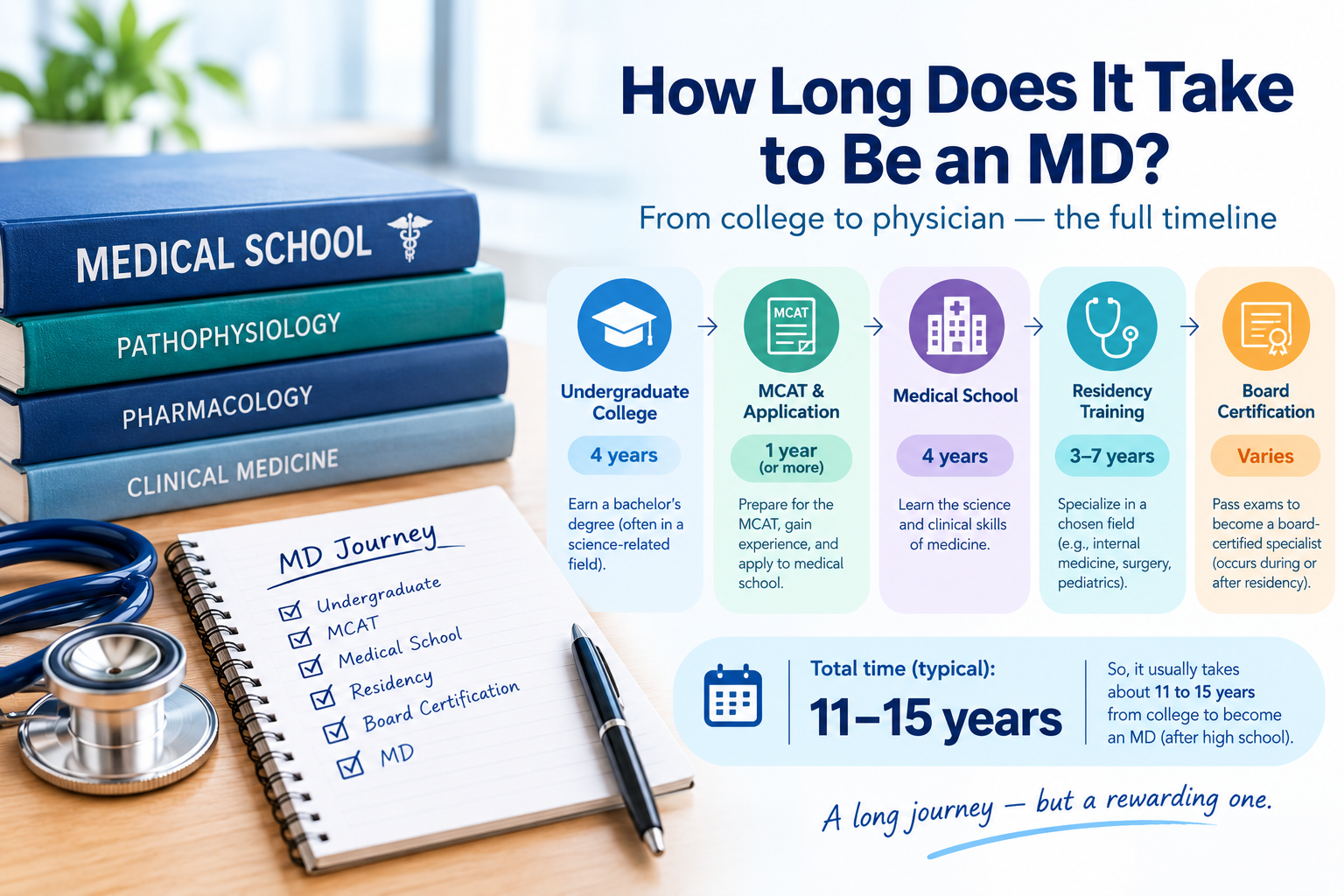
In the United States it takes 11 to 15 years after high school to become a fully trained physician. That is four years of college, four years of medical school, and three to seven years of residency. You hold the MD degree after year eight. You can practise on your own only after residency.
Choose a specialty below to see your own total.
Typical United States lengths. Individual programmes vary, and some surgical residencies add research years.
The four stages
1. Bachelor's degree: 4 years
Medical schools accept any major, provided you complete the pre-medical science courses and sit the Medical College Admission Test (MCAT). Many applicants now take one or two gap years before they apply, usually to work in research or clinical care.
2. Medical school: 4 years
The first two years cover the science of the body and disease. The last two are clinical rotations in hospitals and clinics. Students sit USMLE Step 1 after the pre-clinical years and Step 2 CK during rotations. They graduate with the MD.
3. Residency: 3 to 7 years
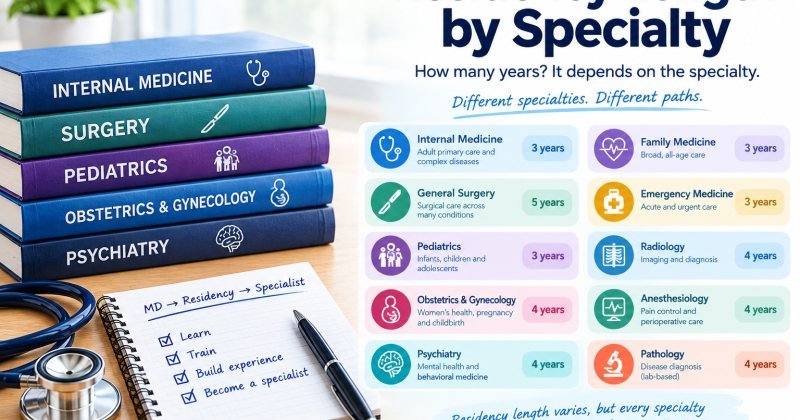
Residency is paid, supervised training in one specialty. Family medicine, internal medicine and paediatrics take three years. General surgery takes five. Neurosurgery takes seven. Residents sit USMLE Step 3 and can then apply for an unrestricted medical licence.
4. Fellowship: 1 to 3 years, optional
A fellowship adds sub-specialty training, such as cardiology after internal medicine. It is required for some careers and optional for others.
What can make it shorter or longer
- Combined BS/MD programmes join college and medical school and can save one or two years.
- Three-year MD programmes exist at a small number of schools, often linked to a primary care residency.
- Gap years add one or two years for many applicants.
- Dual degrees add time. An MD-PhD usually takes seven to eight years in place of four.
- Research years are built into some surgical residencies.
A typical timeline by age
The table shows the route for a student who goes straight through with no breaks and chooses a three-year residency. Most people take a little longer.
| Age | Stage | Main milestones |
|---|---|---|
| 18 to 22 | College | Science courses, clinical experience, MCAT in the third year, applications in the summer before the fourth year |
| 22 to 24 | Medical school, years 1 and 2 | Foundations of medicine, organ systems, USMLE Step 1 |
| 24 to 26 | Medical school, years 3 and 4 | Core clerkships, USMLE Step 2 CK, residency applications, Match Day, graduation with the MD |
| 26 to 29 | Residency | Supervised practice, USMLE Step 3, full licence |
| 29 onwards | Independent practice or fellowship | Board certification examination |
In practice the average age of students starting medical school in the United States is around 24, because so many take time out before applying. That moves every later row back by a year or two.
What happens in each year of medical school
Year 1: foundations
Students learn anatomy, biochemistry, physiology and the basics of examining a patient. Many schools begin short clinic visits in the first weeks so that the science has a human context.
Year 2: disease by organ system
Teaching moves through the heart, lungs, kidneys, gut, brain and other systems, covering what goes wrong and how it is treated. The year ends with several weeks of full-time revision for USMLE Step 1, which is now reported as pass or fail.
Year 3: core clerkships
Students join hospital and clinic teams for blocks of four to eight weeks in internal medicine, surgery, paediatrics, obstetrics and gynaecology, psychiatry, family medicine and neurology. This is the year most people decide on a specialty.
Year 4: choosing and applying
The final year is built around the residency application. Students take advanced rotations in their chosen field, sit Step 2 CK, apply in the autumn, interview over the winter and learn where they are going on Match Day in March.
The exams along the way
| Exam | When | What it decides |
|---|---|---|
| MCAT | Before applying to medical school | Admission. It takes about seven and a half hours including breaks. |
| USMLE Step 1 | After the second year | Pass or fail test of medical science |
| USMLE Step 2 CK | During the third or fourth year | Scored test of clinical knowledge, used by residency programmes |
| USMLE Step 3 | During residency | Final step for a full licence. It is sat over two days. |
| Board certification | After residency | Recognition as a specialist in one field |
Students at osteopathic schools sit the COMLEX-USA series, and many take the USMLE as well.
Why the application year adds time
Applying to medical school takes about a year from start to finish. Applications open in late spring, interviews run from autumn to early spring, and classes begin the following summer. A student who wants to go straight through must therefore have grades, test scores and clinical experience ready by the end of the third year of college. Many are not ready by then, and that is the main reason gap years have become normal.
When do you start earning?
Medical students pay tuition and are not paid. Income begins in residency. Residents receive a salary, which in recent surveys has been roughly 60,000 to 70,000 dollars in the first year and rises a little each year. Full physician pay starts only after residency or fellowship. This is why the length of training matters financially as well as personally.
When can you get a licence?
Each state has its own medical board and its own rules. All require passing the three USMLE steps or the COMLEX equivalent. Most states also require at least one year of residency training before granting a full licence, and some require two or three, particularly for graduates of medical schools outside the United States. In practice almost every doctor completes a full residency, because hospitals and insurers expect board certification.
Starting later in life
There is no upper age limit for medical school. Career changers usually need to complete the science courses first, often through a one or two year post-baccalaureate programme, and then follow the same route as everyone else. Someone who decides at 30 can expect to be practising independently in their early forties. Admissions committees generally value the experience that older applicants bring.
How the MD compares with other clinical careers
| Career | Typical training after high school in the United States |
|---|---|
| Registered nurse | 2 to 4 yrs |
| Physician assistant | about 6 to 7 yrs |
| Pharmacist | 6 to 8 yrs |
| Physician (MD or DO) | 11 to 15 yrs |
The extra years buy the widest scope of practice and final responsibility for the patient. Whether that trade is worth it depends on what you want from your working life.
What can delay training
- Reapplying to medical school. Many successful applicants were not accepted the first time.
- Failing a licensing examination. A resit usually costs a few months and can affect residency applications.
- Not matching. Applicants who do not obtain a residency place often spend a year in research or a one-year post before reapplying.
- Changing specialty. Earlier training may only partly count towards the new field.
- Leave. Time taken for illness, parenthood or family reasons is normally made up at the end.
- Research years. These are chosen by many residents aiming for competitive fellowships or academic careers.
None of these is unusual. Plan for the shortest timeline and expect to add a year somewhere.
Making a long path manageable
- Think in stages. Each stage has its own goal, and you only need to complete the one you are in.
- Keep costs down early. Scholarships, public universities and careful borrowing during college reduce pressure later.
- Use gap years on purpose. Paid clinical or research work strengthens an application and gives you a rest from examinations.
- Choose a specialty for the work. Three extra years of training matter less than thirty years in a job that suits you.
- Protect your health. Sleep, exercise and friendships are part of the plan.
A planning checklist
- Write down your age now and the earliest year you could start medical school.
- Add four years for the degree.
- Add the residency length for two or three specialties that interest you.
- Add one year as a margin.
- Check the result against your other plans for work, family and money.
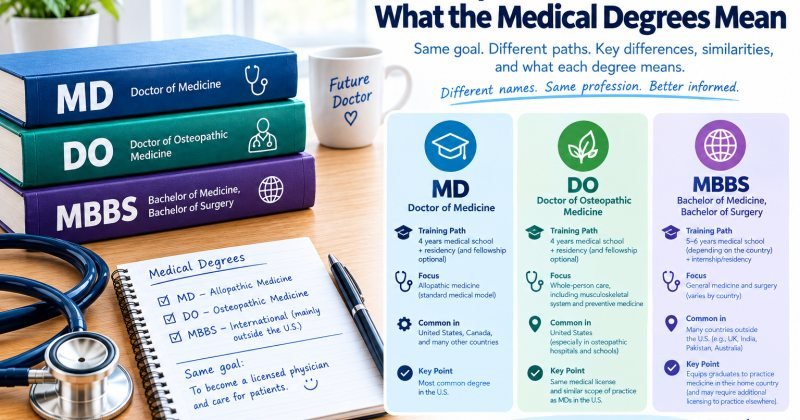
For other countries, read MD, DO and MBBS: what the medical degrees mean.
Common questions
How old are most doctors when they finish training?
Most finish residency between the ages of 29 and 33. Those who complete long surgical residencies or fellowships are often in their mid-thirties.
Can you become a doctor in six years?
In the United States, no. In countries where students enter medical school straight from high school, such as the United Kingdom and Pakistan, the medical degree itself takes five or six years, followed by supervised practice.
Can you work while in medical school?
A few students tutor or do research for pay, but the workload leaves little time. Most rely on loans, scholarships and family support.
What is the fastest way to become an MD?
The shortest common route is 11 years: four years of college, four of medical school and a three-year residency. Combined or accelerated programmes can bring that down to nine or ten.
Are you a doctor once you finish medical school?
You hold the degree and the title. You cannot practise independently until you complete residency training and hold a full licence.
Is a DO the same length as an MD?
Yes. Doctor of Osteopathic Medicine programmes also last four years, and DO graduates enter the same residency programmes.
This guide is general education and is not medical, legal or career advice. Entry rules, fees, training lengths and treatment guidance change, so confirm them with the official body in your country or with your own doctor or pharmacist. Read our disclaimer. Found an error? Tell us.