Home / Guides / Training timeline
MD, DO and MBBS: what the medical degrees mean
The letters after a doctor's name mean different things in different countries. A comparison of the United States, Canada, the United Kingdom and Pakistan.
On this page (18 sections)
- United States: MD and DO
- Canada: MD
- United Kingdom: MBBS or MBChB
- Pakistan: MBBS, then FCPS, MD or MS
- Side by side
- What the letters stand for
- Why there are two traditions
- More about the DO degree
- Three more countries
- Titles: who is called "Doctor"?
- Postgraduate letters you will see
- MD and PhD
- Is one degree better than another?
- If you are studying in Pakistan
- How to read a doctor's credentials
- School-leaver entry and graduate entry
- Moving between countries
- Common questions
The letters MD do not mean the same thing everywhere. In some countries the MD is the first medical degree. In others it is a higher qualification taken years later. This guide sets out the main routes.
United States: MD and DO
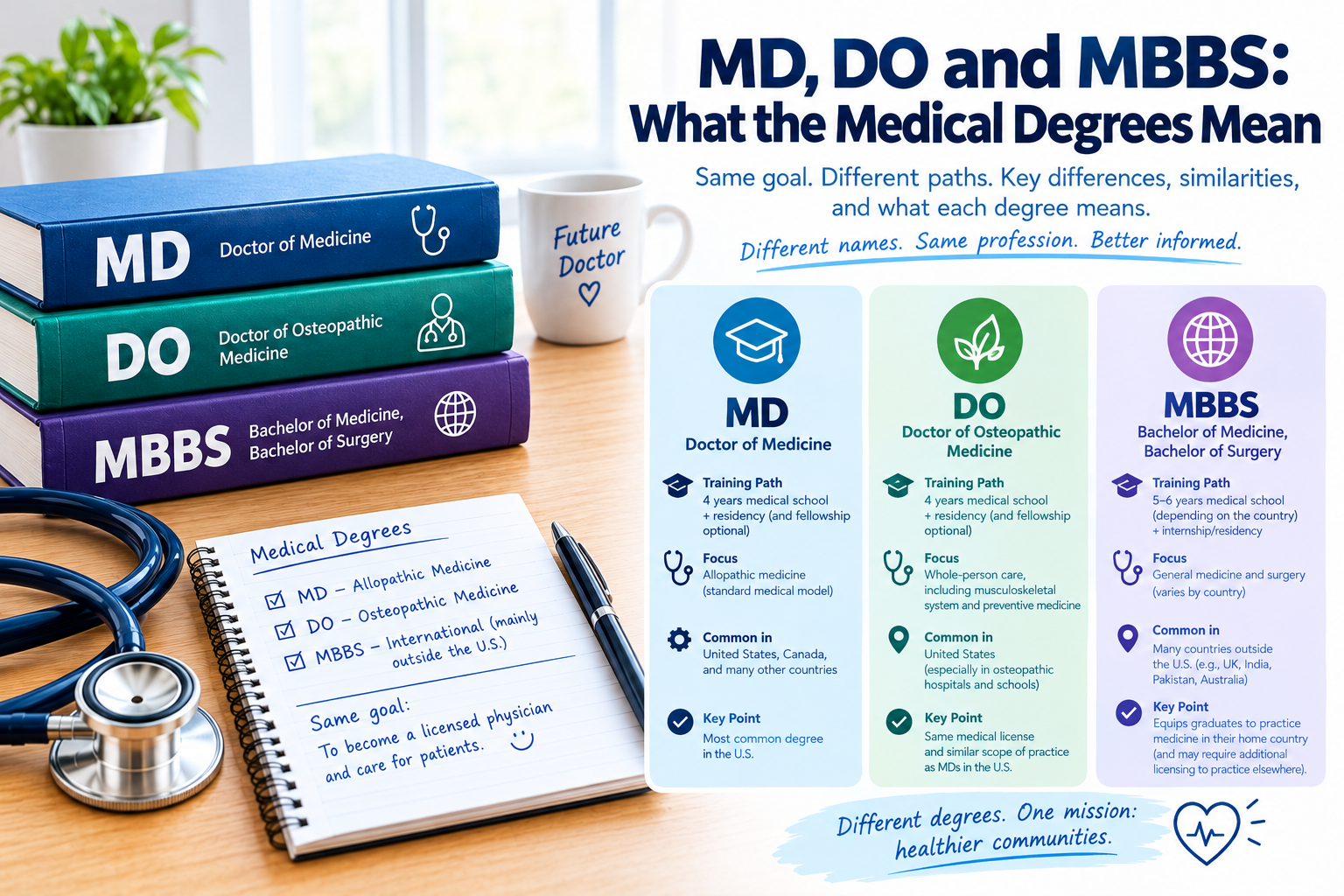
There are two medical degrees. The MD, Doctor of Medicine, is awarded by allopathic medical schools. The DO, Doctor of Osteopathic Medicine, is awarded by osteopathic schools, which add training in hands-on musculoskeletal treatment. Both take four years after a bachelor's degree. Both lead to the same residency programmes and the same full licence.
Canada: MD
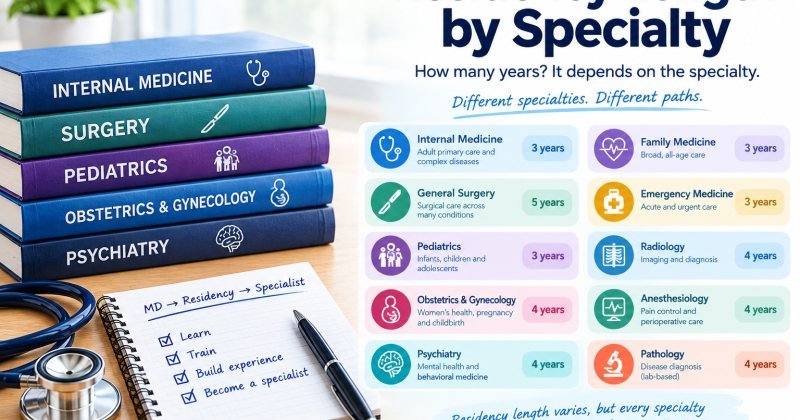
Canadian schools award the MD after three or four years. Most students complete a bachelor's degree first, although some schools admit students after two or three years of university. Residency lasts two years for family medicine and five or more for many specialties.
United Kingdom: MBBS or MBChB
The first medical degree is a bachelor's qualification, written as MBBS, MBChB or similar depending on the university. Students usually enter at 18 and study for five or six years. Graduates then complete a two-year foundation programme, followed by specialty training of three years for general practice and up to eight for some hospital specialties.
In the United Kingdom, an MD is a research degree taken by doctors who are already qualified.
Pakistan: MBBS, then FCPS, MD or MS
The MBBS takes five years and is followed by a one-year house job, after which a doctor can register for independent practice. Specialist training comes next. The FCPS fellowship is awarded by the College of Physicians and Surgeons Pakistan, and universities award the MD in medical specialties and the MS in surgical ones. These programmes usually take four to five years.
Side by side
| Country | Route | Typical total |
|---|---|---|
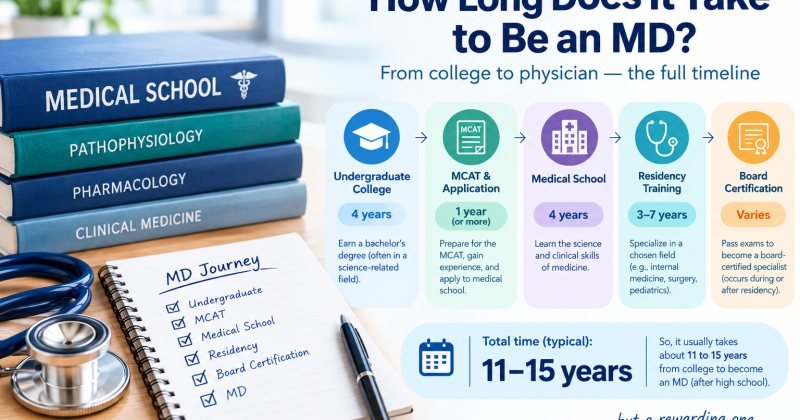
| United States | Bachelor's 4 yrs, MD or DO 4 yrs, residency 3 to 7 yrs | 11 to 15 yrs |
| Canada | University 3 to 4 yrs, MD 3 to 4 yrs, residency 2 to 5 yrs or more | about 10 to 14 yrs |
| United Kingdom | Medical degree 5 to 6 yrs, foundation 2 yrs, specialty training 3 to 8 yrs | 10 to 16 yrs |
| Pakistan | MBBS 5 yrs, house job 1 yr, postgraduate training 4 to 5 yrs | 6 yrs to practise, 10 to 11 as a specialist |
Typical figures. Check the regulator in your country for current rules.
What the letters stand for
| Letters | Full name | Where you see it |
|---|---|---|
| MD | Doctor of Medicine, from the Latin Medicinae Doctor | United States, Canada and many other countries |
| DO | Doctor of Osteopathic Medicine | United States |
| MBBS | Bachelor of Medicine, Bachelor of Surgery | United Kingdom, Pakistan, India, Australia and others |
| MBChB, MB BCh, BMBS | The same pair of bachelor's degrees, abbreviated from Latin or in a different order | Individual universities in the United Kingdom, Ireland and elsewhere |
The different spellings of the British degree carry no difference in status. They reflect the traditions of each university.
Why there are two traditions
In the British system, medicine developed as a first university degree, so it was named as a bachelor's qualification, and the title of doctor was used by courtesy. The doctorate in medicine was kept for advanced study. In North America, medical schools came to require a college degree before entry, and the medical qualification was therefore awarded as a doctorate. The training that each produces is comparable. The names differ because the entry point differs.
More about the DO degree
Osteopathic medical schools teach the same science and clinical medicine as MD schools. They add around 200 hours of training in osteopathic manipulative treatment, a hands-on approach to the muscles and joints. DO students sit the COMLEX-USA licensing examinations, and many also take the USMLE.
Since 2020 all residency programmes in the United States have been accredited by a single body, so MD and DO graduates apply to the same programmes. More than a quarter of medical students in the United States now attend osteopathic schools. A DO is a fully licensed physician who can prescribe, operate and practise in any specialty.
Three more countries
| Country | First degree and length | What follows |
|---|---|---|
| India | MBBS, five and a half years including a one-year internship | Postgraduate MD or MS, usually three years |
| Australia | A five or six year degree from school, or a four year graduate-entry MD | One-year internship, then residency and specialist college training |
| Germany | Six years, ending in a state examination | Specialist training of five to six years. The title "Dr. med." is a separate research doctorate. |
Australia shows how fluid the names are. Many Australian universities have renamed their graduate-entry medical degree from MBBS to MD without changing its length.
Titles: who is called "Doctor"?
Holders of all these degrees use the title Doctor in clinical practice. One exception surprises visitors to the United Kingdom and Ireland. Surgeons there traditionally return to Mr, Miss, Ms or Mrs once they pass the membership examinations of a royal college of surgeons. It is a mark of seniority.
Postgraduate letters you will see
| Letters | Meaning | Country |
|---|---|---|
| MRCP, MRCS | Member of a Royal College of Physicians or Surgeons, earned by examination during training | United Kingdom |
| FRCS, FRCP | Fellow of a royal college, a senior qualification or honour | United Kingdom |
| FCPS, MCPS | Fellow or Member of the College of Physicians and Surgeons Pakistan | Pakistan |
| FRCPC, FRCSC | Fellow of the Royal College of Physicians and Surgeons of Canada | Canada |
| Board certified | Passed the examination of a specialty board after residency | United States |
MD and PhD
An MD in the North American sense is a professional degree that prepares someone to treat patients. A PhD is a research degree earned by producing original research. Some people hold both. Combined MD-PhD programmes in the United States usually take seven to eight years, and many are funded so that students pay no tuition.
Is one degree better than another?
No. What matters is whether the medical school is properly accredited and whether the degree is recognised where you want to work. Two checks help:
- The World Directory of Medical Schools lists recognised schools worldwide. A school that is not listed will cause problems if you ever want to practise abroad.
- The national regulator in the country where you plan to work publishes which qualifications it accepts.
If you are studying in Pakistan
- Check that your college is recognised by the Pakistan Medical and Dental Council and appears in the World Directory of Medical Schools.
- For the United States, plan for ECFMG certification and the USMLE steps, followed by a residency application.
- For the United Kingdom, international graduates take the licensing assessment required by the General Medical Council and must show English language ability.
- For specialist practice at home, the usual routes are FCPS training through the College of Physicians and Surgeons Pakistan or a university MD or MS.
Rules for foreign graduates change often. Read the regulator's own website before you pay for any examination or course.
How to read a doctor's credentials
The letters after a name tell a short story if you read them in order.
| Example | What it tells you |
|---|---|
| Dr A. Khan, MBBS, FCPS (Medicine) | First medical degree in the British tradition, then a specialist fellowship in internal medicine from the College of Physicians and Surgeons Pakistan |
| Jane Smith, MD, FACC | North American medical degree. Fellow of the American College of Cardiology, so a cardiologist. |
| John Brown, MBChB, MRCP(UK) | British medical degree, and has passed the membership examinations of the Royal Colleges of Physicians |
| Maria Lopez, DO | Osteopathic medical degree from the United States. A fully licensed physician. |
| Sam Lee, MD, PhD | A physician who also holds a research doctorate |
The first degree shows where and how the doctor qualified. The later letters show specialist training, which is usually the more useful information for a patient.
School-leaver entry and graduate entry
The two traditions are converging. Countries that train doctors from the age of 18 have added shorter courses for people who already hold a degree. The United Kingdom offers four-year graduate-entry programmes alongside the standard five-year course. Australia runs both school-leaver and graduate-entry degrees. In the other direction, some universities in the United States offer combined programmes that admit students from high school and award a bachelor's degree and an MD in six or seven years.
For an applicant, this means the choice is less about the letters and more about timing: whether you are ready to commit to medicine at 18, or would prefer to take a first degree and decide later.
Moving between countries
A degree from one country does not automatically allow practice in another. A doctor with an MBBS who wants to train in the United States must be certified by the ECFMG, pass the USMLE exams and complete a United States residency. The United Kingdom and Canada have their own registration exams and rules. Plan for this early, because it adds time and cost.
Common questions
Is MBBS equal to MD?
For the purpose of becoming a doctor, yes. An MBBS and a North American MD are both first medical qualifications. In countries that award the MBBS, an MD is a higher degree taken afterwards.
Can an MBBS doctor write MD after their name in the United States?
Practice varies between states and employers. Many internationally trained physicians who are licensed in the United States are listed as MD. Follow the rules of your state medical board.
Is a DO a real doctor?
Yes. DOs hold full medical licences and work in every specialty.
Which is harder, MD or MBBS?
They cover the same ground. The MBBS starts at a younger age and is longer as a single degree. The North American MD is shorter and follows a separate bachelor's degree.
- Association of American Medical Colleges (AAMC)
- American Association of Colleges of Osteopathic Medicine (AACOM)
- General Medical Council, United Kingdom
- Pakistan Medical and Dental Council (PM&DC)
- College of Physicians and Surgeons Pakistan (CPSP)
- Canadian Resident Matching Service (CaRMS)
- Educational Commission for Foreign Medical Graduates (ECFMG)
This guide is general education and is not medical, legal or career advice. Entry rules, fees, training lengths and treatment guidance change, so confirm them with the official body in your country or with your own doctor or pharmacist. Read our disclaimer. Found an error? Tell us.