Home / Guides / Training timeline
Residency length by specialty
A table of typical United States residency lengths, from three years in family medicine to seven in neurosurgery, plus common fellowships.
On this page (18 sections)
- How residents are counted: PGY
- How you get a residency place
- Common fellowships after residency
- Why some residencies are longer
- Preliminary and transitional years
- Combined programmes
- Working hours during residency
- More fellowships and total training time
- Board certification
- Pay during residency
- How other countries compare
- If you do not match, or change your mind
- A quick way to estimate your own timeline
- The residency application year
- How the years of residency differ
- Comparing programmes in the same specialty
- Choosing with length in mind
- Common questions
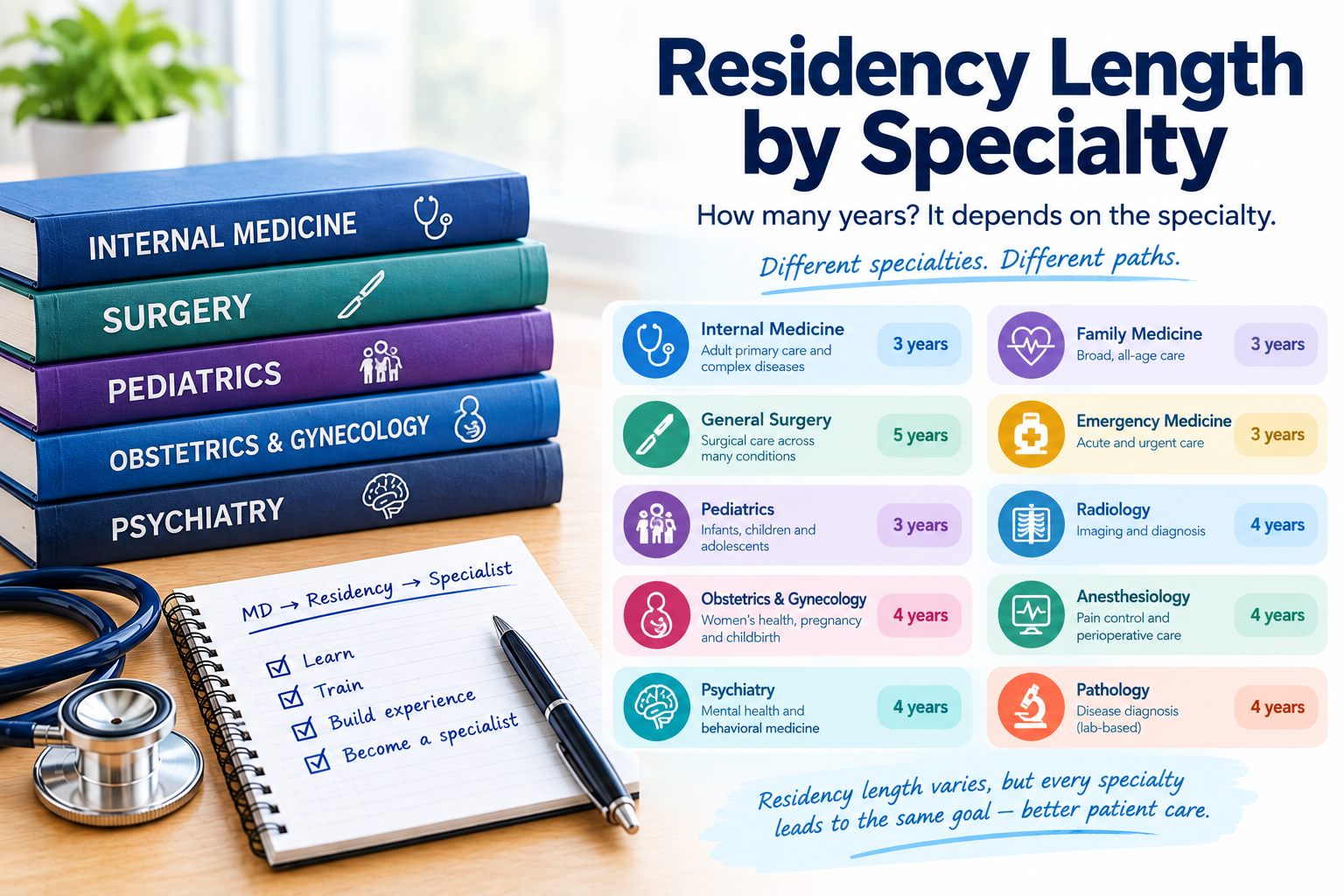
Residency is the stage that decides how long medical training takes. Every United States physician spends four years in medical school, but residency ranges from three years to seven. The table shows typical lengths and the total number of years after high school, assuming four years of college and four of medical school.
| Specialty | Residency | Total after high school |
|---|---|---|
| Family medicine | 3 yrs | 11 yrs |
| Internal medicine | 3 yrs | 11 yrs |
| Pediatrics | 3 yrs | 11 yrs |
| Emergency medicine | 3 yrs | 11 yrs |
| Psychiatry | 4 yrs | 12 yrs |
| Neurology | 4 yrs | 12 yrs |
| Anesthesiology | 4 yrs | 12 yrs |
| Dermatology | 4 yrs | 12 yrs |
| Obstetrics and gynecology | 4 yrs | 12 yrs |
| Pathology | 4 yrs | 12 yrs |
| Diagnostic radiology | 5 yrs | 13 yrs |
| General surgery | 5 yrs | 13 yrs |
| Orthopedic surgery | 5 yrs | 13 yrs |
| Otolaryngology (ENT) | 5 yrs | 13 yrs |
| Urology | 5 yrs | 13 yrs |
| Plastic surgery (integrated) | 6 yrs | 14 yrs |
| Neurosurgery | 7 yrs | 15 yrs |
Typical lengths for programmes accredited in the United States. Emergency medicine programmes run three or four years. Some surgical programmes add one or two research years.
How residents are counted: PGY
Residents are described by postgraduate year. A PGY-1 is in the first year after medical school, which is also called the intern year. A PGY-3 in internal medicine is in the final year. A PGY-3 in neurosurgery is not yet halfway.
How you get a residency place
Final-year students apply to programmes and attend interviews. Students and programmes then rank each other, and the National Resident Matching Program pairs them using an algorithm. Results are released on Match Day in March. Graduates begin residency around the start of July.
Common fellowships after residency
| Fellowship | After | Extra time |
|---|---|---|
| Cardiology | Internal medicine | 3 yrs |
| Gastroenterology | Internal medicine | 3 yrs |
| Neonatology | Pediatrics | 3 yrs |
| Child and adolescent psychiatry | Psychiatry | 2 yrs |
| Sports medicine | Family medicine | 1 yr |
A cardiologist therefore trains for six years after medical school: three in internal medicine and three in cardiology.
Why some residencies are longer
Length follows the range of skills a specialist must have on the first day of independent practice. A family doctor needs broad knowledge and a modest set of procedures. A neurosurgeon must be able to operate safely on the brain and spine, which takes thousands of supervised hours. Surgical programmes are longer for that reason, and some build in one or two years of research.
Preliminary and transitional years
Several specialties do not begin with their own training. Anesthesiology, dermatology, diagnostic radiology, neurology, ophthalmology and radiation oncology require a first year of general clinical work. The lengths in the table above include that year.
- Categorical positions include the first year and the specialty years in one programme.
- Advanced positions start in the second year. The applicant must also secure a separate first-year place.
- Preliminary years are one-year posts in internal medicine or surgery.
- Transitional years rotate through several specialties.
Combined programmes
Combined residencies train a doctor in two fields in less time than doing both one after the other.
| Programme | Length | If done separately |
|---|---|---|
| Internal medicine and pediatrics | 4 yrs | 6 yrs |
| Internal medicine and psychiatry | 5 yrs | 7 yrs |
| Emergency medicine and internal medicine | 5 yrs | 6 to 7 yrs |
Working hours during residency
The Accreditation Council for Graduate Medical Education sets limits for all accredited programmes in the United States:
- no more than 80 hours of work a week, averaged over four weeks
- at least one day in seven free of clinical work, averaged over four weeks
- continuous duty of no more than 24 hours, with up to four more hours for handover and teaching
Actual hours vary widely by specialty and by rotation. Surgical and intensive care rotations often sit near the limit. Outpatient rotations are closer to a normal working week.
More fellowships and total training time
| Subspecialty | Residency first | Fellowship | Years after medical school |
|---|---|---|---|
| Pulmonary and critical care | Internal medicine, 3 | 3 | 6 |
| Hematology and oncology | Internal medicine, 3 | 3 | 6 |
| Endocrinology | Internal medicine, 3 | 2 | 5 |
| Nephrology | Internal medicine, 3 | 2 | 5 |
| Infectious disease | Internal medicine, 3 | 2 | 5 |
| Geriatric medicine | Internal or family medicine, 3 | 1 | 4 |
| Pediatric surgery | General surgery, 5 | 2 | 7 |
| Cardiothoracic surgery | General surgery, 5 | 2 to 3 | 7 to 8 |
| Hand surgery | Orthopedic or plastic surgery, 5 to 6 | 1 | 6 to 7 |
An interventional cardiologist trains for three years in internal medicine, three in cardiology and at least one more in interventional work. That is seven years after medical school and fifteen after high school.
Board certification
Finishing residency makes a doctor board eligible. Passing the examination set by the specialty board makes them board certified. Certification is voluntary in law, but most hospitals and insurers expect it. Doctors then keep it up through continuing education and periodic assessment.
Pay during residency
Residents are employees and receive a salary with benefits. Pay is set by the hospital, is broadly the same across specialties within one institution, and rises by a small step each postgraduate year. It is modest compared with a fully trained physician's income, which is why long residencies and fellowships carry a real financial cost.
How other countries compare
| Country | Shortest route | Longer routes |
|---|---|---|
| United States | 3 yrs: family medicine, internal medicine, pediatrics | 5 to 7 yrs for surgical specialties |
| Canada | 2 yrs: family medicine | 4 to 6 yrs for Royal College specialties |
| United Kingdom | 3 yrs of general practice training after the 2 foundation years | 5 to 8 yrs for hospital specialties |
| Pakistan | House job of 1 yr, then FCPS training | 4 to 5 yrs for most FCPS programmes |
If you do not match, or change your mind
Applicants who do not obtain a place on Match Day can apply for unfilled positions through the Supplemental Offer and Acceptance Program, which runs in the same week. Others spend a year in research or a preliminary post and apply again.
Switching specialty during residency is possible. It usually means applying for an open position in the new field, and some earlier training may not count, so the total time grows.
A quick way to estimate your own timeline
Start with eight years for college and medical school. Add the residency length from the first table. Add any fellowship from the fellowship tables. Then add one year for each gap or research year you expect to take. A student who takes one gap year, trains in internal medicine and completes a cardiology fellowship reaches fifteen years after high school. A student who goes straight through into family medicine reaches eleven. Writing the sum down early helps you plan money, family life and where you want to live.
The residency application year
The process runs on a fixed national calendar, which is why final-year students all apply at the same time.
| When | What happens |
|---|---|
| Summer | Students finish advanced rotations, request letters of recommendation and write a personal statement |
| September | Applications are submitted through the Electronic Residency Application Service and released to programmes |
| October to January | Interviews, many of them now held online |
| February | Applicants and programmes submit their rank order lists |
| March | Match Day, on the third Friday of the month |
| Late June or 1 July | Residency begins |
How the years of residency differ
- First year (intern). The steepest learning curve. Interns admit patients, write orders and are closely supervised.
- Middle years. Residents take more decisions, lead parts of the team and begin to teach students and interns.
- Final year. Senior or chief residents run teams, perform the most complex procedures of their training and prepare for board examinations and job or fellowship applications.
Responsibility grows each year by design. The principle is called graded autonomy, and it is the reason training cannot simply be compressed.
Comparing programmes in the same specialty
Two programmes of the same length can offer very different experiences. When you compare them, look at:
- Setting. University hospitals see rarer conditions and offer more research. Community hospitals often give earlier hands-on experience.
- Case volume. For procedural specialties, ask how many operations or procedures a typical graduate has performed.
- Call schedule. How many nights and weekends, and whether a night-float system is used.
- Fellowship results. Where recent graduates went next.
- Board pass rates. Programmes publish these or will share them on request.
- Culture and support. Talk to current residents away from the formal interview.
- Location and cost of living. A resident's salary goes much further in some cities than in others.
Choosing with length in mind
Length matters, but it is one factor among several. Residents are paid a salary, so longer training delays a full income without stopping income altogether. Daily work, patient contact and the hours of the finished job differ far more between specialties than the two or three years that separate their residencies. Use rotations in medical school to test what the work feels like.
To add up your own total, use the calculator in How long does it take to be an MD?
Common questions
What is the shortest residency?
Family medicine, internal medicine and pediatrics, at three years each in the United States.
What is the longest residency?
Neurosurgery, at seven years. Some general surgery and plastic surgery routes reach a similar length when research years or fellowships are added.
Is a resident a real doctor?
Yes. A resident holds a medical degree and treats patients under the supervision of fully trained physicians.
Do all doctors do a fellowship?
No. Many family doctors, general internists, pediatricians and emergency physicians start practice straight after residency.
This guide is general education and is not medical, legal or career advice. Entry rules, fees, training lengths and treatment guidance change, so confirm them with the official body in your country or with your own doctor or pharmacist. Read our disclaimer. Found an error? Tell us.