Home / Guides / Learning medicine
How to start learning about medicine
Medicine is built in layers. Here is the order to study them in, what you can learn on your own, and a plan for your first month.
On this page (15 sections)
- The usual order of study
- What you can learn on your own
- A plan for your first month
- The foundation subjects, one by one
- A worked example: one disease through every layer
- Learn the language
- Which resource for which job
- How to judge a source
- Mistakes beginners make
- How long does it take?
- A weekly routine that fits around work or school
- Ways to see medicine in practice
- Where to go after the basics
- Habits that help from day one
- Common questions
Medicine is a large subject, but it is built in layers. First you learn how a healthy body is put together and how it works. Then you learn what goes wrong, how to recognise it, and what can be done about it. Almost every medical course in the world follows that order, and it works just as well for someone studying on their own.
The usual order of study
- Structure and function. Anatomy, histology, physiology and biochemistry. This is the vocabulary of medicine. Learn it system by system: heart and circulation, lungs, kidneys, gut, nervous system, hormones.
- Disease and its causes. Pathology, microbiology, immunology and genetics. For each organ system, ask what can fail, why it fails, and what the patient would notice.
- Treatment. Pharmacology and therapeutics. Learn drugs by class and mechanism before you learn individual names and doses.
- Clinical reasoning. History taking, physical examination, and building a list of possible diagnoses. Worked cases are the best practice.
- Clinical practice. Supervised rotations in medicine, surgery, paediatrics, obstetrics, psychiatry and family medicine.
What you can learn on your own
You do not need to be enrolled in a medical school to begin. Free video lessons, open textbooks and open-access journals cover most of the first three layers. Good sources include university open courses, free health and medicine video libraries, and student-written revision sites.
What you cannot get from a screen is supervised contact with patients. That is the part a medical degree exists to provide, and it is why self-study can make you well informed but cannot make you a doctor.
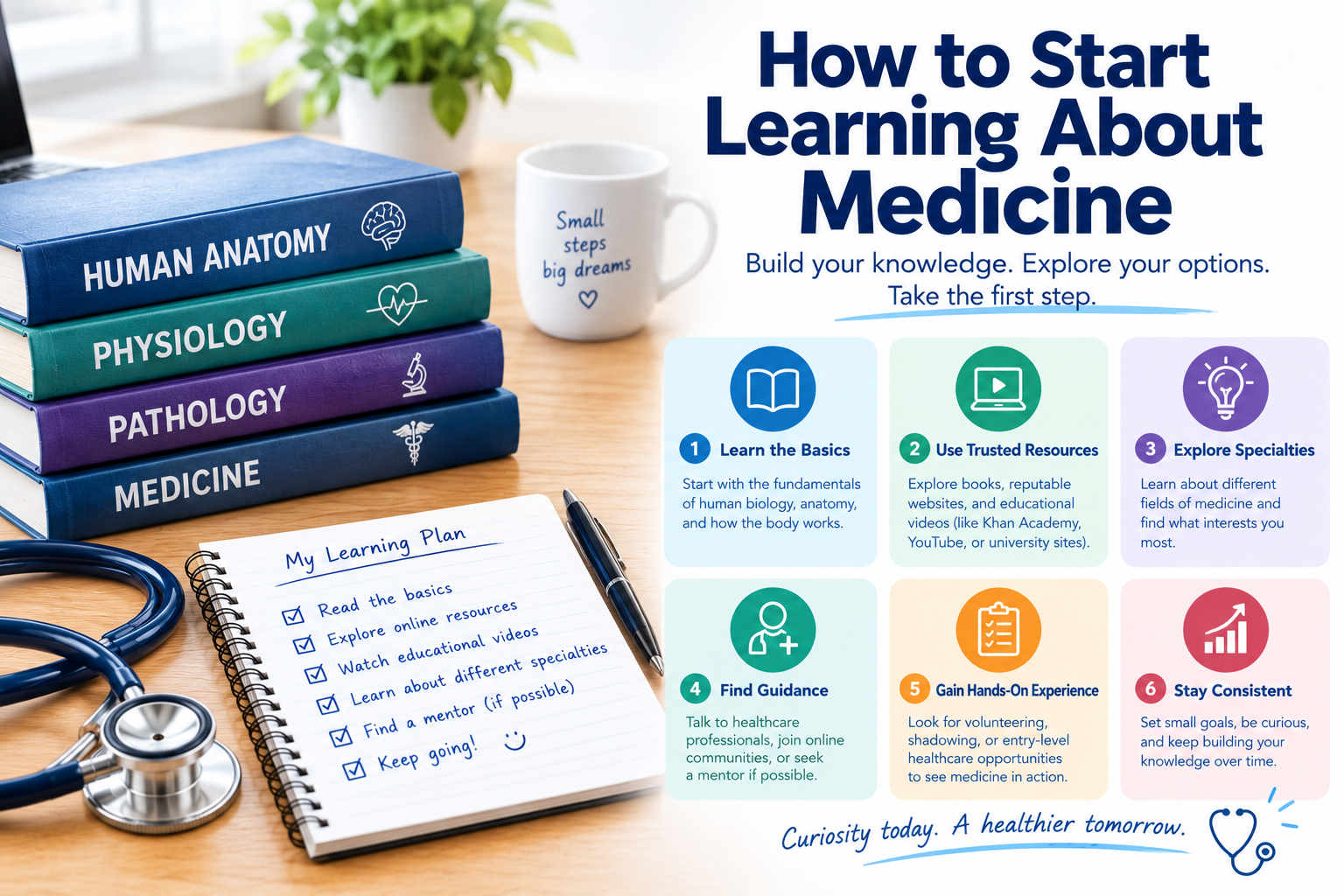
A plan for your first month
- Week 1: learn the basic language. Anatomical directions, the major organ systems, and how cells make and use energy.
- Week 2: pick one system, such as the heart. Study its anatomy, then its physiology.
- Week 3: study two or three common diseases of that system. Link every symptom back to the physiology you learned.
- Week 4: learn the main drug classes used for those diseases, then test yourself with practice questions.
Repeat the cycle with the next system. Going deep on one system at a time is more satisfying than skimming all of them, and it mirrors how most medical schools now teach.
The foundation subjects, one by one
Anatomy
Anatomy is the map of the body: bones, muscles, organs, nerves and blood vessels, and how they sit next to each other. It answers "where is it?" A good atlas and a habit of drawing from memory matter more than long reading.
Physiology
Physiology explains how the parts work when they are healthy. How does the heart keep blood moving? How do the kidneys decide what to keep? Most of clinical medicine is physiology that has gone wrong, so time spent here pays back more than any other subject.
Biochemistry
Biochemistry covers the chemistry of cells: how the body turns food into energy, builds proteins and stores information in DNA. Beginners need the main pathways and what happens when one is blocked, and can leave the fine detail for later.
Pathology
Pathology is the study of disease itself. It describes what injury, infection, inflammation and cancer do to tissue. Learn each disease in the same order: cause, what changes in the body, what the patient notices, and what tests show.
Microbiology and immunology
These cover the organisms that cause infection and the body's defences against them. They also explain vaccines, allergies and autoimmune disease.
Pharmacology
Pharmacology explains how drugs act and how the body handles them. Drugs in the same class usually share an ending to their names, a mechanism and a set of side effects, so learning by class saves a great deal of memory work.
A worked example: one disease through every layer
A heart attack shows how the layers connect.
- Anatomy: the heart muscle is supplied by the coronary arteries.
- Physiology: heart muscle needs a constant flow of oxygen-rich blood and cannot rest.
- Pathology: fatty plaque builds up in an artery wall. If the plaque breaks open, a clot forms and blocks the artery.
- What the patient notices: heavy central chest pain that may spread to the arm or jaw, often with sweating and breathlessness.
- Tests: an electrocardiogram shows the electrical pattern of injury, and a blood test detects troponin released from damaged muscle.
- Treatment: drugs that stop the clot growing, and a procedure to reopen the artery.
Once you can tell this kind of story for a disease, you understand it. If you can only list facts about it, you have memorised it, and it will fade.
Learn the language
Medical terms are built from a small set of Greek and Latin parts. Learning about fifty of them lets you decode thousands of words.
| Word part | Meaning | Example |
|---|---|---|
| cardio- | heart | cardiology |
| nephro-, ren- | kidney | nephritis, renal |
| hepato- | liver | hepatitis |
| neuro- | nerve | neurology |
| hyper-, hypo- | too much, too little | hypertension, hypoglycaemia |
| -itis | inflammation | appendicitis |
| -ectomy | surgical removal | appendectomy |
| -aemia or -emia | in the blood | anaemia |
| -pathy | disease of | neuropathy |
Which resource for which job
| Resource | Best for | Watch out for |
|---|---|---|
| Video lessons | First contact with a new topic | Watching feels like learning. Test yourself afterwards. |
| Textbooks | Depth and reliable detail | Too long to read cover to cover |
| Anatomy atlas or 3D app | Seeing structures and their relations | Looking without drawing or recalling |
| Flashcards | Keeping facts for the long term | Making too many cards |
| Practice questions | Applying knowledge to patients | Memorising answers without reading explanations |
| Clinical guidelines | Current standard treatment | Written for professionals, so hard going at first |
How to judge a source
- Who wrote it? Prefer universities, health services, professional bodies and named clinicians.
- When? Treatment advice older than about five years may be out of date.
- Does it cite evidence? Good sources link to studies or guidelines.
- Is it selling something? Be wary of sites that end with a product.
Discussion forums are useful for study tips and morale. They are poor sources of medical fact.
Mistakes beginners make
- Starting with rare, dramatic diseases before understanding normal function.
- Collecting resources instead of using one or two well.
- Reading passively for hours with no self-testing.
- Memorising lists without asking why each item is on the list.
- Diagnosing themselves or relatives from what they have just read.
How long does it take?
With five to seven hours a week, most people can gain a sound outline of one body system in about a month and of the whole body in about a year. That is roughly the content of a first university course in human biology, and it is enough to follow health news, talk to doctors with confidence and decide whether a medical career is for you.
A weekly routine that fits around work or school
| Day | Time | Task |
|---|---|---|
| Monday | 45 min | New topic: watch or read, and write five questions as you go |
| Tuesday | 30 min | Answer yesterday's questions from memory, then check |
| Wednesday | 45 min | Second new topic in the same body system |
| Thursday | 30 min | Recall both topics and draw one diagram from memory |
| Saturday | 60 min | Practice questions on the week's material, and review of last week |
Three and a half hours a week, used this way, will take you further than ten hours of passive reading.
Ways to see medicine in practice
- Take a first aid or basic life support course. You will learn skills that save lives and see how clinical teaching works.
- Volunteer with a hospital, hospice, ambulance service or health charity.
- Attend public lectures at universities and medical societies. Many are free and recorded.
- Enrol in an online university course in anatomy, physiology or public health. Most can be followed without charge.
- Read well written books by clinicians about their work. They convey what the job feels like in a way textbooks cannot.
Where to go after the basics
Once you have an outline of the body systems, choose a direction.
- Aiming for medical school? Shift your effort to the entry requirements and the admission test. Read what to know before studying medicine.
- Learning for interest? Follow a specialty that fascinates you, such as neurology or infectious disease, and read review articles in open-access journals.
- Working in a health-related job? Focus on the conditions and medicines you meet most often at work.
- Caring for a relative? Learn about their condition from the national health service or the main patient charity for that illness, and take your questions to their doctor.
Habits that help from day one
- Test yourself instead of rereading. See our guide to study methods for medical students.
- Draw things. Pathways, nerve routes and blood supply stick better when you sketch them from memory.
- Learn word roots. "Cardio", "nephro", "-itis" and "-ectomy" unlock hundreds of terms.
- Be careful with what you learn about your own health. Reading about disease is not the same as being examined, so see a doctor for any real concern.
Common questions
Do I need a science background?
School-level biology and chemistry help. If you do not have them, spend your first few weeks on cells, basic chemistry and how to read a graph before starting anatomy and physiology.
Can I learn medicine online for free?
You can learn most of the science for free. Clinical skills need real patients and supervision, which only a medical school can provide.
Which subject should I start with?
Start with physiology and anatomy together, one body system at a time.
This guide is general education and is not medical, legal or career advice. Entry rules, fees, training lengths and treatment guidance change, so confirm them with the official body in your country or with your own doctor or pharmacist. Read our disclaimer. Found an error? Tell us.