Home / Guides / Learning medicine
Study methods for medical students that hold up
Active recall, spaced repetition, practice questions and teaching it back. How each method works and how to fit them into a day.
On this page (22 sections)
- Active recall
- Spaced repetition
- Practice questions
- Interleaving
- Teaching it back
- What works less well
- A sample study day
- What the research says
- How to write good flashcards
- How to use a question bank
- Getting more from lectures
- Different subjects, different tactics
- Memory aids
- Managing time and attention
- Planning for a major exam
- Studying in the clinical years
- Studying in groups
- Signs your method is not working
- Choosing tools
- How study changes through medical school
- Look after the basics
- Common questions
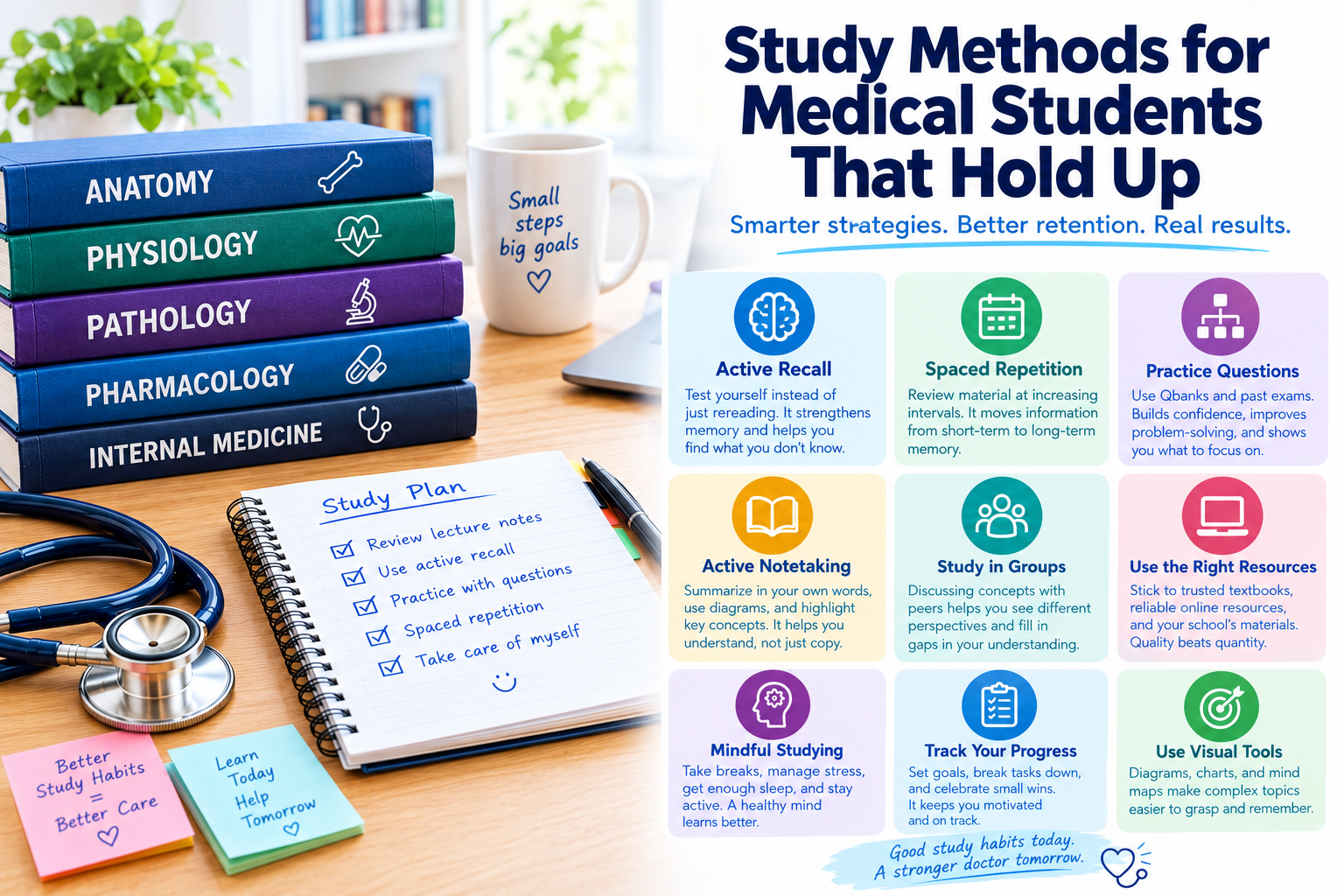
Medical students have to remember more than they can comfortably reread. The methods that work share one feature: they make you pull information out of your memory instead of putting it back in. Each one below is supported by decades of research on learning.
Active recall
Close the book and write down or say what you remember. Then check. Testing yourself feels harder than rereading, and that effort is what builds the memory. Turn headings in your notes into questions and answer them from memory before you look.
Spaced repetition
You forget new facts quickly at first and more slowly each time you review them. Spaced repetition schedules a review just before you would forget. Flashcard apps handle the scheduling, which is why most medical students use one daily. Keep cards short: one fact, one card.
Practice questions
Exam-style questions show how knowledge is applied to a patient. Start early, even before you feel ready. Read the explanation for every answer you got wrong and every answer you guessed. A wrong answer you understand is worth more than a right answer you cannot explain.
Interleaving
Mix topics within a study session. Doing cardiology, then renal, then pharmacology questions together feels slower than doing fifty cardiology questions in a row. It trains you to work out which kind of problem you are facing, which is what exams and patients require.
Teaching it back
Explain a topic aloud to a friend or to an empty room, in plain words. The gaps in your understanding show up within a minute. Study groups work well when each person teaches one topic.
What works less well
- Rereading and highlighting. They feel productive because the material looks familiar. Familiar is not the same as remembered.
- Copying notes neatly. It takes hours and involves little thinking.
- Cramming. It can get you through tomorrow's test. Little of it remains a month later.
A sample study day
| When | What |
|---|---|
| Morning | Flashcard reviews that are due today |
| Late morning | New material: one lecture or chapter, with questions written as you go |
| Afternoon | A mixed block of practice questions, then review of the explanations |
| Evening | Ten minutes recalling the day's new material from memory |
What the research says
These methods are not study folklore. In 1885 Hermann Ebbinghaus described the forgetting curve: memory for new material drops steeply within days unless it is reviewed. In 2006 Henry Roediger and Jeffrey Karpicke showed that students who tested themselves remembered more a week later than students who reread the same text, even though the rereaders felt more confident.
A large review of learning techniques led by John Dunlosky in 2013 rated practice testing and spaced practice as the two most useful methods. Highlighting, rereading and summarising were rated as low in usefulness.
How to write good flashcards
- One fact per card. A card that asks for five things will be failed for any one of them.
- Ask a question. "Which nerve is injured in a mid-shaft fracture of the humerus?" works better than a heading with a list under it.
- Use fill-in-the-blank cards for definitions and values.
- Cover labels on a diagram for anatomy and pathways.
- Understand first, then make the card. Memorising something you do not understand is slow and it does not last.
- Do your reviews every day. Skipped days pile up quickly.
- Limit new cards. Twenty to forty a day is sustainable for most students.
How to use a question bank
- Start during the course. Do questions on each topic in the week you study it.
- Move to mixed, timed blocks as the exam approaches, to practise pace and switching between subjects.
- Review every question, including the ones you got right. Make sure you were right for the right reason.
- Keep an error log. For each mistake, write one line on what went wrong.
| Type of error | What it looks like | Fix |
|---|---|---|
| Knowledge gap | You had never learned the fact | Study the topic and add a flashcard |
| Recall failure | You knew it once and could not retrieve it | More frequent review |
| Misreading | You missed a word such as "not" or the patient's age | Slow down and read the last line of the question first |
| Reasoning error | You knew the facts and reached the wrong conclusion | Talk through similar cases step by step |
Getting more from lectures
- Before: spend ten minutes looking at the headings and diagrams so the structure is familiar.
- During: write questions in the margin instead of copying the slides.
- The same day: close your notes and answer those questions from memory.
- That week: do practice questions on the topic.
Different subjects, different tactics
| Subject | What works |
|---|---|
| Anatomy | Draw from memory, use a 3D model or the dissection room, and link every structure to what happens when it is injured |
| Physiology | Explain each mechanism aloud and sketch the graphs. Understanding matters more than memorising here. |
| Biochemistry | Learn the outline of each pathway, its rate-limiting step and what goes wrong in disease |
| Pathology | Use the same template for every disease: cause, mechanism, features, tests, complications |
| Pharmacology | Learn by class. Shared name endings, such as -olol for beta blockers and -pril for ACE inhibitors, do much of the work. |
| Microbiology | Group organisms by type and build a short profile for each: what it is, what it causes, how it is treated |
Memory aids
Mnemonics, rhymes and vivid mental images help with lists that have no logic to them, such as the order of the cranial nerves. Make your own where you can, because the effort of inventing them helps them stick. Use them sparingly. Anything that can be understood should be understood, not encoded.
Managing time and attention
- Work in short, focused blocks. Twenty-five to fifty minutes of full attention, then a break of five to ten minutes.
- Put the phone in another room. A phone on the desk reduces attention even when it is silent.
- Do the hardest task first, when you are freshest.
- Plan the week, not just the day, so that every subject comes round again before it fades.
Planning for a major exam
- Count the weeks you have and divide the syllabus across them, leaving the final two weeks free of new material.
- Take a practice exam early to find your weak areas.
- Spend most of your time on those weak areas. Revising what you already know is comfortable and achieves little.
- Sit at least two full-length practice exams under timed conditions.
- In the final days, reduce the load and protect your sleep.
Studying in the clinical years
On the wards, patients become your syllabus. Read about each patient's condition on the day you see them, and the facts will attach themselves to a face and a story. Practise presenting cases aloud, ask for feedback after every presentation, and keep up a small daily set of practice questions so that examination knowledge does not slip.
Studying in groups
Groups work when they have a purpose. Keep them to three or four people, agree the topic in advance, and spend the time testing and teaching each other. A group that sits together reading in silence would do better apart.
Signs your method is not working
- You recognise material when you see it and cannot produce it on a blank page.
- Your practice question scores have stopped rising.
- You spend more time making notes or cards than testing yourself.
- You keep revising favourite topics and avoiding weak ones.
- You are studying long hours and remembering less.
If two or more of these apply, change the method before adding more hours. Swap one hour of reading each day for one hour of self-testing and see what happens over two weeks.
Choosing tools
Students often lose weeks comparing apps and resources. A simple set is enough:
- one main source for each subject, such as your course notes or one textbook
- one flashcard tool that schedules reviews for you
- one question bank suited to your exam
- a calendar or planner
Ask students a year ahead of you what they used, pick, and stay with your choice for at least a term.
How study changes through medical school
| Stage | Main challenge | Emphasis |
|---|---|---|
| First year | Volume and a new vocabulary | Build daily habits and learn how to learn |
| Second year | Linking systems and preparing for a licensing exam | Mixed practice questions and steady review of old material |
| Clinical years | Little fixed study time | Learn from each patient, with short daily question sets |
| Finals | Breadth across every specialty | Timed practice exams and clinical skills rehearsal with friends |
Look after the basics
Sleep is when the brain consolidates memory, so a full night is part of studying. Regular exercise, breaks and time with other people protect against burnout. No study method makes up for running yourself down.
New to the subject? Begin with how to start learning about medicine.
Common questions
How many hours a day should a medical student study?
It varies by person and by stage. Most students do three to six hours of private study on top of teaching. The method you use matters more than the number of hours.
Do I have to use flashcards?
No. Any method that makes you recall information at spaced intervals will work, including practice questions and blank-page recall.
Is cramming ever worth it?
It can help you pass a test the next day. It is a poor way to build knowledge you will need for later exams and for patients.
This guide is general education and is not medical, legal or career advice. Entry rules, fees, training lengths and treatment guidance change, so confirm them with the official body in your country or with your own doctor or pharmacist. Read our disclaimer. Found an error? Tell us.