Home / Guides / Medical education
Perspectives on Medical Education: a reader's guide to the journal
What the journal publishes, who runs it, how to read it for free, and how it sits beside other medical education journals.
On this page (17 sections)
- What it publishes
- How to read it
- How to judge an article
- Related journals
- A longer history
- Types of article you will find
- The research methods you will meet
- What open access means here
- How to find articles
- Using the journal as a student or teacher
- How peer review works
- Getting started in five steps
- Topics the journal covers often
- How to read a paper in fifteen minutes
- Terms you will meet
- Thinking of submitting?
- Common questions
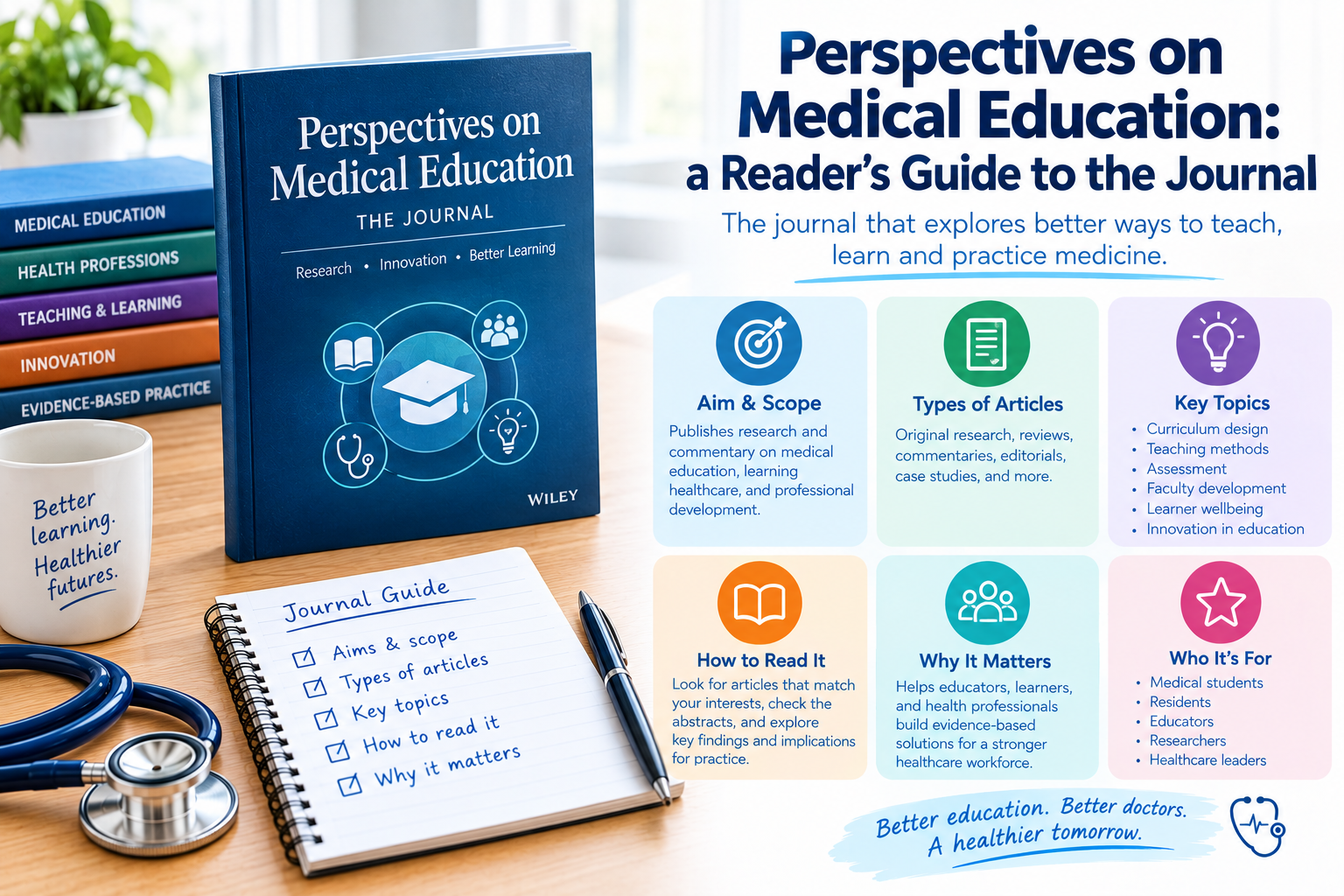
Perspectives on Medical Education is a peer-reviewed journal about how doctors and other health professionals are trained. This guide explains what it is, what it publishes and how to use it. Pexarenti is an independent site and is not affiliated with the journal.
- Founded in 1982 as the Dutch-language Netherlands Journal of Medical Education
- Became an English-language, open-access journal under its current name in 2012
- Official journal of the Netherlands Association for Medical Education (NVMO)
- Published by Ubiquity Press since 2023, and by Springer before that
- Indexed in MEDLINE, Web of Science and Scopus
- Free to read. Authors pay an article processing charge.
What it publishes
The journal's stated mission is to support collaboration between education researchers and clinical teachers. In practice that means original research, reviews and shorter commentary on topics such as assessment, curriculum design, feedback, professional identity and trainee wellbeing.
It sits between two types of journal. Some medical education journals lean towards theory. Others focus on practical tips for teachers. Perspectives on Medical Education aims to be readable by busy clinicians while holding to research standards.
How to read it
Every article is open access, so you can read the full text without a subscription at pmejournal.org. Articles are also archived in PubMed Central. If you are new to the field, start with review articles and commentaries, which summarise a topic before you move on to single studies.
How to judge an article
- What was measured? Student satisfaction is easy to measure. Changes in behaviour or patient care are harder and more meaningful.
- Where was it done? A finding from one school in one country may not transfer to yours.
- How many took part? Small studies are common in education research and should be read with caution.
Related journals
| Journal | Linked organisation |
|---|---|
| Academic Medicine | Association of American Medical Colleges |
| Medical Education | Association for the Study of Medical Education |
| Medical Teacher | AMEE, an international association for health professions education |
| Advances in Health Sciences Education | Published by Springer |
A longer history
The journal began in 1982 as the Dutch-language journal of the Netherlands Association for Medical Education. For thirty years it served teachers in Dutch and Flemish medical schools. In 2012 it was relaunched in English under its present name and became open access, with the aim of reaching an international readership.
At the end of 2022 the editors ended their contract with Springer Nature, and since 2023 the journal has been published by Ubiquity Press, a publisher that works only with open access titles. The editors said at the time that the move was made to keep the journal in line with their values of openness and transparency. The journal had received more than 900 submissions in 2021, which gives a sense of its size.
At the time of the move the editor-in-chief was Erik Driessen and the deputy editor-in-chief was Lauren Maggio. Check the journal's site for the current editorial team.
Types of article you will find
Besides standard research papers and reviews, the journal has carried several formats and series of its own. Names and rules change, so treat this as a guide to the range.
| Format | What it is |
|---|---|
| Original research | A full study with methods, results and discussion |
| Review | A structured summary of the published evidence on one question |
| Show and Tell | A short description of a teaching innovation and what was learned from it |
| Eye-Opener | An argued essay that challenges an accepted idea |
| Commentary | A response to a paper in the same issue |
| The Writer's Craft | A series of short pieces on academic writing |
| Statistical Points and Pitfalls | A series explaining common statistical errors |
Students new to the field often find the Show and Tell papers and the writing series the easiest place to start.
The research methods you will meet
Medical education research borrows from the social sciences, so its methods can look unfamiliar to readers trained in laboratory or clinical science.
- Qualitative studies use interviews, focus groups or observation and analyse what people say and do. They answer "how" and "why" questions.
- Quantitative studies use surveys, test scores or trials and analyse numbers. They answer "how much" and "does it work".
- Mixed methods studies combine both.
- Systematic reviews collect all studies on a narrow question and judge their quality.
- Scoping reviews map what has been published on a broad topic.
A small interview study can be excellent research. Judge it by whether the question suits the method and whether the conclusions follow from the data, and do not dismiss it for having few participants.
What open access means here
Every article is free to read from the day it is published. Articles carry a Creative Commons licence, which lets anyone share and reuse the text as long as the authors are credited. The cost of publishing is met by an article processing charge paid by the authors, usually through their university or research funder. The journal publishes information about fee waivers for authors who cannot pay.
How to find articles
- On the journal site. Browse by issue or search by keyword at pmejournal.org.
- In PubMed. Search for your topic and add the journal's abbreviation, Perspect Med Educ, as a journal filter.
- In PubMed Central. Full text of the journal's articles is archived there.
- In Google Scholar. Useful for seeing which later papers cite an article.
Using the journal as a student or teacher
For a journal club
- Pick a paper of under 4,000 words on a topic your group has experienced, such as feedback or assessment.
- Ask one person to summarise the question, method and main finding in five minutes.
- Discuss whether the finding matches your own experience and why it might not.
- Agree one thing you could try or change as a result.
For your own project
If you are planning a student research or audit project in education, search the journal first. You will often find a tested survey, an interview guide or a study design that you can adapt, with permission and proper citation.
How peer review works
An editor reads each submission and decides whether it fits the journal. Papers that pass this stage are sent to independent experts, who comment on the methods and conclusions. Authors usually revise the paper at least once before a decision is made. The process takes weeks to months, and many submissions are declined.
Getting started in five steps
- Open the journal's site and read the titles in the latest issue.
- Choose one short paper on a topic you have experienced as a learner or teacher.
- Read it using the fifteen-minute method above.
- Write three sentences: what the authors asked, what they found, and whether you believe it.
- Follow one reference from that paper to the next. After five or six papers you will know the main ideas and the names that recur in that corner of the field.
Topics the journal covers often
- Assessment. How to judge whether a trainee is competent, and how assessment shapes what trainees choose to learn.
- Feedback. Why feedback is often given and not used, and what makes it land.
- Workplace learning. How students and residents learn while delivering care.
- Professional identity. How a student comes to think and act as a doctor.
- Wellbeing. Stress, burnout and what training programmes can do about them.
- Equity and inclusion. Who gains entry to medicine and how they are treated once there.
- Research methods. How education research should be designed, reported and reviewed.
How to read a paper in fifteen minutes
- Two minutes: title and abstract. Decide whether the question matters to you.
- Three minutes: the end of the introduction. Find the sentence that states the aim.
- Four minutes: methods. Who took part, where, and how were the data gathered?
- Four minutes: tables, figures and the first paragraph of the discussion. This is where the main finding sits.
- Two minutes: limitations. Authors usually name the main weaknesses themselves.
Read the whole paper only if it passes this first look.
Terms you will meet
| Term | Meaning |
|---|---|
| Curriculum | The planned content, teaching and assessment of a course |
| Formative assessment | Assessment meant to help the learner improve, with no pass or fail |
| Summative assessment | Assessment that decides whether the learner progresses |
| Faculty development | Training for the doctors and scientists who teach |
| Simulation | Practice on models, mannequins or actors instead of real patients |
| Thematic analysis | A way of finding patterns in interview or text data |
| Validity | Whether an assessment measures what it claims to measure |
Thinking of submitting?
Read the author guidelines on the journal's site first. Check the current article types, word limits and processing charge, since these change. Journal metrics such as impact factor are also updated every year, so use the journal's own site for current figures.
For the ideas the journal covers, read five debates shaping how doctors are trained.
Common questions
Is Perspectives on Medical Education free to read?
Yes. All articles are open access.
Is it a reputable journal?
Yes. It is the official journal of a national medical education association, is indexed in MEDLINE, Web of Science and Scopus, and is listed in the Directory of Open Access Journals.
Is it only about Dutch medical education?
No. Since 2012 it has published work from authors around the world.
Is it the same as the journal Medical Education?
No. Medical Education is a separate journal linked to the Association for the Study of Medical Education and published by Wiley.
This guide is general education and is not medical, legal or career advice. Entry rules, fees, training lengths and treatment guidance change, so confirm them with the official body in your country or with your own doctor or pharmacist. Read our disclaimer. Found an error? Tell us.