Home / Guides / Medical education
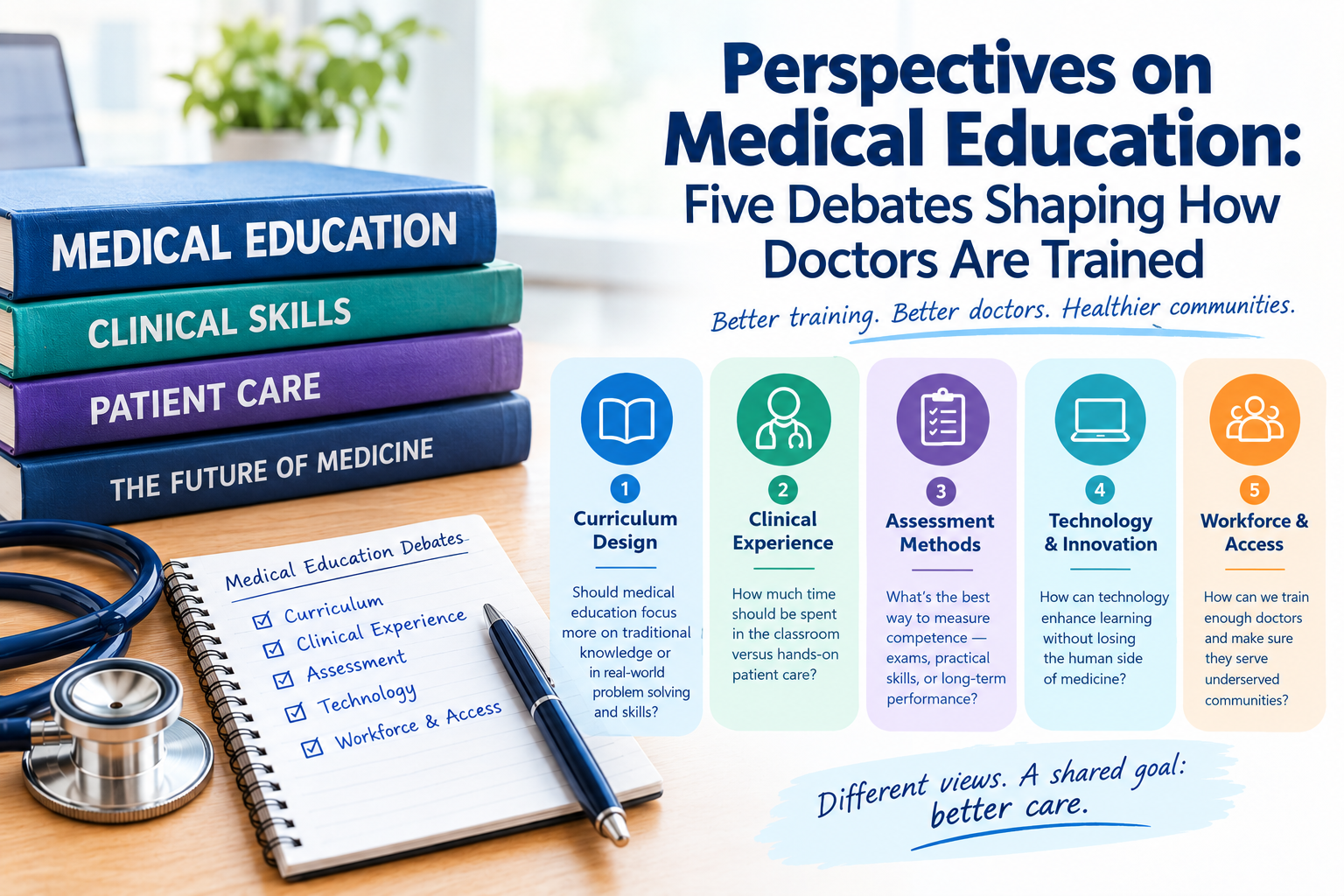
Perspectives on medical education: five debates shaping how doctors are trained
Competency-based training, case-led curricula, new forms of assessment, wellbeing and technology. A plain summary of each debate.
On this page (15 sections)
- 1. Competency over time served
- 2. Integrated, case-led curricula
- 3. Assessment for learning
- 4. Wellbeing and the hidden curriculum
- 5. Technology in teaching
- How we got here: a short history
- More debates worth knowing
- Whose perspective?
- How the evidence is judged
- What this means if you are a student
- Where most people agree
- Open questions for the next decade
- Key terms
- Where to read more
- Common questions
Medical training still carries the shape set by the Flexner Report of 1910: two years of science followed by two years on the wards. Most current perspectives on medical education are arguments about how far that model should bend. These are the five you will meet most often.
1. Competency over time served
Traditional training measures progress in years. Competency-based medical education asks a different question: what can this trainee safely do? Progress is judged against defined abilities, and in principle a trainee who reaches them sooner could finish sooner.
Entrustable professional activities, often shortened to EPAs, make this practical. An EPA is a named task, such as admitting a patient or handing over care at the end of a shift. Supervisors record how much help the trainee needed. Critics point out that this creates a heavy load of forms, and that some qualities of a good doctor are hard to split into tasks.
2. Integrated, case-led curricula
Problem-based learning began at McMaster University in Canada in the late 1960s. Students meet a patient case first and work out what science they need to understand it. Many schools now mix this with lectures and bring patient contact into the first year.
Supporters say it builds reasoning and keeps students motivated. Sceptics worry about gaps in basic science. Most schools have settled on a blend.
3. Assessment for learning
For decades a few large exams decided a student's future. Programmatic assessment replaces them with many small observations collected over time, each with feedback, and a committee makes the progress decision from the whole picture.
The same thinking sits behind the change to USMLE Step 1, which moved from a three-digit score to pass/fail in January 2022. The aim was to reduce pressure in the pre-clinical years. One effect has been more weight on Step 2 CK when residency programmes compare applicants.
4. Wellbeing and the hidden curriculum
Burnout among students and residents is now treated as a problem of training design. In the United States, residents' duty hours are limited to an average of 80 a week. Researchers also study the hidden curriculum: the unwritten lessons about hierarchy, patients and self-care that trainees pick up from the people around them.
5. Technology in teaching
Simulation lets trainees practise procedures and emergencies without risk to patients. Virtual patients, recorded lectures and artificial intelligence tools are spreading quickly. The open question is which of these improve the care patients receive and which only add novelty. Good studies measure patient outcomes, and those take years.
How we got here: a short history
| Year | Event | Why it matters |
|---|---|---|
| 1910 | Flexner Report | Tied medical schools to universities and science, and set the two plus two model |
| 1952 | Organ-system curriculum at Western Reserve University | Taught subjects together by body system instead of by department |
| 1969 | McMaster University opens its medical school | Introduced problem-based learning |
| 1993 | "Tomorrow's Doctors" in the United Kingdom | The regulator asked schools to cut factual overload and teach communication |
| 1996 | CanMEDS framework in Canada | Described a doctor through roles such as communicator, collaborator and scholar |
| 1999 | Six core competencies in the United States | Residency training was reorganised around outcomes |
| 2022 | USMLE Step 1 becomes pass or fail | A high-stakes score was removed from the pre-clinical years |
Each step moved the focus a little further from what is taught and towards what graduates can do.
More debates worth knowing
6. Who gets in
Medical schools have long selected on grades and test scores. Critics argue that this favours applicants from wealthy families and does not measure the personal qualities patients value. Many schools now use holistic review, situational judgement tests and the multiple mini interview, a circuit of short stations first developed at McMaster. The debate is whether these tools are fair and whether they predict who becomes a good doctor.
7. How long and how costly training should be
Some educators argue that the fourth year of medical school is used poorly and that training could be shortened. Three-year programmes now exist at a number of schools. Others reply that students need the time to mature and choose a specialty. Rising student debt keeps this question alive.
8. Learning in teams
Patient care is delivered by doctors, nurses, pharmacists, therapists and others working together, yet each profession has traditionally trained apart. The World Health Organization published a framework for interprofessional education in 2010. Schools now run shared classes and simulations, and researchers are still testing whether these change how teams perform.
9. Health systems science
Medical curricula were built on two pillars: basic science and clinical science. A third is now proposed, covering how care is organised and paid for, patient safety, quality improvement and the social causes of illness. Supporters say doctors cannot improve care without it. The difficulty is finding room in a full timetable.
10. Global standards and social accountability
Doctors move between countries more than ever. The World Federation for Medical Education publishes standards and recognises national accrediting agencies so that degrees can be compared. Alongside this runs the idea of social accountability: that a medical school should be judged by whether it serves the health needs of its own region, including rural and poor communities.
Whose perspective?
The same reform looks different depending on where you stand.
| Group | What they tend to want | What worries them |
|---|---|---|
| Students | Clear expectations, useful feedback, time to learn | Debt, exam pressure, constant assessment |
| Clinical teachers | Motivated learners and protected teaching time | Paperwork and service pressure |
| Patients | Doctors who listen and are safe | Being treated by learners without proper supervision |
| Regulators | Proof that every graduate meets a standard | Variation between schools |
| Health systems | Enough doctors in the right specialties and places | Shortages in primary care and rural areas |
How the evidence is judged
Education research often uses a ladder known as the Kirkpatrick model to describe what a study has shown.
- Reaction. Did learners like it?
- Learning. Did their knowledge or skills improve?
- Behaviour. Did they act differently in real clinical work?
- Results. Did patients do better?
Most studies reach only the first or second level, because the higher levels need large numbers and years of follow-up. Keep this in mind when you read claims that one teaching method is better than another.
What this means if you are a student
- Expect more frequent, lower-stakes assessment and learn to use the feedback.
- Expect to work in small groups on cases and to explain your reasoning aloud.
- Expect early patient contact, and treat it as a chance to practise communication.
- Look after your own wellbeing and use the support your school offers.
- When you choose a school, ask how it teaches and assesses, and do not judge by its ranking alone.
Where most people agree
The debates can hide how much common ground there is. Across countries and schools, most educators now accept that:
- students should meet patients early
- communication and professionalism have to be taught and assessed, not assumed
- feedback should be frequent and specific
- simulation should come before practice on patients for risky procedures
- graduates must be able to keep learning for a whole career
- the wellbeing of trainees affects the safety of patients
Open questions for the next decade
- Artificial intelligence. If software can recall facts and draft a diagnosis, what should students still commit to memory, and how should they be taught to check a machine's answer?
- Time-variable training. Can programmes really let trainees finish at different times without disrupting hospital staffing?
- Fair selection. Which admission methods widen access without lowering standards?
- Workforce needs. How can schools encourage more graduates into primary care and under-served areas?
- Measuring what matters. Can training programmes be linked to the outcomes of the patients their graduates treat?
Key terms
| Term | Meaning |
|---|---|
| Clerkship | A block of weeks spent learning in one clinical specialty |
| OSCE | Objective structured clinical examination. A circuit of timed stations that test clinical skills, first described in 1975. |
| Milestone | A described level of performance that a trainee is expected to reach by a certain stage |
| EPA | Entrustable professional activity. A real clinical task used to judge readiness. |
| Formative assessment | Assessment designed to guide learning |
| Summative assessment | Assessment that decides progression |
| Portfolio | A collected record of a trainee's assessments, reflections and achievements |
If you are new to these ideas, learn the terms in the table first. They appear in almost every paper, policy document and school prospectus, and knowing them makes the rest of the literature much easier to follow.
Where to read more
These debates are carried in journals such as Academic Medicine, Medical Education, Medical Teacher and Perspectives on Medical Education. Our guide to the journal Perspectives on Medical Education explains what it publishes and how to read it for free.
Common questions
What is competency-based medical education in one sentence?
It is training organised around defined abilities that a learner must show, with time treated as flexible.
Is problem-based learning better than lectures?
Reviews generally find that students from both approaches reach similar levels of knowledge. Problem-based learning tends to score better on student satisfaction and some clinical and teamwork skills. Most schools now combine the two.
What is the hidden curriculum?
It is everything students learn from the culture around them without being formally taught, such as how senior doctors speak about patients or respond to mistakes.
This guide is general education and is not medical, legal or career advice. Entry rules, fees, training lengths and treatment guidance change, so confirm them with the official body in your country or with your own doctor or pharmacist. Read our disclaimer. Found an error? Tell us.