Home / Guides / Medical education
Medical improvisation: what medical improv is and why doctors learn it
Medical improv uses exercises from improvisational theatre to train listening, teamwork and thinking on your feet. How it works, the evidence, and exercises to try.
On this page (11 sections)
- Two meanings of the phrase
- Where medical improv came from
- Why a doctor needs improv skills
- The core principle: "Yes, and"
- What happens in a session
- Exercises you can try
- What does the evidence show?
- How it differs from other communication training
- Common worries
- How to bring it into a course or team
- Common questions
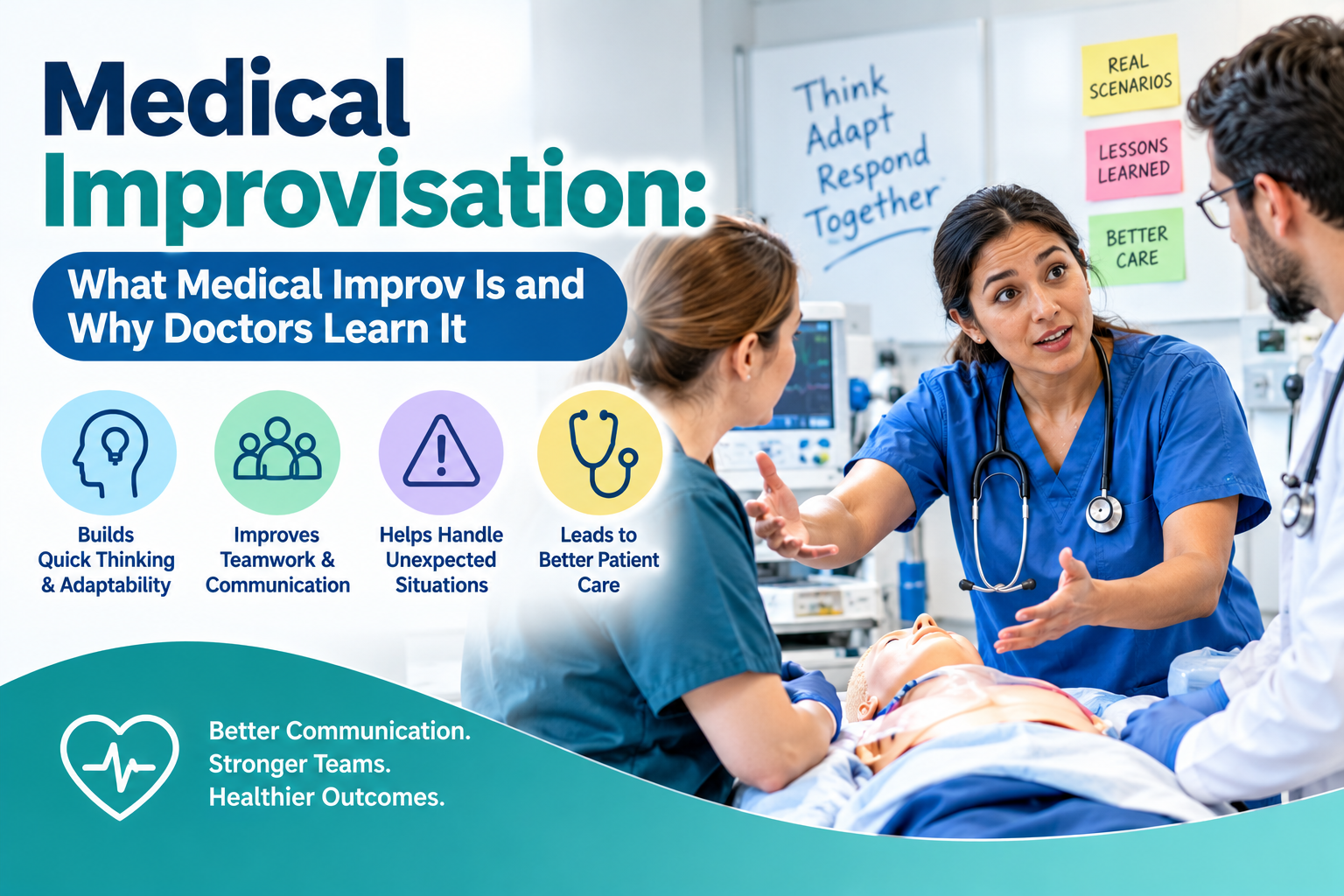
Medical improvisation, usually shortened to medical improv, is the use of exercises from improvisational theatre to train health professionals. The aim is to make clinicians better at listening, working in teams and responding well when something unexpected happens. Making people funny is not the goal. The group that leads training in the field describes it as the adaptation of improvisational theatre principles and techniques to improve communication, cognition and teamwork in medicine.
Two meanings of the phrase
The words medical improvisation are used in two ways.
- Medical improv as a teaching method. This is the main meaning today and the subject of this guide.
- Improvised medicine. This means providing care with whatever is to hand when normal equipment is missing, for example in disasters, remote areas or on expeditions. It is a branch of emergency and wilderness medicine and has nothing to do with theatre.
Where medical improv came from
Improvisational theatre grew out of games devised to train actors to react to each other without a script. In the early 2000s, teachers in medical schools began to adapt those games for clinical training. Katie Watson, a lawyer, bioethicist and improviser on the faculty of Northwestern University's medical school, built one of the first courses for medical students and described the approach in the journal Academic Medicine in 2011 under the title "Serious Play". She later joined with Belinda Fu, a family physician and improviser at the University of Washington, to run workshops that train other teachers.
By 2020 the Association of American Medical Colleges reported that Watson had taught her curriculum to more than 180 people through these train-the-trainer classes, many of them medical school faculty. Courses or electives have been reported at schools including the University of Wisconsin and Johns Hopkins. The Alan Alda Center for Communicating Science at Stony Brook University uses similar methods to teach scientists and clinicians to explain their work clearly.
Why a doctor needs improv skills
A consultation has no script. The patient may say something unexpected, become upset, disagree, or reveal the real problem only on the way out of the door. A clinician who is busy following a mental checklist can miss it. Hospital teams face the same problem at speed during emergencies and handovers.
Improvisers train for exactly this. On stage they must notice what a partner has just offered, accept it and build on it straight away. Those habits correspond closely to clinical skills that are otherwise hard to teach.
| Improv habit | Clinical skill it trains |
|---|---|
| Listen to the whole of what your partner says before responding | Taking a history without interrupting |
| Accept the offer and build on it ("Yes, and") | Acknowledging a patient's concern before adding your own view |
| Make your partner look good | Supporting colleagues and sharing credit in a team |
| Stay in the present moment | Noticing emotion, body language and changes in a patient's condition |
| Treat mistakes as material to work with | Recovering calmly from an error and speaking up about it |
| Adjust your status and tone to the scene | Speaking differently to a frightened child, a senior colleague and a grieving relative |
The core principle: "Yes, and"
The best known rule of improv is "Yes, and". Whatever your partner says is accepted as real, and you add something to it. The opposite is blocking, where one person denies or ignores what the other has said, and the scene stops.
In clinical conversation, "Yes, and" does not mean agreeing to everything a patient asks for. It means accepting what the patient has told you as their reality and building from there. Compare two replies to a patient who says she is frightened of a new medicine.
- Blocking: "There's nothing to worry about. Just take it."
- Yes, and: "You're worried about this medicine, and I want to hear what concerns you most so we can work it out together."
The second reply keeps the conversation open. The doctor can still recommend the medicine.
What happens in a session
A typical session lasts one to two hours with eight to twenty people and no audience. It has three parts.
- Warm-up. Short, low-pressure games so that everyone speaks and laughs early.
- Exercises. Games in pairs or small groups, each chosen to practise one skill.
- Debrief. The teacher asks what people noticed and how it relates to clinical work. This is the step that turns a theatre game into medical training.
Some exercises use medical scenes. Many do not, and the link to practice is made in the discussion afterwards. Nobody is asked to perform comedy, and nobody is scored.
Exercises you can try
These are standard improv games of the kind used in medical courses. Each needs no equipment and about ten minutes.
1. Mirror
Two people face each other. One moves slowly and the other copies as exactly as possible, then they swap, and finally neither leads. It trains close attention to another person's body language.
2. One-word story
The group tells a story, each person adding a single word in turn. Nobody can control where it goes. It trains listening and letting go of your own plan.
3. "Yes, and" planning
In pairs, plan an outing. Every sentence must begin "Yes, and". Repeat with "Yes, but" and compare how each version felt. It shows how quickly "but" closes a conversation.
4. Gibberish interpreter
One person speaks in nonsense syllables as a visiting expert, and a partner "translates" for the group. It trains reading tone, gesture and emotion when words are not available, which is relevant to any consultation across a language barrier.
5. The rant
One person complains for two minutes about something trivial. The partner listens in silence, then introduces the speaker to the group by naming what the speaker cares about underneath the complaint. It trains listening for values behind anger.
6. Group juggle
Standing in a circle, the group passes one ball in a fixed pattern, then adds more balls. Dropped balls are picked up without comment. It makes visible how teams handle overload and error.
What does the evidence show?
Research on medical improv is growing but still small in scale.
- Students rate the sessions highly. In a study at Johns Hopkins reported by the Association of American Medical Colleges, 81 percent of participants rated their enjoyment as "tremendous" and 85 percent said the training was very relevant to patient care.
- A study of pharmacy students found a clear improvement in communication skills after improv training.
- A pilot study across four medical schools used a rating scale for empathy and clarity and found that students who took a six-hour improv course scored higher than those who did not.
The limits are important. Most studies are small, have no comparison group or rely on what students say about themselves. Few have followed learners into practice, and none has shown that patients do better as a result. In the terms used by education researchers, the evidence is good for satisfaction, fair for short-term skills and missing for patient outcomes. Our guide to perspectives on medical education explains how such evidence is graded.
How it differs from other communication training
| Method | What happens | Strength |
|---|---|---|
| Lecture on communication | Students hear about good practice | Covers frameworks quickly |
| Simulated patient | A student interviews a trained actor playing a scripted case and receives feedback | Realistic rehearsal of a specific task, such as breaking bad news |
| Medical improv | The whole group plays unscripted exercises and discusses them | Trains underlying habits of attention and flexibility, with little fear of judgement |
The methods complement each other. Improv builds the general skills, and simulated patients apply them to particular clinical tasks.
Common worries
- "I am not funny." You do not need to be. The exercises are about listening and responding.
- "I am shy." Sessions start with easy group games, and good teachers never single people out. Quiet people often do well, because they listen.
- "It is not serious enough for medicine." The play is the method and the purpose is serious. Watson's phrase for this is that the whole purpose of medical training is to serve patients.
- "Improvising with patients sounds unsafe." Medical improv does not teach clinicians to invent treatment. It teaches them to pay attention and adapt how they communicate. Clinical decisions still follow evidence and guidelines.
How to bring it into a course or team
- Start small. Add one ten-minute exercise to an existing communication class or team meeting.
- Find a trained facilitator. Look for someone who has both improv experience and a clinical or teaching background. Train-the-trainer workshops exist for this purpose.
- Make it voluntary at first, and set ground rules about respect and confidentiality.
- Always debrief. Ask what people noticed, when they have seen the same thing at work, and what they will try differently.
- Evaluate. Collect feedback and, where you can, an observed measure of communication before and after.
Common questions
Is medical improv the same as stand-up comedy?
No. Stand-up is one person delivering prepared material. Improv is unscripted and depends on cooperation. Medical improv removes the performance element altogether.
Who can take part?
Medical, nursing and pharmacy students, residents, practising clinicians and whole clinical teams. No acting experience is needed.
Does it help with burnout?
Participants often report that sessions are enjoyable and build connection with colleagues. Firm evidence of an effect on burnout is still lacking.
How can I learn more?
Read the Association of American Medical Colleges article listed below and look for workshops run by experienced medical improv teachers.
This guide is general education and is not medical, legal or career advice. Entry rules, fees, training lengths and treatment guidance change, so confirm them with the official body in your country or with your own doctor or pharmacist. Read our disclaimer. Found an error? Tell us.