Home / Guides / Medical education
Is Heel Pain a Sign of Cancer? Warning Signs & Causes
Is heel pain a sign of cancer? Learn common causes, cancer warning signs, night pain, swelling, bone metastasis, and when persistent heel pain needs medical care.
On this page (34 sections)
- Is Heel Pain Usually a Sign of Cancer?
- Quick Answer: When Should Heel Pain Be More Concerning?
- What Causes Most Heel Pain?
- Can Cancer Cause Heel Pain?
- What Does Cancer-Related Heel Pain Feel Like?
- Is Heel Pain at Night a Sign of Cancer?
- Heel Pain From Cancer vs Plantar Fasciitis
- Can Lung Cancer Cause Heel Pain?
- Can Breast Cancer Cause Heel Pain?
- Can Prostate Cancer Cause Heel Pain?
- What Are the Red Flags for Heel Pain?
- When Is Heel Pain an Emergency?
- How Do Doctors Check Heel Pain for Cancer?
- Can an X-Ray Detect Cancer in the Heel?
- When Is an MRI Used for Heel Pain?
- What About CT Scans and Bone Scans?
- Is a Biopsy Needed?
- Can Heel Pain Be a Symptom of Bone Cancer?
- Can Heel Pain Be Caused by Cancer Treatment?
- When Should You See a Doctor for Heel Pain?
- How Is Common Heel Pain Treated?
- Can Heel Pain Be Prevented?
- Frequently Asked Questions
- Is heel pain a sign of cancer?
- Can heel pain be a symptom of bone cancer?
- What does cancer-related heel pain feel like?
- Is heel pain at night a sign of cancer?
- Can lung cancer cause heel pain?
- Can breast cancer spread to the heel?
- Can prostate cancer cause heel pain?
- What are the red flags for heel pain?
- Can an X-ray show heel cancer?
- When should heel pain be checked by a doctor?
- Final Thoughts
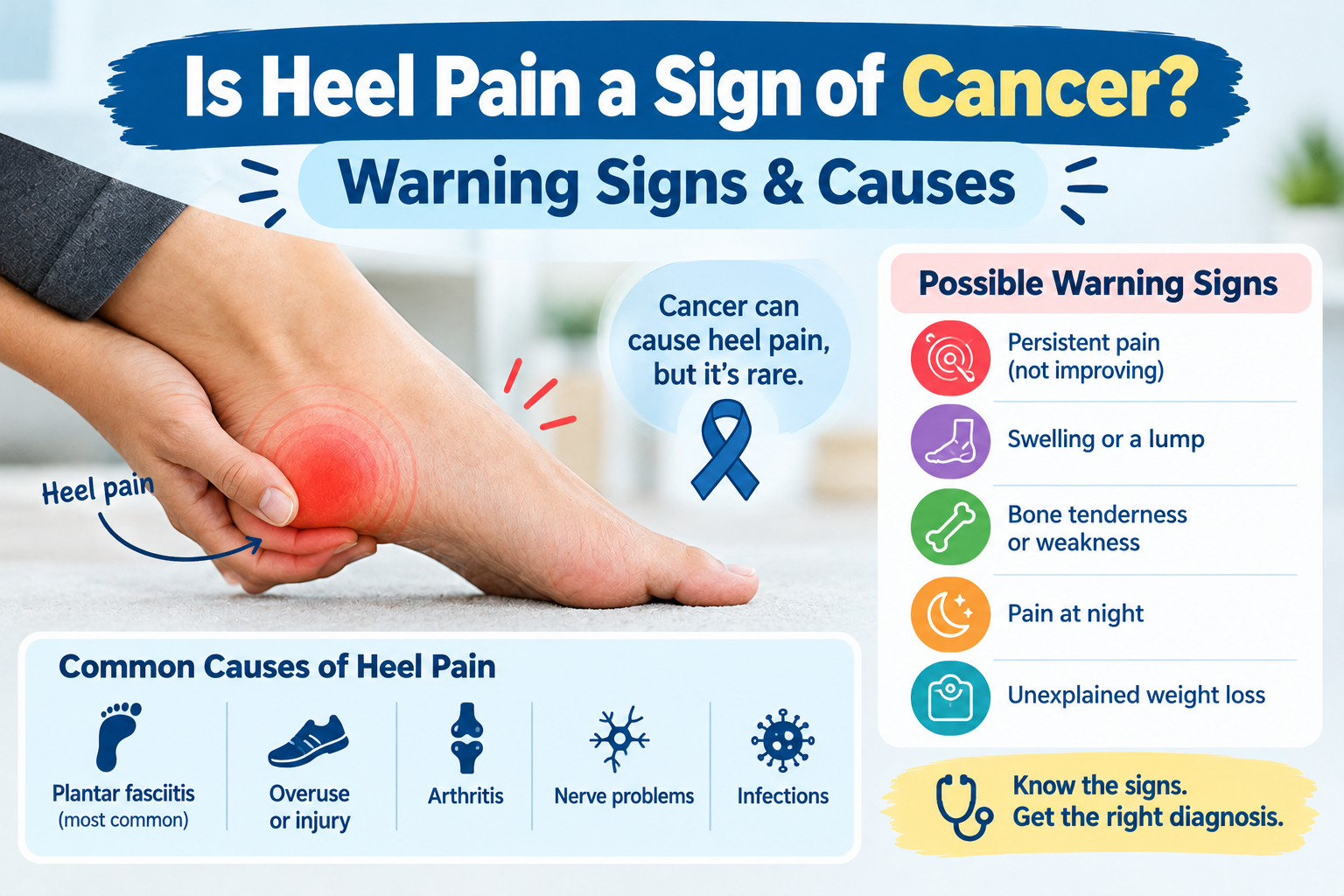
If you are asking is heel pain a sign of cancer, the reassuring answer is that most heel pain is caused by non-cancerous conditions such as plantar fasciitis, Achilles tendon problems, overuse, stress injuries, or poor footwear.
Cancer involving the heel is rare. However, persistent or unexplained heel pain—especially when it occurs with swelling, a lump, pain at rest or at night, unexplained weight loss, or a previous history of cancer—should be evaluated by a healthcare professional.
Heel pain by itself does not mean you have cancer.
The pattern of the pain, how long it lasts, whether it is getting worse, and whether other symptoms are present are much more important than pain alone.
This guide explains the difference between common heel pain and more concerning symptoms, what cancer-related heel pain may feel like, and how doctors investigate persistent heel pain.
Is Heel Pain Usually a Sign of Cancer?
No. Heel pain is usually caused by common musculoskeletal problems rather than cancer.
Frequent causes include:
- Plantar fasciitis
- Achilles tendinitis
- Heel spurs
- Overuse injuries
- Stress fractures
- Heel pad irritation
- Poorly fitting shoes
- Bursitis
- Arthritis
- Nerve irritation
Cancer affecting the heel bone or surrounding soft tissues is uncommon.
That said, any pain that is persistent, progressive, unexplained, or accompanied by other warning signs deserves medical attention.
Quick Answer: When Should Heel Pain Be More Concerning?
Heel pain deserves closer evaluation if it is:
- Getting progressively worse
- Present even at rest
- Waking you from sleep
- Associated with swelling
- Accompanied by a lump or mass
- Linked with unexplained weight loss
- Occurring with unusual fatigue
- Associated with fever without a clear cause
- Not improving with typical treatment
- Occurring in someone with a previous cancer history
These signs do not prove cancer, but they can justify further assessment.
What Causes Most Heel Pain?
Most people with heel pain have a common mechanical or inflammatory condition.
Plantar Fasciitis
Plantar fasciitis is one of the most common causes of heel pain.
It affects the thick band of tissue that runs along the bottom of the foot.
Typical features include:
- Sharp pain under the heel
- Pain with the first steps in the morning
- Pain after sitting for a long time
- Symptoms that may ease after moving around
This pattern is much more typical of plantar fasciitis than cancer.
Achilles Tendinitis
The Achilles tendon connects the calf muscles to the heel bone.
Pain from Achilles tendinitis usually occurs at the back of the heel.
Symptoms may include:
- Tenderness
- Stiffness
- Pain after activity
- Swelling near the tendon
It often develops after repetitive strain or increased physical activity.
Heel Spurs
Heel spurs are bony growths that can develop on the heel bone.
They are often associated with long-term stress on the foot and may occur alongside plantar fasciitis.
Not everyone with a heel spur has pain.
Stress Fracture
A calcaneal stress fracture can cause:
- Persistent heel pain
- Tenderness
- Pain that worsens with activity
- Difficulty bearing weight
Stress fractures are more common in runners, military personnel, and people who suddenly increase activity levels.
Heel Pad Syndrome
The fat pad under the heel helps absorb shock.
When irritated or bruised, it can cause deep pain in the center of the heel.
Pain may feel worse when standing or walking on hard surfaces.
Poor Footwear and Overuse
Shoes with poor cushioning or inadequate support can increase pressure on the heel.
Long periods of standing, running, jumping, or sudden increases in exercise can also cause pain.
Can Cancer Cause Heel Pain?
Yes, but it is uncommon.
Cancer-related heel pain can occur in a few different ways.
Primary Bone Cancer
Primary bone cancer begins in the bone itself.
Examples include:
- Osteosarcoma
- Chondrosarcoma
- Ewing sarcoma
These cancers can affect bones throughout the body, but involvement of the heel bone, or calcaneus, is uncommon.
Bone Metastasis
Cancer from another part of the body can sometimes spread to bone.
This is called bone metastasis.
Cancer can spread to:
- Spine
- Pelvis
- Ribs
- Long bones
Spread to the bones of the foot or heel is much less common.
Still, persistent heel pain in someone with a known cancer history may deserve further evaluation.
Soft Tissue Sarcoma
Rarely, a cancer can develop in the soft tissues around the heel or ankle.
A soft tissue sarcoma may present with:
- A growing lump
- Swelling
- Pressure or discomfort
- Persistent pain
Not all soft tissue lumps are cancerous, but an enlarging mass should be examined.
What Does Cancer-Related Heel Pain Feel Like?
There is no single type of pain that proves cancer.
However, cancer-related bone pain may sometimes be:
- Deep
- Persistent
- Progressive
- Present at rest
- Worse at night
- Unrelated to exercise
- Poorly responsive to routine treatment
In some cases, swelling or a mass may also be present.
These features are not unique to cancer.
Many non-cancerous conditions can cause similar symptoms, which is why medical evaluation matters.
Is Heel Pain at Night a Sign of Cancer?
Not necessarily.
Night pain can happen with several non-cancerous conditions.
However, pain that:
- Regularly wakes you from sleep
- Is severe at rest
- Continues to worsen
- Has no clear mechanical cause
may deserve medical assessment.
Night pain becomes more concerning when it occurs with other symptoms such as:
- Swelling
- A growing lump
- Unexplained weight loss
- Fever
- A history of cancer
Heel Pain From Cancer vs Plantar Fasciitis
The following comparison may help explain why the pattern of pain matters.
| Feature | Plantar Fasciitis | Possible Cancer-Related Concern |
|---|---|---|
| Morning pain | Common | Not specific |
| Pain with first steps | Very common | Less typical |
| Pain linked to activity | Common | May occur but can also happen at rest |
| Pain at rest | Less typical | Can be concerning if persistent |
| Night pain | Less typical | May warrant evaluation |
| Swelling or mass | Usually absent | Can occur |
| Progressive worsening | Possible | More concerning if persistent |
| Weight loss or fatigue | Not typical | May increase concern |
| Response to conservative care | Often improves | May fail to improve |
This table is not diagnostic.
A clinician may need to examine the foot and order imaging if the symptoms are unusual.
Can Lung Cancer Cause Heel Pain?
Very rarely, cancer can spread from another organ to bones in the foot.
Lung cancer is one type of cancer that can metastasize to bone.
However, heel pain is not a common or typical first symptom of lung cancer.
Symptoms such as heel pain alone should not be assumed to indicate lung cancer.
Can Breast Cancer Cause Heel Pain?
Breast cancer can spread to bone, but it more commonly affects areas such as the spine, ribs, pelvis, or long bones.
Heel involvement is uncommon.
If someone with a history of breast cancer develops new, persistent, unexplained bone pain, they should discuss it with their healthcare team.
Can Prostate Cancer Cause Heel Pain?
Prostate cancer can spread to bone, particularly in advanced disease.
The spine, pelvis, and ribs are more typical sites.
Heel pain alone is not a common sign of prostate cancer.
Persistent unexplained bone pain in a person with prostate cancer should still be evaluated.
What Are the Red Flags for Heel Pain?
Certain symptoms deserve prompt medical review.
Persistent Pain
Heel pain that does not improve after several weeks may need evaluation.
Progressive Pain
Pain that becomes stronger or more frequent over time can justify further testing.
Pain at Rest
Pain that occurs without walking or activity may be more concerning than pain linked clearly to mechanical stress.
Night Pain
Pain that repeatedly wakes you from sleep should not be ignored.
Swelling
Persistent swelling around the heel, ankle, or foot may require imaging.
A Lump or Mass
Any new or growing lump around the heel should be medically assessed.
Unexplained Weight Loss
Weight loss without trying can be a warning sign when combined with persistent pain.
Previous History of Cancer
People with a known cancer history may need a lower threshold for medical evaluation of unexplained bone pain.
When Is Heel Pain an Emergency?
Seek urgent medical care if you have:
- Sudden severe heel pain after an injury
- Inability to bear weight
- Severe swelling
- Redness and fever
- Numbness or weakness
- A rapidly enlarging mass
- Severe pain with systemic illness
- Signs of infection
These symptoms can have causes other than cancer but may require prompt treatment.
How Do Doctors Check Heel Pain for Cancer?
Doctors usually begin with a history and physical examination.
They may ask:
- When did the pain start?
- Is it getting worse?
- Is it present at night?
- Is there swelling?
- Is there a lump?
- Have you lost weight unintentionally?
- Do you have a history of cancer?
- Did the pain start after increased activity or injury?
The answers help determine whether imaging is needed.
Can an X-Ray Detect Cancer in the Heel?
An X-ray can sometimes identify abnormal areas in bone.
It may show:
- Bone destruction
- Unusual bone growth
- Fractures
- Suspicious lesions
However, some problems may not be obvious on a standard X-ray.
If symptoms remain concerning, additional imaging may be needed.
When Is an MRI Used for Heel Pain?
An MRI provides detailed images of:
- Bone marrow
- Tendons
- Ligaments
- Muscles
- Soft tissues
- Masses
Doctors may consider MRI when pain is unexplained, persistent, or associated with abnormal findings.
What About CT Scans and Bone Scans?
Other imaging tests may be used depending on the situation.
CT Scan
A CT scan provides detailed images of bone structure.
Bone Scan
A bone scan can show areas of increased bone activity.
It may be useful when doctors are investigating cancer spread or multiple bone abnormalities.
Is a Biopsy Needed?
A biopsy is not routinely needed for heel pain.
It is considered when imaging reveals a suspicious bone or soft tissue lesion.
During a biopsy, a small tissue sample is removed and examined under a microscope.
This is how doctors confirm whether a suspicious mass is cancerous.
Can Heel Pain Be a Symptom of Bone Cancer?
It can, but bone cancer is rare.
Possible symptoms of bone cancer can include:
- Persistent bone pain
- Swelling
- A noticeable mass
- Increasing tenderness
- Reduced function
- Pain at rest or at night
These symptoms overlap with many non-cancerous conditions.
A diagnosis cannot be made from symptoms alone.
Can Heel Pain Be Caused by Cancer Treatment?
Yes.
In people already receiving cancer treatment, heel or foot pain may develop for reasons unrelated to cancer spread.
Possible causes include:
- Peripheral neuropathy
- Muscle weakness
- Bone density changes
- Altered gait
- Reduced activity
- Weight changes
- Medication side effects
Anyone undergoing cancer treatment who develops new foot pain should discuss it with their oncology team.
When Should You See a Doctor for Heel Pain?
Consider seeing a healthcare provider if:
- Pain lasts longer than expected
- It continues despite rest and supportive footwear
- Symptoms keep returning
- The pain is severe
- It wakes you at night
- There is swelling
- You notice a lump
- You cannot walk normally
- You have unexplained weight loss
- You have a personal history of cancer
Persistent symptoms deserve evaluation even when cancer is unlikely.
How Is Common Heel Pain Treated?
Treatment depends on the cause.
For many non-cancerous conditions, care may include:
- Rest
- Activity modification
- Supportive footwear
- Stretching
- Physical therapy
- Ice
- Orthotics
- Pain-relief medications when appropriate
Do not begin treatment based only on an online diagnosis.
Can Heel Pain Be Prevented?
Not every cause can be prevented, but you can reduce mechanical strain by:
- Wearing supportive shoes
- Replacing worn-out footwear
- Increasing exercise gradually
- Stretching calves and feet
- Maintaining a healthy body weight
- Avoiding prolonged barefoot walking on hard surfaces
These steps are most useful for common mechanical causes of heel pain.
Frequently Asked Questions
Is heel pain a sign of cancer?
Usually not. Most heel pain is caused by common conditions such as plantar fasciitis, Achilles tendon problems, overuse, or stress injuries. Cancer involving the heel is rare.
Can heel pain be a symptom of bone cancer?
Yes, but it is uncommon. Persistent or worsening heel pain with swelling, a mass, pain at rest, or unexplained weight loss deserves medical evaluation.
What does cancer-related heel pain feel like?
Cancer-related bone pain may be persistent, deep, progressive, present at rest, or worse at night. These features are not specific to cancer.
Is heel pain at night a sign of cancer?
Not necessarily. Night pain can have many causes, but persistent pain that repeatedly wakes you from sleep should be checked if it is unexplained or worsening.
Can lung cancer cause heel pain?
Very rarely, lung cancer can spread to bones in the foot or heel, but heel pain is not a common symptom of lung cancer.
Can breast cancer spread to the heel?
Bone metastasis from breast cancer is possible, but heel involvement is uncommon.
Can prostate cancer cause heel pain?
Advanced prostate cancer can spread to bone, but the heel is not a common site. Persistent unexplained pain in someone with prostate cancer should be evaluated.
What are the red flags for heel pain?
Red flags include persistent worsening pain, pain at rest or at night, swelling, a lump, unexplained weight loss, fever, inability to bear weight, or a history of cancer.
Can an X-ray show heel cancer?
An X-ray can sometimes identify suspicious bone changes, but additional imaging such as MRI or CT may be required.
When should heel pain be checked by a doctor?
Seek medical advice if heel pain is severe, persistent, worsening, associated with swelling or a lump, or not improving with usual conservative measures.
Final Thoughts
So, is heel pain a sign of cancer?
In most cases, no.
Heel pain is far more commonly caused by plantar fasciitis, Achilles tendon problems, stress injuries, heel pad irritation, or footwear-related strain.
Cancer involving the heel is rare, but persistent or unexplained pain should not be ignored—especially when it is associated with night pain, swelling, a growing lump, unexplained weight loss, or a previous history of cancer.
If your heel pain is not improving or has unusual features, a healthcare professional can examine your foot and decide whether imaging or further testing is needed.
This article is for general educational purposes and is not a substitute for professional diagnosis or treatment.
This guide is general education and is not medical, legal or career advice. Entry rules, fees, training lengths and treatment guidance change, so confirm them with the official body in your country or with your own doctor or pharmacist. Read our disclaimer. Found an error? Tell us.