Home / Guides / Medical terms
Medicine versus medication: what is the difference?
Medicine is the wider word. It names the whole field and also the things you take. Medication only means a drug used as treatment. Examples and a comparison table.
On this page (16 sections)
- The short answer in a table
- Medicine: two meanings in one word
- Medication: the clinical word for drug treatment
- Where does "drug" fit?
- British and American habits
- Grammar: countable or not?
- Which word should you use?
- Examples side by side
- Related words and how they differ
- Prescription and over-the-counter medicines
- The word family
- Idioms use medicine, never medication
- Common mistakes for learners of English
- What style guides prefer
- A quick check
- Common questions
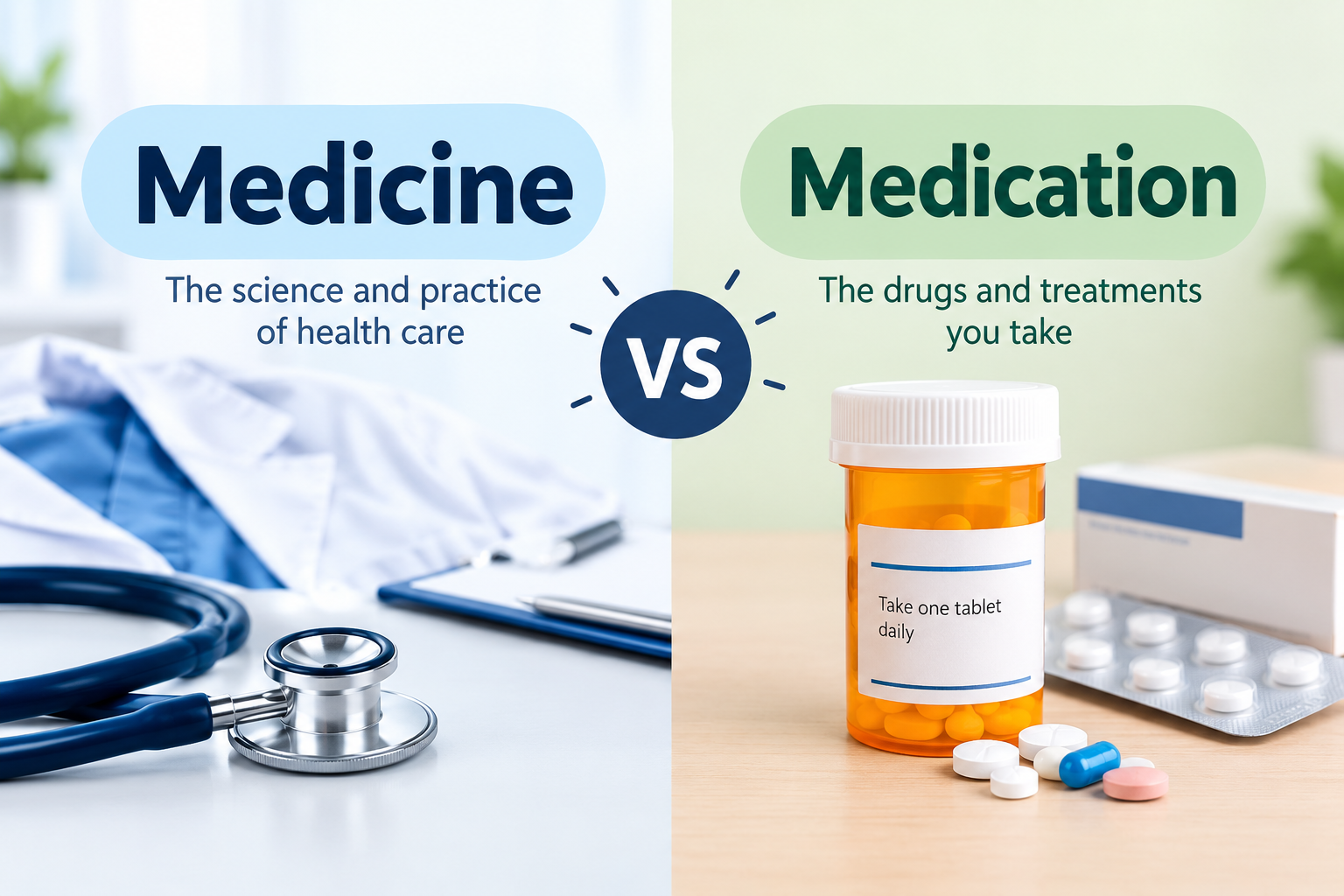
People use medicine and medication as if they were the same word, and in many sentences they are. The difference is that medicine has two meanings and medication has one. Medicine is the science and practice of treating disease, and it is also a substance you take to get better. Medication only means the substance, or the treatment given with it.
So every medication is a medicine, but medicine is also the name of a profession, a degree and a body of knowledge.
The short answer in a table
| Medicine | Medication | |
|---|---|---|
| Meaning 1 | The science and practice of diagnosing, treating and preventing disease | Not used this way |
| Meaning 2 | A substance taken to treat or prevent illness | A substance taken to treat or prevent illness |
| Meaning 3 | Not used this way | The act or course of treating with drugs, as in "on medication" |
| Tone | Everyday and general | More clinical and formal |
| Typical phrases | Study medicine, cough medicine, medicine cabinet | Prescription medication, medication list, medication error |
Medicine: two meanings in one word
The first meaning is the field. A student studies medicine. A doctor practises medicine. Internal medicine, emergency medicine and sports medicine are branches of it. You cannot replace the word with medication in any of these phrases.
The second meaning is the thing you swallow, inject, inhale or apply. "Take your medicine" and "this medicine may cause drowsiness" use the word this way. It is the ordinary, household word, and the one most people use with children.
Medicine also stretches beyond drugs. People speak of herbal medicine, traditional medicine and preventive medicine, and say that laughter is the best medicine. Medication is not used in these wider or figurative ways.
Medication: the clinical word for drug treatment
Medication is narrower. It means a drug used for a medical purpose, usually one that has been prescribed or recommended. Health professionals prefer it because it is exact. A hospital chart has a medication list. A pharmacist carries out a medication review. Giving the wrong drug or dose is a medication error.
The word also names the state of being treated. "She is on medication for blood pressure" does not point to one tablet. It says that drug treatment is under way.
Where does "drug" fit?
Drug is the widest of the three words. In pharmacology, a drug is any substance that changes how the body works. That includes medicines, and it also includes caffeine, alcohol, nicotine and illegal substances. In United States law, the Food and Drug Administration treats as a drug any article intended to diagnose, cure, mitigate, treat or prevent disease.
In everyday speech the word drug often suggests misuse, which is one reason patients are usually told about their medicines or medications. Among professionals, drug is neutral and common, as in drug interaction or drug dose.
| Word | Covers | Example |
|---|---|---|
| Drug | Any substance that acts on the body, helpful or harmful | Caffeine is the most widely used drug in the world. |
| Medicine | A drug or preparation used to treat or prevent illness, and the field itself | Keep all medicines out of reach of children. |
| Medication | A medicine as part of someone's treatment | Bring a list of your current medications to the clinic. |
British and American habits
Both words are correct in every variety of English. There is a difference in habit. British health services tend to say medicines, as in the NHS "Medicines A to Z". American clinicians and pharmacies tend to say medications, often shortened to meds. Neither choice is wrong, and readers in both countries understand both.
Grammar: countable or not?
- Medicine as the field is uncountable. You study medicine, never "a medicine".
- Medicine as a substance can be either. "Take some medicine" is uncountable. "Three different medicines" counts types.
- Medication works the same way. "He is on medication" is uncountable. "He takes four medications" counts them.
Which word should you use?
- Talking about the profession, a degree or a specialty: use medicine.
- Talking to patients, families or children: medicine is warmer and clearer.
- Writing clinical notes, exam answers or care plans: medication is the standard term.
- Writing about how a substance acts in the body: drug is the scientific term.
Examples side by side
- She wants to study medicine at university. (the field)
- The medicine tastes of cherry. (a substance, everyday tone)
- The patient stopped his medication two weeks ago. (a course of treatment)
- List all medications, including those bought without a prescription. (clinical tone)
- This drug is cleared by the kidneys. (scientific tone)
Related words and how they differ
| Word | Meaning | Example |
|---|---|---|
| Treatment | Anything done to manage an illness, including surgery, drugs and therapy | Treatment for a broken leg does not always involve medicine. |
| Therapy | A planned course of treatment, with or without drugs | Physiotherapy, radiotherapy, drug therapy |
| Remedy | Something that relieves a problem, often traditional or made at home | Honey and lemon is a common remedy for a sore throat. |
| Cure | A treatment that removes the disease completely | Antibiotics can cure many bacterial infections. |
| Prescription | A written instruction from a prescriber, and informally the medicine itself | I need to collect my prescription. |
| Pharmaceutical | A manufactured medicinal drug, mostly used in industry and regulation | The pharmaceutical industry |
| Dose | The amount of a medicine taken at one time | The usual dose is one tablet twice a day. |
Prescription and over-the-counter medicines
Both medicine and medication can be used for products bought with or without a prescription. A prescription medicine needs authorisation from a doctor or other prescriber. An over-the-counter medicine can be bought directly. In the United Kingdom there is a middle group, pharmacy medicines, which are sold without a prescription but only under a pharmacist's supervision.
Each medicine also has two kinds of name. The generic name identifies the active ingredient, such as paracetamol or ibuprofen. A brand name is chosen by the manufacturer. Clinicians are taught to use generic names because they are the same everywhere.
The word family
- Medical (adjective): relating to medicine as a field. A medical student, medical records.
- Medicinal (adjective): having healing properties. Medicinal plants.
- Medicate (verb): to treat with a drug. The patient was medicated for pain.
- Medicated (adjective): containing a drug. Medicated shampoo.
- Medic (noun): informal for a doctor, medical student or military medical worker.
Idioms use medicine, never medication
- A taste of your own medicine: being treated as badly as you have treated others.
- Take your medicine: accept an unpleasant consequence without complaint.
- Laughter is the best medicine: good humour helps people feel better.
- Strong medicine: a severe measure for a serious problem.
Common mistakes for learners of English
| Avoid | Say instead | Why |
|---|---|---|
| I ate my medicine. | I took my medicine. | English uses "take" for all medicines, including tablets and syrups. |
| I drink medicine every morning. | I take medicine every morning. | "Take" is used even for liquids. |
| She is studying medication. | She is studying medicine. | Only medicine names the field. |
| The doctor gave me a medication for sleep. | The doctor gave me medication for sleep, or a medicine for sleep. | Medication is usually uncountable when you mean treatment in general. |
| He is a doctor of medication. | He is a doctor of medicine. | The degree and profession use medicine. |
Speakers of Spanish, French, Italian and Portuguese often choose medication because it resembles "medicamento" or "medicament" in their own languages. In English, medicine is the more common everyday word.
What style guides prefer
Writing guidance for patient information generally favours the plainest word. The National Health Service in England uses medicine in its public content and avoids drug where it could suggest illegal substances. Clinical journals and hospital policies in North America more often use medication. If you write for patients, choose medicine. If you write for a clinical audience, follow the house style of the journal or hospital.
A quick check
Choose medicine or medication for each sentence. The answers are below.
- He practises ______ in a rural clinic.
- The nurse checked the patient's ______ chart.
- This cough ______ is suitable for children over six.
- She has been on ______ for epilepsy since childhood.
- Emergency ______ is a demanding specialty.
Answers: 1 medicine. 2 medication. 3 medicine. 4 medication. 5 medicine.
If you are unsure what a medicine is for or how to take it, ask a pharmacist or doctor. New to the subject? Read how to start learning about medicine.
Common questions
Can I say "medicines" in the plural?
Yes, when you mean different kinds. "She takes three medicines" is correct, and so is "she takes three medications".
What does "meds" mean?
It is an informal short form of medications, common in hospitals and in American speech.
Is medication more correct than medicine?
No. Medication is more formal and more specific. Medicine is equally correct and is the usual word in everyday speech.
Are vitamins a medication?
It depends on why they are taken and how they are regulated. A vitamin prescribed to treat a deficiency is being used as a medication. Vitamins sold as dietary supplements are regulated as foods in many countries, including the United States.
Is a vaccine a medicine?
Vaccines are regulated as medicines, in the group called biological products. In everyday speech people simply call them vaccines.
Where do the words come from?
Both come from Latin. Medicine comes from "medicina", the healing art. Medication comes from "medicatio", the act of treating.
This guide is general education and is not medical, legal or career advice. Entry rules, fees, training lengths and treatment guidance change, so confirm them with the official body in your country or with your own doctor or pharmacist. Read our disclaimer. Found an error? Tell us.