Home / Guides / Medicines explained
How to know if a medication is effective
What makes a medication effective, how that is tested before approval, how long common medicines take to work, and what to do if yours does not seem to be working.
On this page (13 sections)
- Efficacy and effectiveness are different things
- How effectiveness is tested before approval
- Why trials use a placebo
- What counts as "working"
- Reading the numbers: relative and absolute benefit
- Effective, and safe enough
- How long medicines take to work
- How to tell whether your own medicine is working
- Why a medicine may not work as expected
- Storage, expiry dates and keeping your list current
- Are generic medicines as effective as brands?
- If you think your medicine is not working
- Common questions
This guide explains how the effectiveness of medicines is judged. It is general information and does not replace advice about your own treatment. Do not stop or change a prescribed medicine without speaking to your doctor or pharmacist.
A medication is effective when it produces the benefit it is taken for: it relieves the symptom, controls the condition or prevents the complication. That sounds simple, but it hides three different questions. Does the medicine work in careful trials? Does it work for ordinary patients in daily life? And is it working for you? This guide takes each in turn.
Efficacy and effectiveness are different things
| Term | Meaning | Where the answer comes from |
|---|---|---|
| Efficacy | How well a medicine works under ideal conditions | Controlled clinical trials with selected patients and close supervision |
| Effectiveness | How well it works in everyday use | Studies of ordinary patients, who are older, have other illnesses and sometimes miss doses |
| Safety | How likely it is to cause harm | Trials, and monitoring after the medicine is on sale |
A medicine can show strong efficacy in a trial and be less effective in practice, usually because real life is messier than a trial. The usual reasons are missed doses, side effects that make people stop, and patients who differ from those who were studied.
How effectiveness is tested before approval
New medicines go through a fixed sequence of studies. The figures below are typical ranges.
| Stage | Who takes part | What is being checked |
|---|---|---|
| Laboratory and animal studies | No people | Whether the substance does anything useful and whether it is too toxic to try |
| Phase 1 | About 20 to 80 healthy volunteers | Basic safety and the dose range |
| Phase 2 | Around 100 or more people with the condition | Early signs of benefit, the best dose and common side effects |
| Phase 3 | Hundreds to thousands of people with the condition | Whether it works better than a placebo or an existing treatment, and rarer side effects |
| Regulatory review | The medicines regulator | Whether the benefits outweigh the risks |
| Phase 4 | Everyone who uses it after approval | Rare side effects and performance in everyday use |
Very few candidates survive. According to the MSD Manual, about 5 in every 4,000 substances studied in the laboratory reach testing in people, and about 1 in 5 of those is approved. The process usually takes around ten years.
Why trials use a placebo
People often feel better after taking any treatment, because they expect to and because many conditions improve on their own. In some studies up to half of the people given a dummy tablet report improvement. To prove that a medicine itself is effective, it must do clearly better than a placebo. In the fairest design, neither the patients nor the researchers know who received which until the end. This is called a double-blind trial.
The placebo effect mostly changes how people feel. It can ease pain or nausea. It does not shrink a tumour or mend a fracture.
What counts as "working"
Trials measure outcomes, and not all outcomes carry equal weight.
- Outcomes that matter directly to patients include living longer, avoiding a heart attack or stroke, less pain and better daily function.
- Surrogate outcomes are measurements that stand in for these, such as blood pressure, cholesterol or blood sugar. They change sooner and are easier to measure.
A medicine that improves a number does not always improve health. The most trusted medicines have been shown to do both.
Reading the numbers: relative and absolute benefit
Headlines usually report relative benefit, which can make a small effect sound large. An invented example shows the difference.
Suppose that over five years, 4 in every 100 people on a placebo have a heart attack, and 3 in every 100 on a new medicine do.
- The relative risk reduction is 25 percent, because 3 is a quarter lower than 4.
- The absolute risk reduction is 1 in 100, or one percentage point.
- The number needed to treat is 100. One hundred people must take the medicine for five years for one of them to avoid a heart attack.
All three statements describe the same result. When you are told a medicine "cuts risk by a quarter", ask what the risk was to begin with.
Effective, and safe enough
Every medicine that does something useful can also do harm. Prescribers weigh the expected benefit against the possible harm, and the balance depends on how serious the condition is. For a cold or an occasional headache, only a very small risk is acceptable. For cancer or a transplant, much greater risks are accepted.
The gap between the dose that helps and the dose that harms is called the margin of safety. Penicillin has a wide margin: it is almost harmless even in large doses, except for people who are allergic to it. Warfarin, a blood thinner, has a narrow margin, so people who take it need regular blood tests.
How long medicines take to work
Many people decide a medicine is ineffective before it has had time to act. These are typical times. Your own medicine may differ.
| Type of medicine | When you may notice an effect | When the full effect is usually judged |
|---|---|---|
| Simple painkillers | 30 to 60 minutes | The same day |
| Antibiotics | 1 to 3 days | At the end of the course |
| Blood pressure medicines | Hours to days, and you usually feel nothing | 2 to 4 weeks |
| Cholesterol-lowering statins | You feel nothing | Blood test after 4 to 12 weeks |
| Antidepressants | 1 to 2 weeks | 4 to 8 weeks |
| Thyroid hormone replacement | 1 to 2 weeks | Blood test after about 6 to 8 weeks |
| Disease-modifying drugs for rheumatoid arthritis | Several weeks | About 3 months |
How to tell whether your own medicine is working
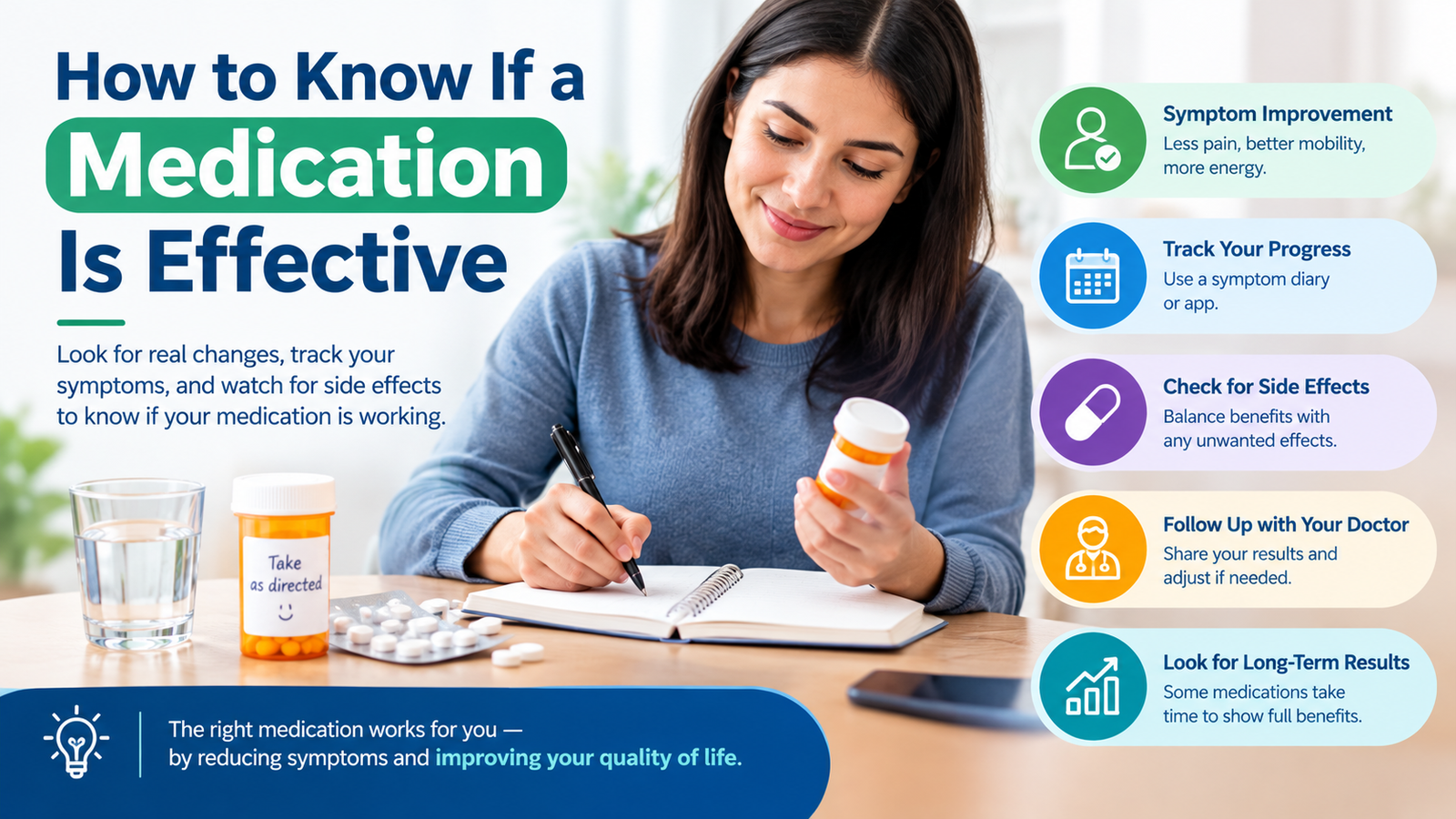
- Know the goal. Ask what the medicine is meant to achieve and how you will both know it has.
- Measure where you can. Home blood pressure readings, blood sugar readings, peak flow or weight give objective evidence.
- Keep a simple diary for medicines that treat symptoms. Rate pain, mood or sleep from 0 to 10 at the same time each day.
- Attend your reviews and blood tests. For preventive medicines, tests are the only way to tell.
- Give it the time it needs before judging, as shown in the table above.
Medicines that prevent problems, such as those for blood pressure, cholesterol and bone thinning, do not make you feel different. Not feeling anything does not mean they are failing. Equally, having no side effects is not a sign that a medicine is too weak.
Why a medicine may not work as expected
| Reason | What is happening |
|---|---|
| Missed doses | The most common reason. Around half of people on long-term medicines do not take them as prescribed. |
| Not enough time or too low a dose | Many medicines are started low and increased step by step. |
| Taken the wrong way | Some must be taken with food, some on an empty stomach, and inhalers need good technique. |
| Interactions | Other medicines, herbal products, alcohol and some foods can block or speed up a drug. |
| Differences between people | Genes affect how fast the body breaks down certain drugs. Codeine, for example, gives little pain relief to people who cannot convert it to its active form. |
| The diagnosis needs another look | If the right medicine does not help, the condition may be something else. |
| Resistance or tolerance | Bacteria can become resistant to antibiotics, and the body can adapt to some drugs over time. |
| Poor storage or expiry | Heat, damp and age can reduce the strength of some medicines. |
| Poor-quality products | Buy from licensed pharmacies. Falsified medicines are a real problem in parts of the world. |
Storage, expiry dates and keeping your list current
The expiry date is the last date on which the manufacturer guarantees full strength and safety when the medicine has been stored correctly. Keep medicines in a cool, dry place away from sunlight, and not in a steamy bathroom or a hot car. Liquid antibiotics, insulin, eye drops and medicines for emergencies, such as adrenaline pens and glyceryl trinitrate tablets, are the ones where age and storage matter most. Return unused and expired medicines to a pharmacy.
Keep an up-to-date list of everything you take, including products bought without a prescription and supplements, and show it at every appointment. Out-of-date prescriptions and duplicated medicines are a frequent cause of treatment that does not work as planned.
Are generic medicines as effective as brands?
Yes. A generic contains the same active ingredient in the same strength and form as the brand. Regulators require the maker to show that it delivers the same amount of drug into the bloodstream, a standard known as bioequivalence. Colour, shape and inactive ingredients may differ. For a small number of medicines with a narrow margin of safety, doctors may prefer you to stay on the same product. Ask your pharmacist if you are unsure.
If you think your medicine is not working
- Do not stop it suddenly. Some medicines cause harm if stopped abruptly.
- Do not take extra. A higher dose brings more side effects and often little more benefit.
- Check the basics. Are you taking it at the right time and in the right way, every day?
- Talk to your pharmacist or prescriber, and take your diary or readings with you.
- Ask about the options: more time, a different dose, a different medicine, or a second look at the diagnosis.
Related guides: medicine versus medication and the most effective medication for arthritis.
Common questions
What is the difference between efficacy and effectiveness?
Efficacy is how well a medicine works in controlled trials. Effectiveness is how well it works in everyday practice.
Does a stronger dose make a medication more effective?
Only up to a point. Beyond the recommended range, the benefit levels off while side effects keep rising.
Do medicines stop working over time?
Some do. The body can develop tolerance to certain painkillers and sleeping tablets, and conditions can progress so that a medicine that was once enough no longer is. Report any change to your doctor.
Is a medicine still effective after its expiry date?
It may have lost strength, and this cannot be judged by looking at it. Do not rely on expired medicines, above all for serious conditions.
This guide is general education and is not medical, legal or career advice. Entry rules, fees, training lengths and treatment guidance change, so confirm them with the official body in your country or with your own doctor or pharmacist. Read our disclaimer. Found an error? Tell us.