Home / Guides / Medicines explained
What is the most effective medication for arthritis?
There is no single best arthritis medicine. The most effective one depends on the type of arthritis. A plain comparison for osteoarthritis, rheumatoid arthritis, gout and more.
On this page (14 sections)
- The short answer by type of arthritis
- Two kinds of arthritis medicine
- Anti-inflammatory drugs (NSAIDs)
- Paracetamol (acetaminophen)
- Steroids
- Conventional disease-modifying drugs
- Biologics
- Targeted tablets
- Medicines for gout
- Medicines with limited or doubtful benefit
- How doctors choose
- Treatment that is not medicine
- Questions to ask your doctor
- Common questions
There is no single most effective medication for arthritis, because arthritis is not one disease. More than a hundred conditions cause joint pain and swelling, and they respond to different drugs. Anti-inflammatory painkillers work best for the pain of osteoarthritis. Methotrexate and other disease-modifying drugs work best for rheumatoid arthritis. Gout needs medicines that lower uric acid. The right answer starts with the right diagnosis.
This guide explains how arthritis medicines compare. It does not recommend a treatment for you. Many of these medicines have serious risks or interact with other drugs, so decisions about starting, stopping or changing them belong with your doctor or pharmacist.
The short answer by type of arthritis
| Type of arthritis | Medicines usually tried first | If that is not enough |
|---|---|---|
| Osteoarthritis | Anti-inflammatory gel or cream on the joint, then anti-inflammatory tablets | Steroid injection into the joint for short-term relief. Duloxetine for some people. |
| Rheumatoid arthritis | Methotrexate, a disease-modifying drug, started early | Adding or switching to a biologic or a JAK inhibitor |
| Psoriatic arthritis | Anti-inflammatories for mild disease, disease-modifying drugs for active disease | Biologics, or targeted tablets such as apremilast or a JAK inhibitor |
| Gout attack | An anti-inflammatory, colchicine or a short steroid course | A different one of the three |
| Gout prevention | Allopurinol to lower uric acid | Febuxostat or other urate-lowering medicines |
| Ankylosing spondylitis | Anti-inflammatory tablets and exercise | Biologics that block TNF or interleukin-17 |
This table reflects the general pattern in guidelines from bodies such as the American College of Rheumatology and the National Institute for Health and Care Excellence. Individual treatment differs.
Two kinds of arthritis medicine
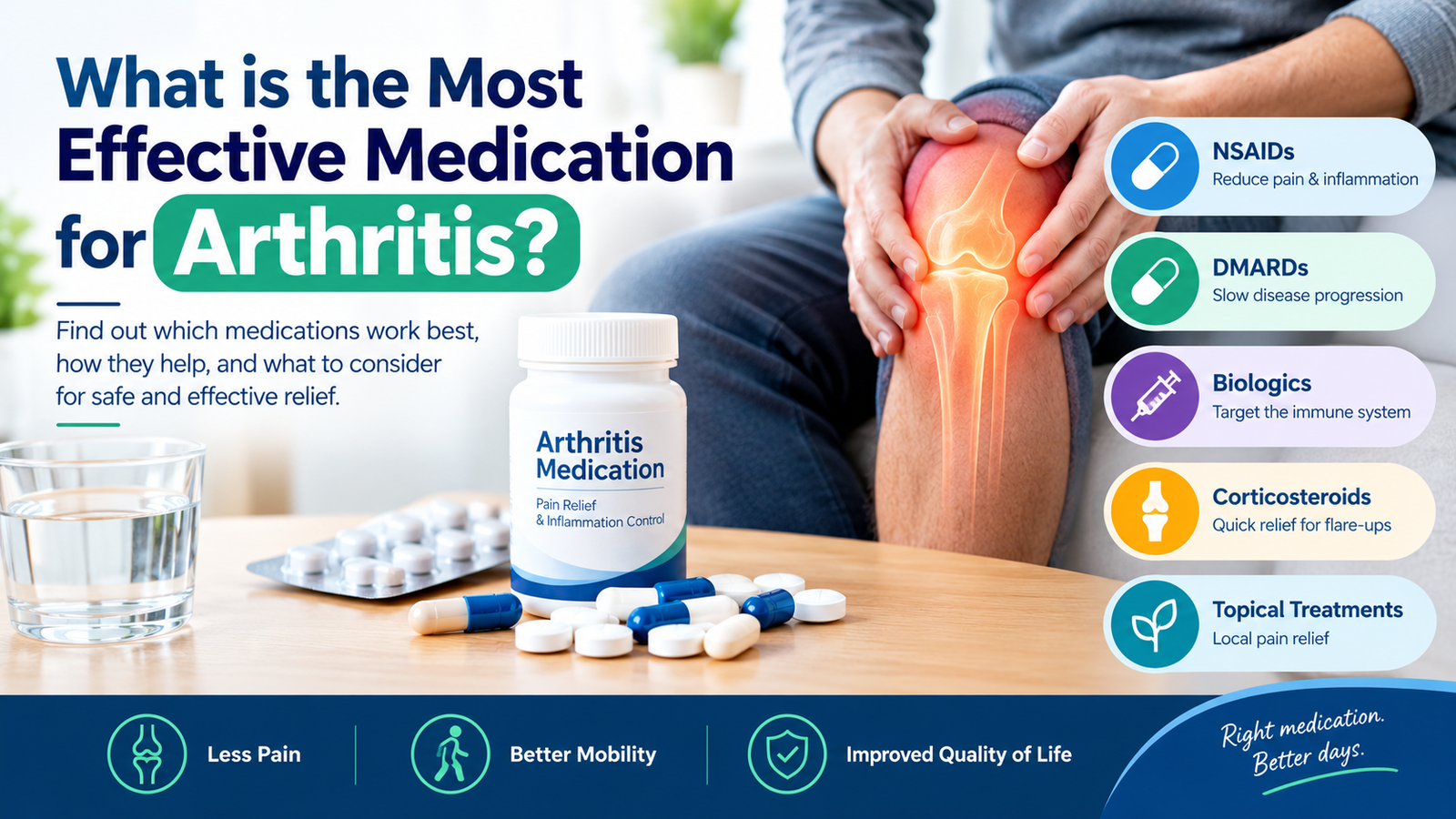
It helps to sort arthritis medicines by what they are meant to do.
- Symptom relievers reduce pain and stiffness. They do not change the course of the disease. Painkillers, anti-inflammatories and steroids used for short periods belong here.
- Disease-modifying medicines act on the immune system to stop inflammation from damaging joints. They are used for rheumatoid arthritis and other inflammatory types. They work slowly, over weeks to months, and protect joints in the long term.
For osteoarthritis there is not yet a medicine that slows the disease, so treatment relies on symptom relief, exercise and weight management. For rheumatoid arthritis, relying on painkillers alone is a mistake, because the joints continue to be damaged even when the pain is dulled.
Anti-inflammatory drugs (NSAIDs)
Non-steroidal anti-inflammatory drugs include ibuprofen, naproxen, diclofenac and celecoxib. They block the production of prostaglandins, the chemicals that drive pain and swelling. For most types of arthritis pain they are more effective than paracetamol.
Gels and creams
Anti-inflammatory gels rubbed into the skin over a knee or hand joint give useful relief with far less of the drug reaching the rest of the body. Guidelines recommend them as the first medicine for knee and hand osteoarthritis, and they suit older people in particular.
Tablets
Tablets are stronger and carry more risk. They can irritate the stomach and cause ulcers or bleeding, raise blood pressure, strain the kidneys and increase the chance of heart attack and stroke. The usual advice is the lowest dose that works for the shortest time needed. Doctors often add a stomach-protecting medicine for people who need them regularly. People with heart, kidney or stomach problems, and people taking blood thinners, should ask before using them.
Paracetamol (acetaminophen)
Paracetamol was the standard first choice for osteoarthritis for decades. Trials have since shown that its benefit for arthritis pain is small. The National Institute for Health and Care Excellence now advises against offering it routinely for osteoarthritis, and American guidance treats it as an option mainly for people who cannot take anti-inflammatories. It remains safe at the recommended dose. Too much can cause severe liver damage, and it is present in many cold and pain products, so check labels to avoid doubling up.
Steroids
Corticosteroids such as prednisolone and prednisone act like the body's own hormone cortisol and calm inflammation quickly.
- Injections into a joint can ease a painful, swollen joint for several weeks. They are used sparingly.
- Tablets are used for short periods to control a flare of rheumatoid arthritis or gout, or as a bridge while a slower disease-modifying drug takes effect.
Long-term use at more than low doses causes weight gain, thinning of the bones, raised blood sugar, cataracts and a higher risk of infection. For that reason steroids are effective but are not a long-term answer.
Conventional disease-modifying drugs
Methotrexate is the usual first medicine after a diagnosis of rheumatoid arthritis and is the standard against which others are compared. Others in the group include sulfasalazine, hydroxychloroquine and leflunomide. Doctors sometimes combine two or three.
- They take from several weeks to a few months to work.
- They need regular blood tests to check the liver and blood counts.
- Methotrexate for arthritis is taken once a week, not every day. Taking it daily by mistake has caused serious harm. Folic acid is normally prescribed with it to reduce side effects.
- Methotrexate and leflunomide must be avoided in pregnancy.
Biologics
Biologics are proteins made in living cells that block one specific part of the immune response. They include TNF inhibitors such as adalimumab and etanercept, interleukin-6 blockers, interleukin-17 blockers, B-cell therapy and others. They are given by injection under the skin or by infusion.
For people whose rheumatoid or psoriatic arthritis is not controlled by methotrexate, adding a biologic is often highly effective. No one biologic is best for everybody. If the first one does not work or stops working, another is tried. The main risks are infections, including the reactivation of old tuberculosis, so screening is done first. They are also expensive, although lower-cost biosimilar versions are now widely available.
Targeted tablets
JAK inhibitors, such as tofacitinib, baricitinib and upadacitinib, are tablets that block signalling inside immune cells. They can work as well as biologics. Regulators, including the United States Food and Drug Administration, have issued warnings about a higher risk of serious heart problems, blood clots, cancer and death with this group, so they are generally used after other options, and with caution in older people, smokers and people with heart disease. Apremilast is a different kind of targeted tablet used in psoriatic arthritis.
Medicines for gout
Gout is caused by crystals of uric acid in the joint, so its treatment is different.
- During an attack, an anti-inflammatory, colchicine or a short course of steroid is used. All three are effective, and the choice depends on the person's other conditions. Starting early in the attack matters more than which one is used.
- To prevent attacks, allopurinol lowers uric acid and is the recommended first choice. The dose is raised gradually until the blood level is below a target. It is taken every day for the long term, including during attacks.
Medicines with limited or doubtful benefit
| Medicine | What the evidence shows |
|---|---|
| Opioids such as codeine, tramadol and morphine | Little benefit over other painkillers for long-term arthritis pain, with risks of dependence, falls and constipation. Guidelines advise against routine use. |
| Glucosamine and chondroitin | Good-quality trials have not shown meaningful benefit. American guidelines recommend against them for knee and hip osteoarthritis. |
| Hyaluronic acid injections | Benefit is small or uncertain. Not routinely recommended. |
| Capsaicin cream | Can help knee and hand osteoarthritis for some people. Causes a burning feeling at first. |
How doctors choose
- The type of arthritis, confirmed by examination, blood tests and imaging.
- How active the disease is, and whether joints are already damaged.
- Your other conditions, such as heart, kidney, liver or stomach disease, and pregnancy plans.
- Your other medicines, to avoid interactions.
- Your preferences, such as tablets or injections, and how you feel about monitoring.
- Cost and availability where you live.
In rheumatoid arthritis, doctors use an approach called treat to target. They set a goal of remission or low disease activity, review progress every one to three months, and change treatment until the goal is reached. Starting within the first few months of symptoms gives the best chance of preventing permanent damage.
Treatment that is not medicine
For osteoarthritis, exercise is at least as important as any drug. Strengthening and aerobic exercise reduce pain and improve function, and losing weight reduces the load on knees and hips. Physiotherapy, heat or cold, walking aids, splints and supportive footwear all help. When a joint is severely damaged, joint replacement surgery is very effective. These measures also matter in inflammatory arthritis, alongside medication.
Questions to ask your doctor
- Which type of arthritis do I have?
- Is this medicine for my symptoms or to control the disease?
- How long before I should notice a benefit?
- What side effects should I report, and what tests will I need?
- Is it safe with my other medicines and conditions?
- What happens if it does not work?
For how effectiveness is measured in the first place, read how to know if a medication is effective.
Common questions
What is the strongest arthritis medicine without a prescription?
Anti-inflammatories such as ibuprofen and naproxen, as tablets or gels, are generally the most effective medicines sold without a prescription for arthritis pain. Read the label and ask a pharmacist whether they are safe for you.
Can arthritis be cured with medicine?
Most types cannot be cured. Rheumatoid arthritis can often be brought into remission, and gout can be fully controlled by keeping uric acid low. Osteoarthritis can be managed well.
How long do arthritis medicines take to work?
Anti-inflammatories work within hours to days. Steroids work within days. Disease-modifying drugs and biologics take from a few weeks to three months.
Is it safe to take anti-inflammatories every day?
Some people do under medical supervision, but daily use raises the risk of stomach, heart and kidney problems. Discuss long-term use with your doctor.
This guide is general education and is not medical, legal or career advice. Entry rules, fees, training lengths and treatment guidance change, so confirm them with the official body in your country or with your own doctor or pharmacist. Read our disclaimer. Found an error? Tell us.