Home / Guides / Medical profession
Definition and criteria for medical associations
What a medical association is, the criteria that set one apart from regulators and certifying boards, the main types, and how to judge one before you join.
On this page (15 sections)
- The core criteria
- A formal definition in United States law
- How associations are usually organised
- What a medical association is not
- Types of medical association
- What medical associations do
- Where medical associations came from
- How associations are governed
- Association, society, college or academy?
- An example from one country: Pakistan
- Their part in medical education
- Criticisms and limits
- Why doctors join
- How to judge a medical association
- Common questions
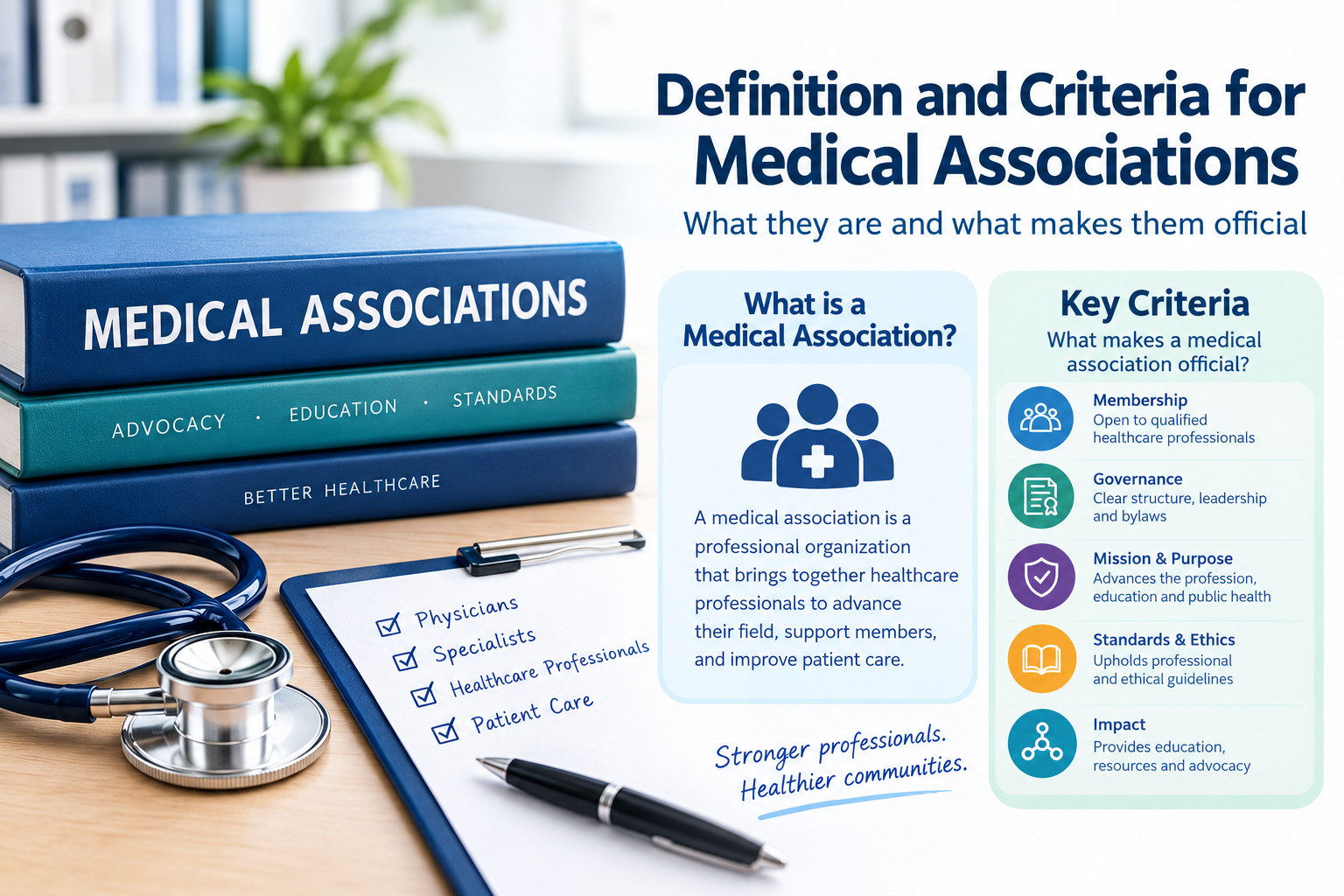
A medical association is a membership organisation of doctors that works to raise standards in medical education, practice and ethics, and to represent the interests of the profession. Encyclopaedia Britannica defines it in those terms: a professional organisation or learned society that promotes high standards in medical education and practice, science and ethics, and that protects the interests of its physician members.
There is no single legal definition used worldwide. In practice, organisations are recognised as medical associations when they meet a common set of criteria. This guide sets those criteria out.
The core criteria
| Criterion | What it means |
|---|---|
| Membership of practitioners | Members are physicians, or medical students and trainees. Joining is normally voluntary. |
| Professional purpose | Its stated aims concern the quality of medical education, practice, science or ethics. |
| Representation | It speaks for its members to governments, employers, insurers and the public. |
| Member governance | Members elect the officers and a governing body, under a written constitution or bylaws. |
| Non-profit status | Income from dues, journals and meetings is used for the association's aims and is not paid out as profit. |
| Standards and ethics | It adopts a code of ethics or professional standards that members are expected to follow. |
| Education and publishing | It runs meetings and continuing education, and often publishes a journal or clinical guidelines. |
An organisation does not need to do every one of these things to the same degree. A small specialty society may publish no journal. A national association may spend most of its effort on policy. The first four criteria are the ones that make an organisation an association and not some other kind of body.
A formal definition in United States law
Some laws need a precise test. The National Practitioner Data Bank, a federal database of malpractice payments and disciplinary actions, defines a professional society as "a membership association of health care practitioners at the national, state, or local level" that "follows a formal peer review process for the purpose of furthering quality health care."
Two criteria follow from that wording:
- It must be a membership association of practitioners.
- It must run formal peer review. That means professional review carried out under written procedures that give the practitioner notice and a chance to be heard.
The same guidebook says that specialty certification boards, independent practice associations, managed care organisations and preferred provider organisations ordinarily do not meet the definition. A society that meets it has reporting duties when it takes certain actions against a member.
How associations are usually organised
In the United States most medical associations are tax-exempt non-profit bodies. Many are organised as professional associations under section 501(c)(6) of the tax code, which allows lobbying on behalf of members. Others, or their linked foundations, are educational and charitable bodies under section 501(c)(3). In the United Kingdom the British Medical Association is both a professional association and a registered trade union for doctors.
What a medical association is not
| Body | Main job | Is membership a choice? | Example |
|---|---|---|---|
| Medical association | Represents and supports doctors, sets professional standards | Yes | American Medical Association |
| Regulator or licensing board | Grants and removes the legal right to practise | No, registration is required by law | General Medical Council, state medical boards |
| Certifying board | Examines and certifies specialists | Certification is earned by examination | Member boards of the American Board of Medical Specialties |
| Trade union | Negotiates pay and conditions | Yes | Some associations also act as unions |
The key test is power. A regulator can stop a doctor from practising. An association can only expel a member from the association.
Types of medical association
| Type | Who it covers | Examples |
|---|---|---|
| International | National associations from many countries | World Medical Association, founded 1947 |
| National | Doctors of all specialties in one country | British Medical Association (1832), American Medical Association (1847), Canadian Medical Association (1867), Pakistan Medical Association |
| State or local | Doctors in one state, county or city | Massachusetts Medical Society (1781), publisher of The New England Journal of Medicine |
| Specialty society | Doctors in one field of medicine | American Academy of Pediatrics (1930), American College of Cardiology (1949) |
| Student and trainee | Medical students and residents | National medical student associations |
What medical associations do
- Ethics. The World Medical Association adopted the Declaration of Geneva in 1948 and the Declaration of Helsinki on research ethics in 1964. National associations publish their own codes.
- Education. They run conferences and continuing medical education, and many accredit training.
- Publishing. JAMA is published by the American Medical Association and The BMJ by the British Medical Association.
- Guidelines. Specialty societies write the clinical guidelines that shape everyday care.
- Advocacy. They lobby on health policy, funding and working conditions.
- Quality improvement. In the United States, ten professional associations and organisations served as Support and Alignment Networks in the Transforming Clinical Practice Initiative run by the Centers for Medicare and Medicaid Services, helping clinicians prepare for new payment models.
Where medical associations came from
Doctors have organised themselves for centuries. The Royal College of Physicians of London received its charter in 1518 to license physicians and act against unqualified practice. The modern national association is a product of the nineteenth century. Qualified doctors wanted to separate themselves from untrained healers, agree a common standard of education and speak to government with one voice.
The British Medical Association began in 1832 as a society of provincial doctors. The American Medical Association was founded in 1847 and adopted a code of medical ethics in the same year. After the Second World War, national associations created the World Medical Association in 1947 to set ethical standards across borders.
How associations are governed
Member control is the feature that most clearly marks out an association. The usual structure has three levels.
- A representative assembly. Delegates elected by local or specialty groups meet once or twice a year to set policy. The American Medical Association calls this its House of Delegates. The British Medical Association holds an Annual Representative Meeting.
- An elected board or council. A smaller group runs the association between meetings.
- Officers and staff. A president, who is usually a practising doctor serving a fixed term, and a paid executive team.
Dues are normally set by career stage, with reduced rates for students, trainees and retired members.
Association, society, college or academy?
| Name | Usual meaning | Example |
|---|---|---|
| Association | A broad body that represents the profession | Canadian Medical Association |
| Society | A local or specialty body with a scientific focus | Massachusetts Medical Society |
| College | A body that sets standards and examinations for a specialty | Royal College of Physicians, College of Physicians and Surgeons Pakistan |
| Academy | A specialty body with an emphasis on education | American Academy of Pediatrics |
These labels are habits, not rules. Look at what an organisation does, and do not rely on its name.
An example from one country: Pakistan
Pakistan shows the three roles clearly, because a different body performs each one.
- The Pakistan Medical Association is the voluntary professional association that represents doctors.
- The Pakistan Medical and Dental Council is the statutory regulator. It registers doctors and recognises medical colleges.
- The College of Physicians and Surgeons Pakistan runs postgraduate training and awards the FCPS and MCPS qualifications.
Only the first of these meets the definition of a medical association.
Their part in medical education
Associations shape how doctors are trained, often through bodies they sponsor.
- In the United States, the Liaison Committee on Medical Education, which accredits MD programmes, is sponsored jointly by the American Medical Association and the Association of American Medical Colleges.
- Specialty societies write curricula, run courses and set the content of continuing education.
- Many associations fund scholarships, student sections and research prizes.
- Education journals are often society journals. Perspectives on Medical Education, for example, belongs to the Netherlands Association for Medical Education.
Criticisms and limits
- Self-interest. An association exists partly to protect its members' income and status. Its positions on pay, on who may perform which tasks, and on health reform should be read with that in mind.
- Who it speaks for. Membership is voluntary, so an association may represent only part of the profession. The American Medical Association's members are a minority of physicians in the United States.
- Funding. Income from industry sponsorship and advertising can create conflicts of interest, especially when a society writes clinical guidelines.
- Discipline. Associations are sometimes slow to act against their own members.
A well run association answers these concerns by publishing its funding, declaring conflicts of interest in guidelines and keeping its ethical procedures independent.
Why doctors join
- access to journals, guidelines and continuing education
- conferences and professional networks
- legal and contract advice in some countries
- a voice in health policy
- mentoring and career support for students and trainees
How to judge a medical association
New societies appear every year, and some exist mainly to sell conferences or certificates. Before you join or cite one, check these points:
- Does it publish its constitution, officers and how they are elected?
- Is it a registered non-profit body, and are its accounts available?
- Are membership requirements tied to a recognised medical qualification?
- Is it recognised by a national association, a federation of specialty societies or the World Medical Association?
- Does it have a code of ethics and a process for complaints about members?
- Are its journal and guidelines peer reviewed and indexed?
Common questions
Is membership of a medical association compulsory?
Usually not. Registration with the regulator is compulsory. Joining an association is a choice, although in a few countries the same body performs both roles.
What is the difference between a medical association and a medical society?
The words are used interchangeably. Society is more common for specialty and local bodies, and association for national ones, but there is no fixed rule.
Can a medical association discipline a doctor?
It can investigate complaints and suspend or expel a member. It cannot remove a licence to practise. Only the regulator can do that.
Can medical students join?
Most national associations offer student membership at a reduced fee. It is a useful way to follow the debates described in our guide to perspectives on medical education.
This guide is general education and is not medical, legal or career advice. Entry rules, fees, training lengths and treatment guidance change, so confirm them with the official body in your country or with your own doctor or pharmacist. Read our disclaimer. Found an error? Tell us.