Home / Guides / Medical journals
Nature Medicine impact factor 2025: the number and what it means
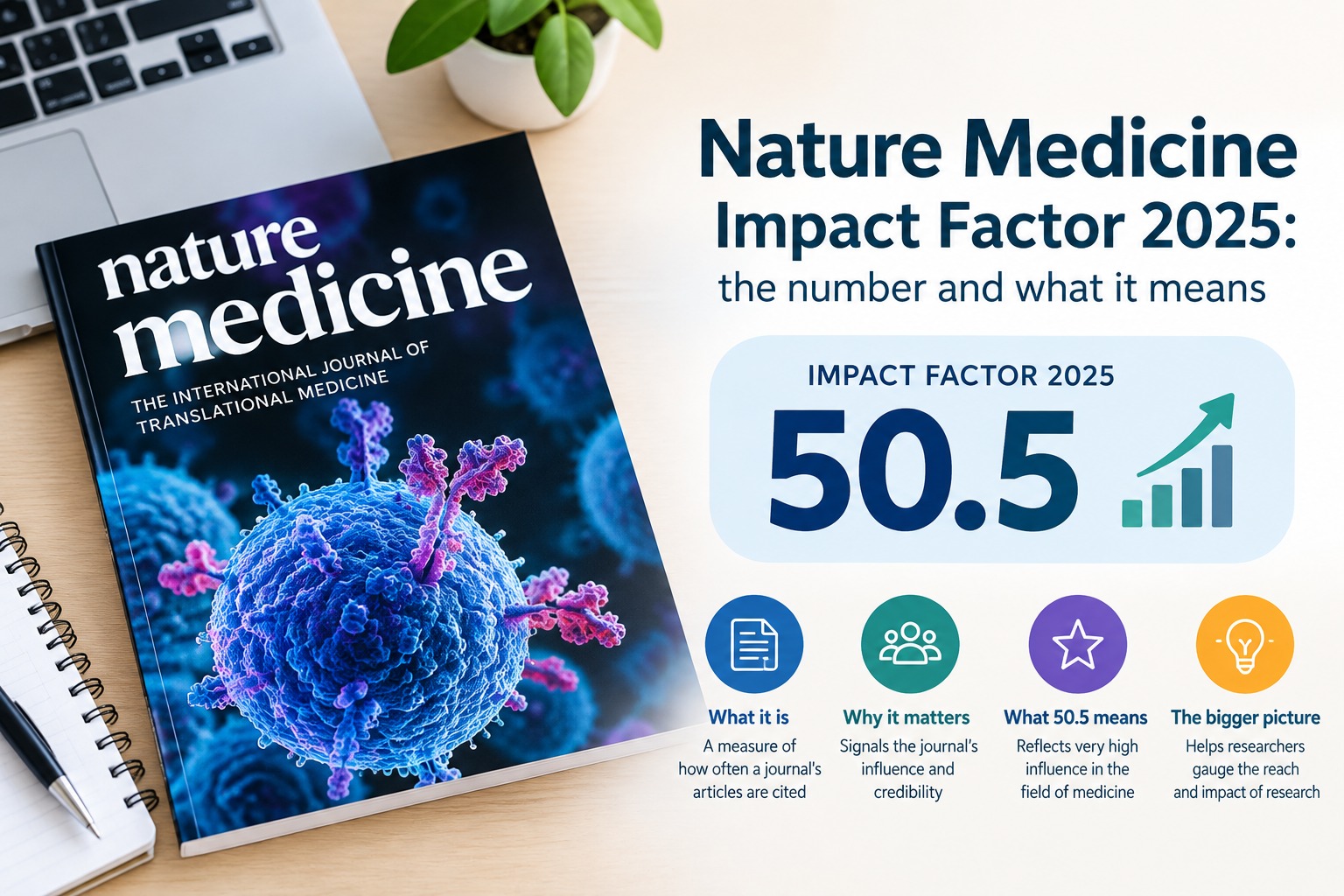
Nature Medicine's 2025 impact factor is 52.5. See how it has changed since 2020, the journal's other metrics, and how to read the figure sensibly.
On this page (14 sections)
- Nature Medicine impact factor by year
- Why the number rose and fell
- How the impact factor is calculated
- Other Nature Medicine metrics
- What 52.5 tells you, and what it does not
- About the journal
- Impact factor compared with other metrics
- Details of the calculation that people miss
- How Nature Medicine sits among medical journals
- What this means for authors
- What this means for students and readers
- Journal details
- How to check the current figure yourself
- Common questions
Nature Medicine's 2025 Journal Impact Factor is 52.5. The journal lists this figure on its own metrics page. It was released in the 2026 edition of Journal Citation Reports, the yearly dataset published by Clarivate.
An impact factor is named after the year of the citations it counts and is published the following June. The 2025 impact factor is 52.5 and came out in 2026. The figure that was published during 2025 is the 2024 impact factor, which was about 50. If a form asks for the latest figure, use 52.5.
Nature Medicine impact factor by year
| Impact factor year | Released | Value |
|---|---|---|
| 2025 | 2026 | 52.5 |
| 2024 | 2025 | about 50 |
| 2023 | 2024 | 58.7 |
| 2022 | 2023 | 82.9 |
| 2021 | 2022 | 87.2 |
| 2020 | 2021 | 53.4 |
The 2025 value is from the journal's metrics page. Earlier values are as widely reported from Journal Citation Reports. Sources differ slightly on the 2024 figure, so it is given as an approximation.
Why the number rose and fell
The peak in 2021 and 2022 was not unique to Nature Medicine. The journal published heavily cited COVID-19 research in 2020 and 2021, and those papers fell inside the two-year counting window for the 2021 and 2022 figures. As they moved out of the window, the impact factor returned towards its earlier level. Most leading general medical journals show the same curve.
The 2025 figure of 52.5 is slightly higher than the year before, which suggests the post-pandemic fall has ended.
How the impact factor is calculated
The formula is simple. Take all citations received in 2025 by items the journal published in 2023 and 2024. Divide by the number of research articles and reviews it published in those two years.
A value of 52.5 means that papers published in Nature Medicine in 2023 and 2024 were cited about 52 times each, on average, during 2025.
Other Nature Medicine metrics
| Metric | Value | What it shows |
|---|---|---|
| 2-year impact factor (2025) | 52.5 | Average citations in 2025 to papers from 2023 and 2024 |
| 5-year impact factor (2025) | 52.5 | The same measure over a five-year window |
| Immediacy index | 16.7 | Citations to papers in the year they were published |
| Article influence score | 21.972 | Average influence per article, weighted by the citing journal |
| Eigenfactor score | 0.21215 | The journal's total weight in the citation network |
| SJR | 17.496 | Scopus-based rank that weights citations by source prestige |
| SNIP | 9.840 | Citations per paper adjusted for the field's citation habits |
| Median time to first editorial decision | 4 days | How quickly editors decide whether to send a paper for review |
| Median time from submission to acceptance | 117 days | For papers that are accepted |
Figures as listed on the journal's metrics page when this guide was updated. The journal also reports about 25.7 million article downloads and 98,677 Altmetric mentions for 2025.
What 52.5 tells you, and what it does not
An impact factor above 50 places Nature Medicine among the most cited medical journals in the world. It tells you that the journal as a whole is read and cited very widely.
It does not tell you how good any single paper is. Citations within a journal are very uneven. A small number of papers collect a large share of them, and many papers are cited far less than the average. For that reason the San Francisco Declaration on Research Assessment, signed by thousands of institutions, asks funders and universities to stop using journal impact factors to judge individual researchers.
- Use it to compare journals within the same field.
- Do not use it to compare journals across fields, because citation habits differ.
- Do not use it as a score for one article or one author.
About the journal
Nature Medicine was founded in 1995 and is published monthly by Nature Portfolio, part of Springer Nature. It publishes research that links laboratory science to patient care, including clinical trials, translational studies and work on digital health. Editorial decisions are made by full-time professional editors, and submitted papers are assessed by external reviewers.
Besides full Articles, it publishes shorter research papers. Read our guide to the Nature Medicine Brief Communication format.
Impact factor compared with other metrics
Several organisations publish journal metrics, and they do not use the same data or the same method. That is why you will see different numbers for the same journal.
| Metric | Published by | How it differs |
|---|---|---|
| Journal Impact Factor | Clarivate, from Web of Science data | Two-year window. The best known figure. |
| CiteScore | Elsevier, from Scopus data | Four-year window and counts more document types, so the value differs from the impact factor |
| SJR | SCImago, from Scopus data | Weights each citation by the standing of the journal it comes from |
| SNIP | CWTS Leiden, from Scopus data | Adjusts for how often papers are cited in each field |
| h-index | Several databases | The largest number h such that h papers each have at least h citations. Grows with the age and size of a journal. |
When you quote a figure, name the metric and the year. "Impact factor 52.5 (2025, Journal Citation Reports)" is clear. "Impact factor 90" copied from a site that is really showing CiteScore is a common mistake.
Details of the calculation that people miss
- Only some items count in the bottom of the fraction. The denominator includes research articles and reviews. News pieces, editorials and correspondence are left out, although citations to them are still counted in the top of the fraction.
- The window is short. Two years suits fast-moving fields such as medicine. Papers that are cited slowly over a decade contribute little.
- Figures are now given to one decimal place. Clarivate made this change in 2023 so that journals are not ranked on tiny differences.
- The value is an average of a skewed distribution. A few very highly cited papers lift it well above what a typical paper receives.
How Nature Medicine sits among medical journals
Most medical journals have impact factors below 5, and a figure above 10 marks a leading journal in its specialty. A value above 50 is rare. The large general medical journals, such as The New England Journal of Medicine and The Lancet, report higher figures than Nature Medicine. Among journals that focus on translational and research medicine, Nature Medicine is at or near the top of its category.
What this means for authors
A high impact factor goes with heavy competition for space. Nature Medicine's editors decline most submissions without sending them to reviewers, and the journal reports a median of four days to that first decision. Authors should weigh the chance of success against the time a submission takes.
- Read recent issues to see what the journal publishes. It favours studies with clear consequences for patients and strong human data.
- If the paper is declined, the publisher offers transfer to other Nature Portfolio journals, such as Nature Communications or Communications Medicine, without a fresh submission.
- Choose a journal for its readership and fit. A well matched specialty journal often serves a paper better than a failed attempt at a famous one.
What this means for students and readers
- A paper in a high-impact journal has passed a demanding review, but it can still be wrong. Read the methods.
- When you list publications on a CV, give the full reference. Many institutions now ask applicants not to list impact factors beside their papers.
- For a single article, look at its own citation count and at what later studies say about it.
Journal details
| Item | Detail |
|---|---|
| Title | Nature Medicine |
| First published | 1995 |
| Publisher | Nature Portfolio, part of Springer Nature |
| Frequency | Monthly |
| ISSN | 1078-8956 (print), 1546-170X (online) |
| Access | Subscription journal with an open access option for authors |
How to check the current figure yourself
- Open the journal's "Journal metrics" page on nature.com. It is updated each summer.
- For the official record, search for the journal in Journal Citation Reports. Most university libraries provide access.
- Be careful with third-party "impact factor" websites. Some show estimates or out-of-date values.
Common questions
Who calculates the impact factor?
Clarivate, the company that runs the Web of Science database. Journals do not calculate their own figure.
What is a good impact factor in medicine?
It depends on the field. Many sound specialty journals have values between 2 and 5. Values above 10 are found in the leading journals of each specialty, and values above 50 in only a handful of journals.
Does a paper in Nature Medicine get 52 citations?
Not necessarily. The figure is an average across all papers. Some are cited hundreds of times and many are cited far less.
Why do some websites show a different number?
They may be showing an older year, a different metric such as CiteScore, or their own estimate. Use the journal's metrics page or Journal Citation Reports.
Is Nature Medicine a Q1 journal?
Yes. It sits in the top quartile of its Journal Citation Reports category, Medicine, Research and Experimental.
When will the 2026 impact factor be released?
Clarivate normally publishes Journal Citation Reports in June. The 2026 impact factor is therefore expected in June 2027.
Is a high impact factor the same as a high acceptance bar?
They are related but different. The impact factor measures citations. Selectivity is about how many submissions are accepted. Nature Medicine is highly selective, and most submissions are declined by the editors without external review.
This guide is general education and is not medical, legal or career advice. Entry rules, fees, training lengths and treatment guidance change, so confirm them with the official body in your country or with your own doctor or pharmacist. Read our disclaimer. Found an error? Tell us.