Home / Guides / Medical journals
Nature Medicine Brief Communication: format, limits and how to write one
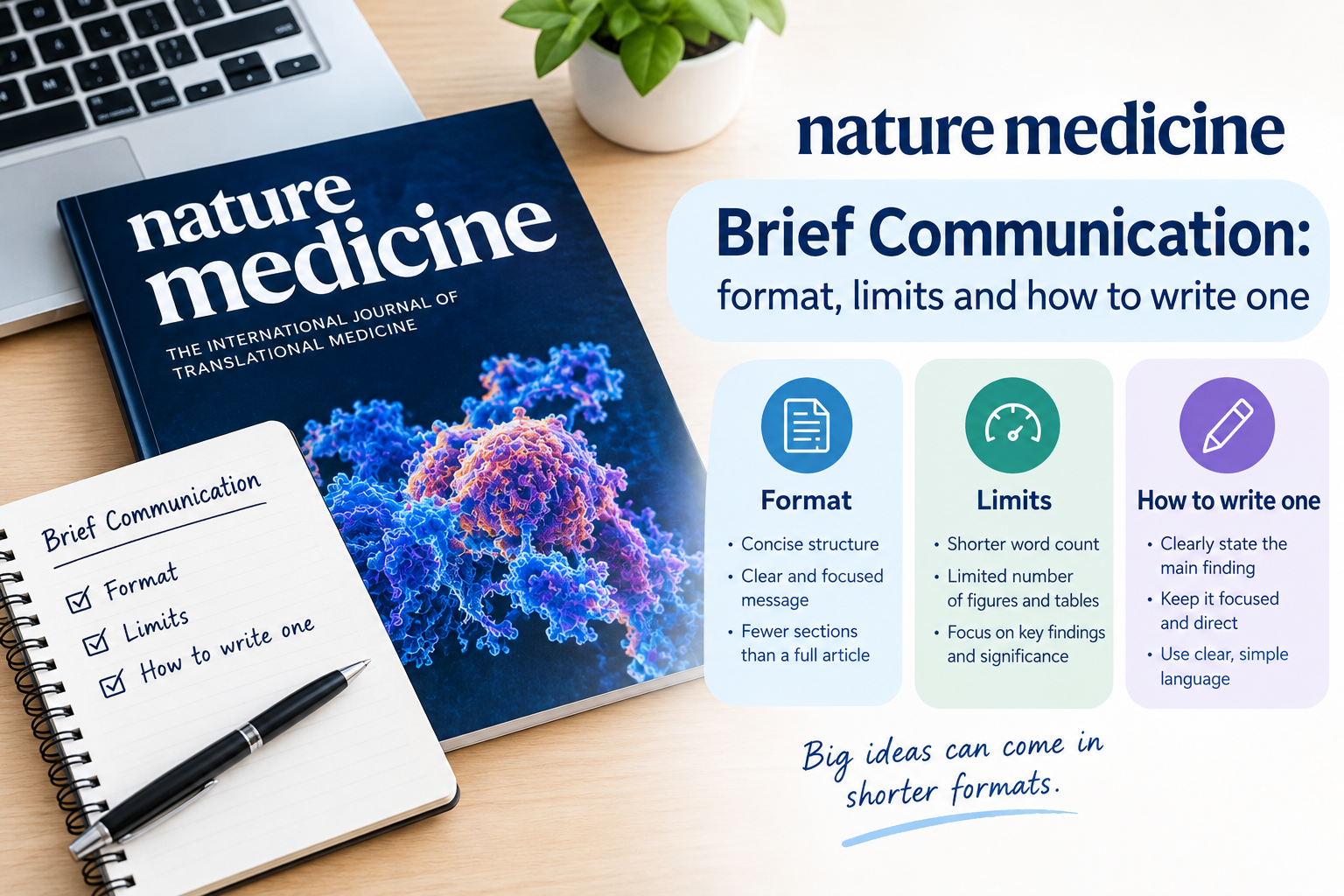
A Brief Communication is Nature Medicine's short research paper: about 1,000 to 1,500 words and two figures. See the limits, recent examples and writing tips.
On this page (13 sections)
- Brief Communication format at a glance
- What kind of study fits the format
- Brief Communication or Article?
- How to write one
- Submitting to Nature Medicine
- A paragraph-by-paragraph outline
- A word budget
- Title and abstract
- What goes in Methods and supplementary files
- The cover letter
- After you submit
- Common mistakes
- Common questions
A Brief Communication is the short research format in Nature Medicine. It reports one clear finding of wide interest in about 1,000 to 1,500 words, with no more than two figures or tables. It is peer reviewed in the same way as a full Article and counts as original research.
Pexarenti is an independent site and is not affiliated with Nature Medicine or its publisher. Limits change, so confirm them on the journal's content types page before you submit.
Brief Communication format at a glance
Nature Portfolio research journals describe the format in the same terms. These are the standard limits.
| Element | Brief Communication | Article, for comparison |
|---|---|---|
| Abstract | Up to 3 sentences, about 70 words, no references | Up to 150 words, no references |
| Main text | 1,000 to 1,500 words, counting the abstract, references and figure legends | Up to about 4,000 words, not counting abstract, Methods, references and legends |
| Headings | None in the main text | Results, Discussion and Methods sections |
| Figures and tables | Up to 2 | Usually 5 to 8 |
| Methods | Separate Methods section | Separate Methods section |
| References | About 20 as a guide | About 60 as a guide |
| Supplementary information | Allowed | Allowed |
| Peer review | Yes | Yes |
The word limit is tighter than it first appears. The abstract, the reference list and the figure legends all count towards the 1,500 words. The Methods section does not, which is where the technical detail belongs.
What kind of study fits the format
A Brief Communication suits a study with one main message that can be shown in one or two figures. It is a complete piece of work. It is not a preliminary report and not a cut-down version of a longer paper.
Typical examples include:
- a focused clinical observation with immediate relevance, such as a case series during an outbreak
- an analysis of a large health dataset that answers one question
- a short evaluation of a diagnostic test, a vaccine effect or an artificial intelligence tool
- a timely finding where speed matters to clinicians or public health teams
Recent Brief Communications
The journal's archive lists more than 270 papers of this type. Titles published in mid-2026 show the range:
- "Recombinant shingles vaccination and the risk of cardiovascular events"
- "A case of Bundibugyo virus disease treated with monoclonal antibodies and remdesivir"
- "Spatiotemporal diffusion of the 2024 Oropouche outbreak in Cuba"
- "General-purpose large language models outperform specialized clinical AI tools on medical benchmarks"
Each one makes a single claim that a reader can grasp from the title.
Brief Communication or Article?
- Choose a Brief Communication if the finding stands on one or two figures and the story needs no long build-up.
- Choose an Article if the claim needs several lines of evidence, mechanistic work or multiple cohorts.
Editors sometimes suggest a change of format after reading a submission. A paper sent as an Article may be accepted as a Brief Communication, and the reverse can also happen.
How to write one
- State the finding in the first paragraph. With no headings, the text reads as one continuous argument. Give the question, what you did and what you found within the first 150 words.
- Write the abstract last. Three sentences: the problem, the result with its key number, and why it matters.
- Design the two figures first. Multi-panel figures are normal. Decide what each must prove, then write the text around them.
- Move detail to Methods and supplementary files. Cohort definitions, statistical models and sensitivity analyses belong there.
- Be strict with references. About 20 is the guide, and they count towards your words. Cite the key prior work and leave the rest.
- End with limits and meaning. One short paragraph on what the study cannot show, and one on what should change because of it.
Submitting to Nature Medicine
Manuscripts are submitted through the journal's online system. For a first submission, a single file with the figures placed in the text is normally accepted, along with a cover letter. You will also need ethics approval details for studies involving people, a data availability statement and a trial registration number where one applies.
Full-time editors read every submission and decide whether to send it to outside reviewers. The journal reports a median of 4 days to that first editorial decision and a median of 117 days from submission to acceptance for papers that are accepted. Most submissions are declined at the first stage, so the cover letter should say plainly what is new and why it matters for patients.
Nature Medicine offers both subscription and open access publication. The open access fee is high, so check the current charge and whether your institution or funder has an agreement that covers it.
A paragraph-by-paragraph outline
Because the main text has no headings, structure has to come from the order of the paragraphs. This outline fits most studies.
| Paragraph | Job | Rough length |
|---|---|---|
| 1 | The problem, the gap in knowledge and what you set out to test | 120 words |
| 2 | Who or what was studied and the design, in two or three sentences, pointing to Methods | 100 words |
| 3 | The main result, with numbers and a reference to Figure 1 | 180 words |
| 4 | Supporting or secondary results, with a reference to Figure 2 or a table | 180 words |
| 5 | Checks that the result holds: sensitivity analyses, subgroups, validation | 120 words |
| 6 | Limitations | 100 words |
| 7 | What the finding means for patients, practice or research | 100 words |
A word budget
The limit covers more than the body text, so plan the whole allowance before you write.
| Part | Illustrative share of 1,500 words |
|---|---|
| Abstract | 70 |
| Body text | 900 to 1,000 |
| Two figure legends | 150 to 200 |
| References | 250 to 300 |
These shares are a planning aid, not a rule from the journal. They show why a body text of more than about 1,000 words will not fit.
Title and abstract
Nature Portfolio guidance asks for short titles, of about ten words or ninety characters, with no punctuation tricks or abbreviations. State the finding. The recent examples above do exactly this.
For the abstract, try this pattern of three sentences:
- One sentence on the clinical or scientific problem.
- One sentence that begins "Here we show" or similar and gives the result with its most important number.
- One sentence on what the result means.
What goes in Methods and supplementary files
The Methods section sits outside the word limit and should allow another group to repeat the work. Include the study population and how it was selected, definitions of exposures and outcomes, laboratory procedures, statistical analysis and software.
Nature Portfolio journals also ask authors to complete a reporting summary and to follow the reporting guideline for their study type, such as CONSORT for randomised trials and STROBE for observational studies. Statements on data availability, code availability and ethics approval are required. Extended data and supplementary tables can hold the additional analyses that reviewers will want to see.
The cover letter
- State in one sentence what you found.
- Explain in a short paragraph why it matters for human health and who needs to know.
- Say why the Brief Communication format suits the work.
- Mention related papers by your group that are under review elsewhere, and any preprint.
- Keep it to one page.
Posting a preprint before or during submission is permitted by Nature Portfolio journals. Tell the editor where it is.
After you submit
- Editorial assessment. An editor reads the paper and discusses it with colleagues. Many papers are declined at this point, usually within days.
- Peer review. If the editors see promise, the paper goes to several external reviewers.
- Decision. The outcome is rejection, an invitation to revise, or, rarely, acceptance in principle.
- Revision. You answer every reviewer comment in a point-by-point letter and may need to add data. The word limit still applies.
- Acceptance and proofs. The journal checks format and reporting documents, then sends proofs.
If the paper is declined, the editors may suggest transferring it to another Nature Portfolio journal. The files and any reviewer reports move with it.
Common mistakes
- Going over the word limit by forgetting that references and legends count.
- Adding section headings to the main text.
- Squeezing a full Article into two crowded figures.
- Submitting early data that still needs a confirming experiment or cohort.
- Writing an abstract that describes the topic without giving the result.
Common questions
Can a Brief Communication have more than two figures?
Two display items is the standard. Nature Portfolio guidance says an editor may allow more if the paper still fits the page limit. Extra material normally goes into extended data or supplementary files.
Can I include supplementary information?
Yes. Supplementary information is allowed and is reviewed with the paper.
Is a Brief Communication peer reviewed?
Yes. It goes through the same external peer review as an Article and is published with received and accepted dates.
Is it the same as Correspondence or a letter to the editor?
No. Correspondence comments on published work or current issues. A Brief Communication is original research with its own data and Methods.
Does a Brief Communication count as a full publication?
Yes. It is indexed and cited like any other research paper, and it is included when the journal's citation metrics are calculated. See our guide to the Nature Medicine impact factor.
Do other journals use the same format?
Many Nature Portfolio journals publish Brief Communications under the same limits. Other publishers use similar short formats under names such as Research Letter or Short Report, each with its own rules.
This guide is general education and is not medical, legal or career advice. Entry rules, fees, training lengths and treatment guidance change, so confirm them with the official body in your country or with your own doctor or pharmacist. Read our disclaimer. Found an error? Tell us.