Home / Guides / Learning medicine
How Can I Tell If My Toe Is Broken? Signs & Symptoms Guide
Wondering how can I tell if my toe is broken? Learn broken toe signs, symptoms, bruising, swelling, treatment, healing time, and when to see a doctor.
On this page (44 sections)
- Quick Answer: How Do You Know If Your Toe Is Broken?
- Broken Toe vs Bruised Toe: How Can You Tell the Difference?
- Common Signs Your Toe May Be Broken
- 1. Persistent Toe Pain After an Injury
- 2. Swelling Around the Toe
- 3. Bruising or Color Changes
- 4. Your Toe Looks Crooked or Misaligned
- 5. Difficulty Moving Your Toe
- 6. Pain When Putting Weight on Your Foot
- What Does a Broken Toe Look Like?
- Can You Move a Broken Toe?
- Can You Walk With a Broken Toe?
- Common Types of Toe Fractures
- Hairline Fracture
- Displaced Fracture
- Open Fracture
- Stress Fracture
- Broken Big Toe: Why It Needs Special Attention
- When Should You See a Doctor for a Broken Toe?
- How Do Doctors Diagnose a Broken Toe?
- Physical Examination
- X-Ray
- How Are Broken Toes Treated?
- Rest
- Ice
- Elevation
- Protective Footwear
- Buddy Taping
- Realignment or Surgery
- How Long Does a Broken Toe Take to Heal?
- How Can You Help a Broken Toe Heal Faster?
- How to Prevent Toe Injuries
- Frequently Asked Questions
- How can I tell if my toe is broken?
- Can a broken toe heal on its own?
- Can you walk on a broken toe?
- Does a broken toe always swell?
- Can you move a broken toe?
- How painful is a broken toe?
- Do broken toes need an X-ray?
- How long does a broken toe take to heal?
- What does a broken toe look like?
- When should I see a doctor for toe pain?
- Final Thoughts
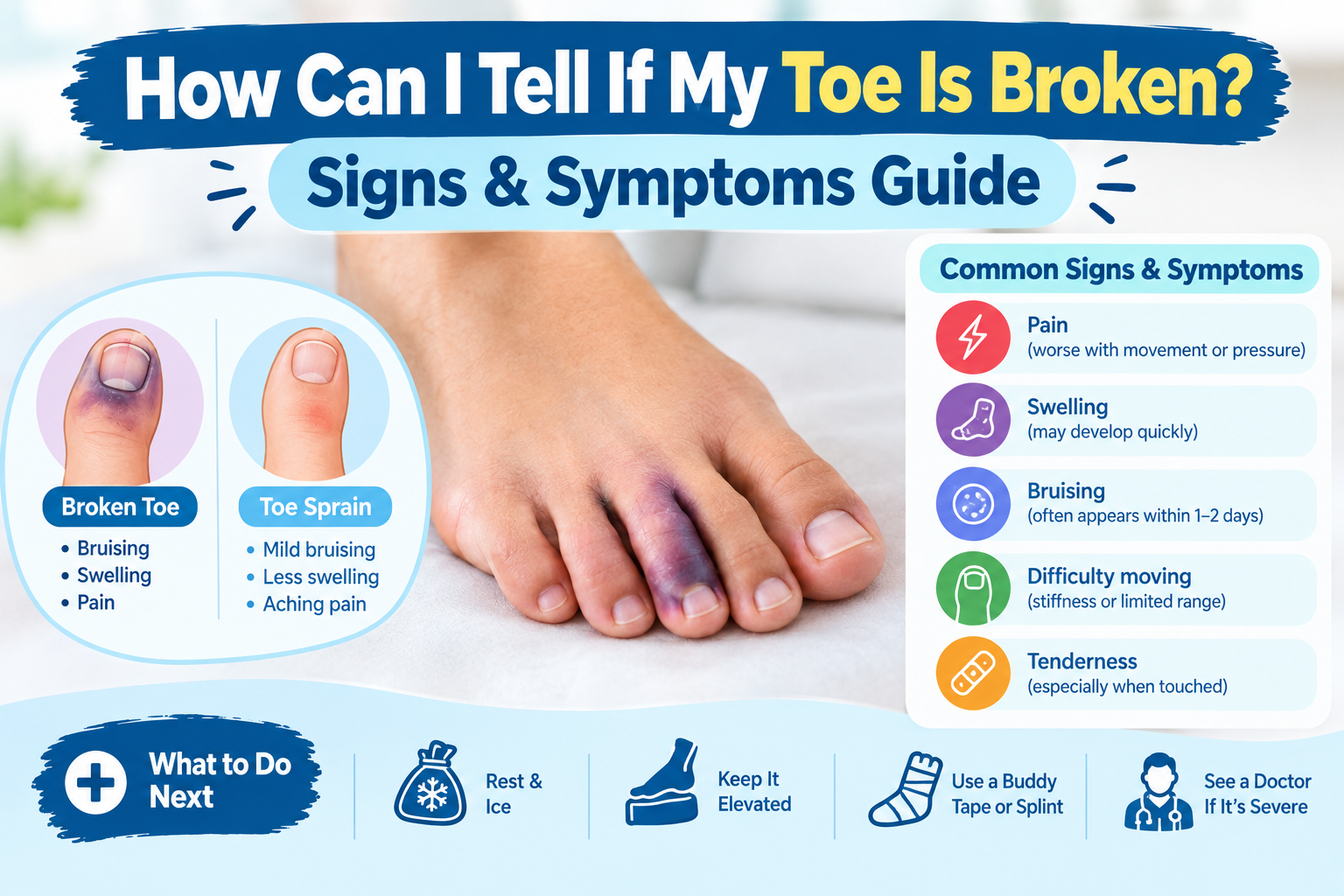
If you are wondering how can I tell if my toe is broken, the most common signs include persistent pain, swelling, bruising, difficulty moving the toe, and changes in the toe’s shape or alignment.
However, it is not always easy to tell the difference between a broken toe, a bruised toe, or a sprained toe. Many toe injuries cause similar symptoms, and an X-ray is the most reliable way to confirm a fracture.
A broken toe (toe fracture) usually hurts more and takes longer to improve than a simple bruise. Some minor fractures can still allow you to walk, so being able to put weight on your foot does not always mean your toe is not broken.
This guide explains how to recognize a broken toe, the difference between a broken and bruised toe, when to see a doctor, treatment options, and how long recovery usually takes.
Quick Answer: How Do You Know If Your Toe Is Broken?
Your toe may be broken if you notice:
- Severe pain that continues after the injury
- Swelling that does not improve
- Significant bruising or discoloration
- Difficulty moving the toe
- Pain when touching or pressing the toe
- A crooked or misshapen toe
- The toe looks different compared with the same toe on the other foot
- Difficulty walking or putting weight on your foot
The only way to confirm a broken toe is usually through a medical evaluation and, if needed, an X-ray.
Broken Toe vs Bruised Toe: How Can You Tell the Difference?
A bruised toe and a broken toe can look very similar at first. Both can cause:
- Pain
- Swelling
- Bruising
- Tenderness
The main difference is that a broken toe often causes more severe or persistent symptoms.
| Symptom | Broken Toe | Bruised Toe |
|---|---|---|
| Pain | Usually stronger and lasts longer | Often improves gradually |
| Swelling | Common and may be significant | Usually mild to moderate |
| Bruising | Can be extensive | Possible but often less severe |
| Movement | Painful or limited | Usually still possible |
| Toe shape | May look crooked or abnormal | Usually normal |
| Walking | May be difficult | Often possible |
| Healing time | Usually 4–6 weeks | Often improves within days |
Keep in mind that symptoms alone cannot always confirm whether a bone is broken.
Common Signs Your Toe May Be Broken
1. Persistent Toe Pain After an Injury
Pain is one of the most common signs of a toe fracture.
A broken toe may cause:
- Sharp pain immediately after injury
- Throbbing pain
- Pain when touching the toe
- Increased pain when walking
- Pain that does not improve after a day or two
A bruised toe often starts feeling better sooner, while fracture pain may continue.
2. Swelling Around the Toe
Swelling commonly occurs after a toe injury.
A broken toe may cause:
- Rapid swelling
- A swollen joint
- Swelling extending into the foot
- Tightness when wearing shoes
Swelling alone does not prove a fracture because bruises and sprains can also swell.
3. Bruising or Color Changes
A broken toe may develop:
- Purple bruising
- Blue or dark discoloration
- Bruising around the nail
- Bruising spreading across the toe or foot
The amount of bruising does not always indicate how serious the injury is.
Some fractures cause little visible bruising, while some bruises may look severe without a fracture.
4. Your Toe Looks Crooked or Misaligned
A toe that looks different from the same toe on your other foot may be a sign of a fracture.
Look for:
- Toe pointing in an unusual direction
- Twisting
- Bending sideways
- Abnormal shape
- A joint appearing out of place
A crooked toe should be evaluated by a healthcare professional.
Do not try to straighten it yourself.
5. Difficulty Moving Your Toe
Limited movement can happen with a broken toe.
You may notice:
- Trouble bending the toe
- Pain when moving it
- Stiffness
- Feeling like the toe will not move normally
However, being able to move your toe does not completely rule out a fracture.
Some small fractures still allow movement.
6. Pain When Putting Weight on Your Foot
Walking may become difficult after a toe fracture.
You may experience:
- Pain when standing
- Limping
- Difficulty wearing shoes
- Avoiding pressure on the injured toe
Some people can still walk with a broken toe, especially with minor fractures.
What Does a Broken Toe Look Like?
A broken toe may appear:
- Swollen
- Bruised
- Red or purple
- Crooked
- Larger than the other toes
- Different in alignment
Some fractures may look normal from the outside.
A toe can be broken even if there is no obvious deformity.
Can You Move a Broken Toe?
Yes, sometimes.
Many people assume a broken toe cannot move, but this is not always true.
You may still be able to move a fractured toe, especially if:
- The fracture is small
- The bones remain aligned
- It is a hairline fracture
Movement may still cause:
- Sharp pain
- Tenderness
- Increased swelling
Can You Walk With a Broken Toe?
Yes, some people can walk with a broken toe.
Being able to walk does not mean your toe is not fractured.
Walking ability depends on:
- Which toe is injured
- The type of fracture
- Whether the bone is displaced
- Pain level
A broken big toe may affect walking more because it plays an important role in balance and pushing off while walking.
Common Types of Toe Fractures
Toe fractures can occur in different ways.
Hairline Fracture
A hairline fracture is a small crack in the bone.
Symptoms may include:
- Mild to moderate pain
- Swelling
- Tenderness
- Pain that worsens with activity
Displaced Fracture
A displaced fracture occurs when broken bone pieces move out of alignment.
Signs may include:
- Crooked appearance
- Abnormal toe position
- Severe swelling
- Difficulty moving the toe
Open Fracture
An open fracture occurs when the broken bone breaks through the skin.
This requires urgent medical attention because of infection risk.
Stress Fracture
A stress fracture develops from repeated pressure rather than a single injury.
Common causes include:
- Running
- Jumping
- Increased exercise
- High-impact sports
Symptoms usually develop gradually.
Broken Big Toe: Why It Needs Special Attention
The big toe is especially important because it helps with:
- Balance
- Walking
- Pushing forward while walking
A broken big toe may require more careful evaluation compared with smaller toe fractures.
Seek medical advice if:
- The big toe looks crooked
- You cannot walk normally
- Pain is severe
- Swelling is significant
When Should You See a Doctor for a Broken Toe?
You should seek medical care if you have:
- A toe pointing in the wrong direction
- Bone visible through the skin
- A deep cut near the injury
- Severe swelling
- Numbness or tingling
- Blue or pale discoloration
- Inability to walk
- Severe pain that does not improve
- A big toe injury
People with certain health conditions should also seek medical advice after toe injuries.
These include:
- Diabetes
- Poor circulation
- Nerve problems
- Immune system conditions
How Do Doctors Diagnose a Broken Toe?
A healthcare provider may diagnose a toe fracture through:
Physical Examination
The doctor checks:
- Swelling
- Bruising
- Tenderness
- Toe alignment
- Movement
- Circulation and sensation
They may compare the injured toe with the same toe on the opposite foot.
X-Ray
An X-ray is the most common test used to confirm a broken toe.
It can show:
- Whether the bone is fractured
- The location of the break
- Whether the bone has moved
- How severe the fracture is
How Are Broken Toes Treated?
Treatment depends on the type and severity of the fracture.
Rest
Avoid activities that increase pain.
Rest helps reduce stress on the injured bone.
Ice
Apply ice during the first few days to help reduce:
- Swelling
- Pain
- Inflammation
Avoid placing ice directly on the skin.
Elevation
Keeping your foot elevated can help reduce swelling.
Protective Footwear
A stiff-soled shoe may help protect the toe while it heals.
Buddy Taping
Buddy taping involves supporting the injured toe by attaching it to the neighboring toe.
It may help stabilize some minor fractures.
However, it should not be used if:
- The toe is crooked
- There is severe swelling
- There is numbness
- The injury is complicated
A healthcare professional can advise whether it is appropriate.
Realignment or Surgery
Some fractures require additional treatment, such as:
- Realigning the bone
- Splinting
- Casting
- Surgery
This is more likely with:
- Displaced fractures
- Open fractures
- Severe big toe injuries
How Long Does a Broken Toe Take to Heal?
Most broken toes heal in about:
4 to 6 weeks
Recovery time depends on:
- Type of fracture
- Location of injury
- Treatment
- Overall health
A general timeline:
| Time Period | What Happens |
|---|---|
| First week | Pain and swelling are usually highest |
| Weeks 2–3 | Symptoms gradually improve |
| Weeks 4–6 | Bone continues healing |
| After 6 weeks | Return to normal activities if healed |
Some complicated fractures may take longer.
How Can You Help a Broken Toe Heal Faster?
To support healing:
- Rest when needed
- Avoid activities that increase pain
- Wear supportive footwear
- Keep swelling controlled
- Follow medical advice
- Avoid returning to sports too quickly
Returning to activity too soon can delay recovery.
How to Prevent Toe Injuries
You can reduce your risk by:
- Wearing protective footwear
- Keeping floors clear of obstacles
- Using proper sports equipment
- Increasing exercise gradually
- Wearing shoes that fit correctly
- Avoiding walking barefoot around heavy objects
Frequently Asked Questions
How can I tell if my toe is broken?
Signs of a broken toe include persistent pain, swelling, bruising, difficulty moving the toe, and changes in toe shape. An X-ray is usually needed to confirm a fracture.
Can a broken toe heal on its own?
Many simple toe fractures heal without surgery with proper protection and care.
Can you walk on a broken toe?
Yes, some people can walk with a broken toe. Walking ability does not always rule out a fracture.
Does a broken toe always swell?
No. Swelling is common but not present in every case.
Can you move a broken toe?
Sometimes. Some fractures still allow movement, although it may be painful.
How painful is a broken toe?
Pain varies depending on the type of fracture. Some cause severe pain, while others may feel like a deep bruise.
Do broken toes need an X-ray?
An X-ray is often used to confirm whether a toe is fractured and determine the best treatment.
How long does a broken toe take to heal?
Most broken toes heal within 4–6 weeks, although severe injuries may take longer.
What does a broken toe look like?
A broken toe may appear swollen, bruised, discolored, or crooked, but some fractures may look normal externally.
When should I see a doctor for toe pain?
Seek medical advice for severe pain, deformity, open wounds, numbness, inability to walk, or symptoms that do not improve.
Final Thoughts
If you are asking how can I tell if my toe is broken, look for signs like persistent pain, swelling, bruising, difficulty moving the toe, or changes in its shape.
However, a broken toe is not always obvious. Some fractures look like simple bruises, and some people can still walk despite having a fracture.
The safest way to know is through a medical evaluation and, when needed, an X-ray.
Most simple toe fractures heal well with proper care, protection, and time.
This article is for educational purposes only and is not a substitute for professional medical diagnosis or treatment.
This guide is general education and is not medical, legal or career advice. Entry rules, fees, training lengths and treatment guidance change, so confirm them with the official body in your country or with your own doctor or pharmacist. Read our disclaimer. Found an error? Tell us.