Home / Guides / Medical Tests
What Does a Positive TB Test Look Like? Bump Size Guide
Learn what a positive TB test looks like, including bump size, induration, redness, 5/10/15 mm cutoffs, 48–72 hour results, and next steps.
On this page (37 sections)
- What Does a Positive TB Test Look Like?
- Positive TB Test Quick Answer
- What Is Induration on a TB Test?
- Redness vs Induration: What Actually Makes a TB Test Positive?
- What Does a Positive TB Test Look Like After 48 Hours?
- What Does a Positive TB Test Look Like After 72 Hours?
- What Size Bump Is Considered a Positive TB Test?
- TB Test Bump Size Chart
- Does a Positive TB Test Always Have a Red Bump?
- Does a Positive TB Test Always Have a Large Bump?
- Can a TB Test Be Positive Without Symptoms?
- Does a Positive TB Test Mean Active Tuberculosis?
- Latent TB vs Active TB After a Positive Test
- What Happens After a Positive TB Test?
- Can a Positive TB Skin Test Be False Positive?
- Can the BCG Vaccine Cause a Positive TB Skin Test?
- TB Skin Test vs TB Blood Test
- How Is a Positive TB Skin Test Measured?
- Can You Read a TB Test at Home?
- What If My TB Test Is Red but Has No Hard Bump?
- What If My TB Test Has a Hard Bump but No Redness?
- What If the TB Test Bump Keeps Getting Bigger?
- Positive TB Test vs Negative TB Test
- Positive TB Test Pictures: Can Images Confirm the Result?
- When Should You Seek Medical Advice After a Positive Test?
- Frequently Asked Questions
- What does a positive TB test look like?
- How big is a positive TB test bump?
- Is redness a sign of a positive TB test?
- What does a positive TB test look like after 48 hours?
- What does a positive TB test look like after 72 hours?
- Can a TB test be positive without symptoms?
- Does a positive TB test mean active TB?
- Can the BCG vaccine cause a positive skin test?
- Can a positive TB test be wrong?
- What happens after a positive TB skin test?
- Final Thoughts
If you are wondering what does a TB positive test look like, the most important thing to know is that a positive TB skin test is identified by a firm, raised or hardened area called induration at the injection site.
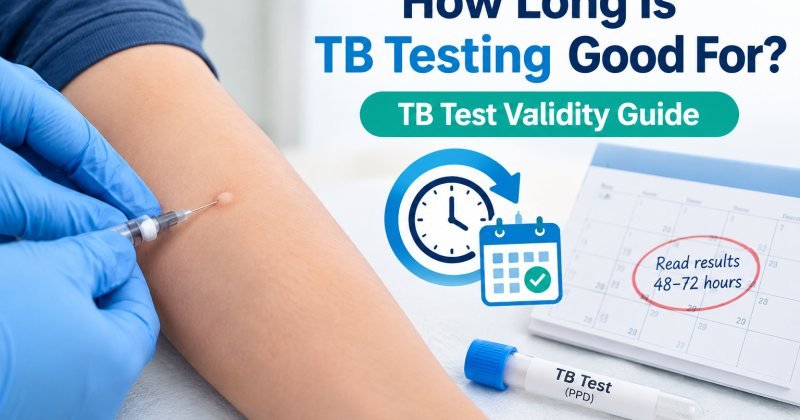
The test is not considered positive because the skin looks red. A healthcare professional measures the hardened area in millimeters, usually 48 to 72 hours after the test is placed.
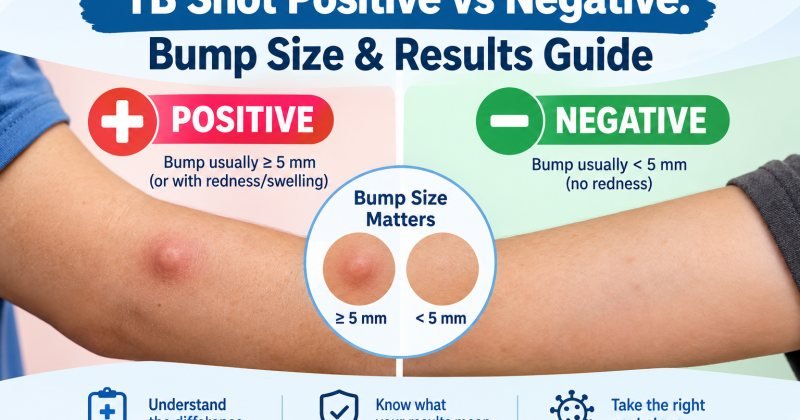
Depending on your TB risk factors, an induration of 5 mm, 10 mm or 15 mm or more may be considered positive.
A positive skin test suggests that your immune system has reacted to tuberculosis-related antigens, but it does not automatically mean you have active tuberculosis disease.
This guide explains what a positive TB test may look and feel like, how the bump is measured, what different sizes mean, and what usually happens after a positive result.
What Does a Positive TB Test Look Like?
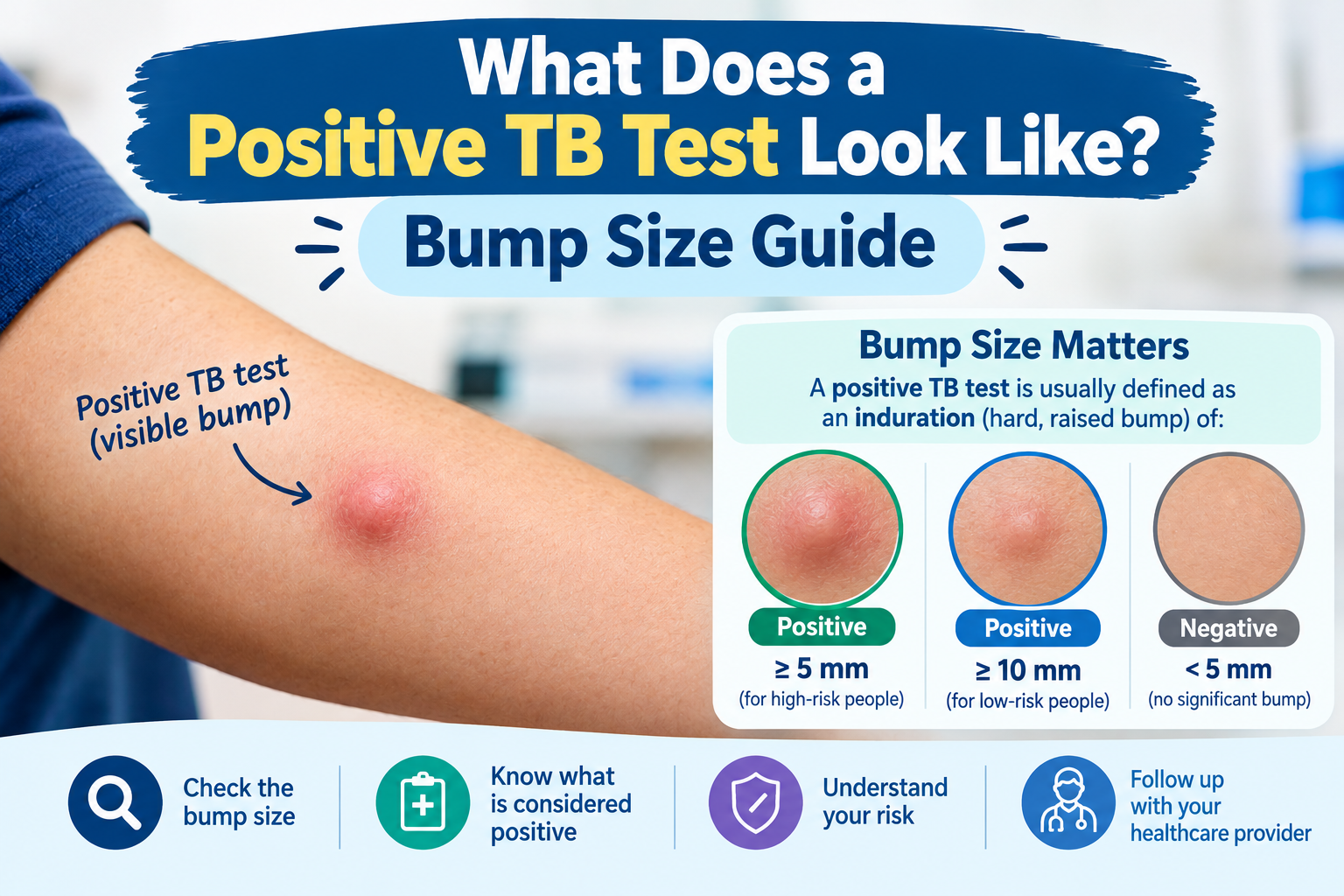
A positive TB skin test usually has a firm, raised, hardened area at the site where the test material was injected.
Common features may include:
- A raised or slightly elevated area
- Firmness under the skin
- A clearly defined hardened bump
- Swelling that can be felt when touched
- Redness around the area in some people
The most important feature is induration, not redness.
A healthcare professional feels the skin and measures the width of the hardened area across the forearm.
Positive TB Test Quick Answer
A positive TB skin test typically shows measurable induration at the injection site.
The size considered positive depends on your risk level:
| Induration Size | When It May Be Considered Positive |
|---|---|
| 5 mm or more | Certain high-risk individuals |
| 10 mm or more | People with specific TB risk factors |
| 15 mm or more | People with no known TB risk factors |
The result must be interpreted by a qualified healthcare professional.
What Is Induration on a TB Test?
Induration is the firm, raised or hardened area that develops under the skin after a tuberculin skin test.
It may feel:
- Firm
- Thickened
- Slightly raised
- Different from the surrounding skin
This is the area healthcare providers measure.
Redness around the test site is called erythema, and it is not included in the measurement.
Redness vs Induration: What Actually Makes a TB Test Positive?
This is one of the most important points when reading a TB skin test.
Redness
Redness can occur after the injection, but redness alone does not mean the test is positive.
A TB test may look:
- Red
- Pink
- Slightly irritated
and still be negative.
Induration
Induration is the firm, raised area that healthcare professionals measure.
The test result is based on:
- The size of the induration
- Your TB risk factors
- Your medical history
So, a red TB test is not automatically a positive TB test.
What Does a Positive TB Test Look Like After 48 Hours?
At around 48 hours, a positive TB skin test may show:
- A firm bump
- Noticeable induration
- Slight elevation above surrounding skin
- Redness around the injection site
However, redness is still not used to determine positivity.
A trained healthcare professional can begin evaluating the reaction during this time window.
What Does a Positive TB Test Look Like After 72 Hours?
At 72 hours, a positive test may still show:
- A firm or hardened area
- Measurable swelling
- Raised induration
- Redness in some cases
The test should generally be read within the recommended 48–72 hour window.
If it is not checked in time, your healthcare provider may recommend repeating the test.
What Size Bump Is Considered a Positive TB Test?
The size of the bump is interpreted differently depending on your risk category.
5 mm or More
An induration of 5 mm or more may be considered positive in certain high-risk individuals.
This can include people with:
- HIV
- Recent close contact with someone who has infectious TB
- Certain chest X-ray findings suggesting previous TB
- Significant immune suppression
- Some transplant-related risk factors
10 mm or More
An induration of 10 mm or more may be considered positive in people with additional TB risk factors.
This may include:
- People from countries where TB is more common
- Certain healthcare workers
- People living or working in some high-risk settings
- People with particular medical conditions
- Some children with specific risk factors
15 mm or More
An induration of 15 mm or more may be considered positive in people who do not have known TB risk factors.
This is why the exact same bump size may be interpreted differently in different people.
TB Test Bump Size Chart
| TB Skin Test Measurement | Possible Interpretation |
|---|---|
| 0–4 mm | Usually negative |
| 5 mm or more | May be positive in high-risk individuals |
| 10 mm or more | May be positive in people with certain risk factors |
| 15 mm or more | May be positive in people without known TB risk factors |
This chart is for general understanding only.
Your healthcare provider should interpret the actual result.
Does a Positive TB Test Always Have a Red Bump?
No.
A positive TB test does not have to be strongly red.
Some people may have:
- Clear induration with little redness
- Noticeable redness with only small induration
- Both redness and induration
Only the hardened area is measured.
Does a Positive TB Test Always Have a Large Bump?
Not necessarily.
A bump as small as 5 mm may be considered positive in some high-risk people.
For someone with no known risk factors, a larger reaction may be required before the result is considered positive.
That is why bump size should never be interpreted without knowing the person's risk category.
Can a TB Test Be Positive Without Symptoms?
Yes.
A person can have a positive TB skin test and feel completely well.
This may indicate latent TB infection, meaning TB bacteria may be present in the body without causing active disease.
People with latent TB infection usually:
- Do not feel sick
- Do not have TB symptoms
- Cannot spread TB to others
- May be offered treatment to reduce the risk of developing active TB later
Does a Positive TB Test Mean Active Tuberculosis?
No.
A positive TB skin test does not automatically mean you have active TB disease.
It means your immune system has reacted to TB-related antigens.
Further testing is needed to determine whether you have:
- Latent TB infection
- Active TB disease
- A false-positive result
Latent TB vs Active TB After a Positive Test
Latent TB Infection
With latent TB:
- You usually have no symptoms
- You do not spread TB to other people
- Your chest X-ray may be normal
- Treatment may be recommended to reduce future risk
Active TB Disease
Active TB can cause symptoms such as:
- Persistent cough
- Fever
- Night sweats
- Fatigue
- Weight loss
- Chest pain
- Coughing up blood
Active TB requires medical treatment and may be contagious depending on where the infection is located.
What Happens After a Positive TB Test?
If your TB skin test is positive, your healthcare provider may recommend additional evaluation.
This may include:
- Medical history
- Physical examination
- Chest X-ray
- TB blood test
- Sputum testing if active pulmonary TB is suspected
The goal is to determine whether TB infection is latent or active.
Can a Positive TB Skin Test Be False Positive?
Yes.
False-positive TB skin test results can occur.
Possible causes include:
- Previous BCG vaccination
- Exposure to certain non-tuberculosis mycobacteria
- Incorrect test administration
- Incorrect interpretation
This is one reason a TB blood test may sometimes be preferred.
Can the BCG Vaccine Cause a Positive TB Skin Test?
Yes, BCG vaccination can affect TB skin test results in some people.
The BCG vaccine is commonly used in countries where tuberculosis is more prevalent.
If you have received BCG, a healthcare provider may recommend a TB blood test because blood tests are generally not affected by BCG vaccination.
TB Skin Test vs TB Blood Test
Two common types of testing are used to detect TB infection.
TB Skin Test
Also known as:
- TST
- PPD test
- Mantoux test
Advantages:
- Widely available
- Commonly used
- Relatively simple
Limitations:
- Requires a second visit
- Must be read within 48–72 hours
- Can be affected by BCG vaccination
TB Blood Test
Also called an interferon-gamma release assay (IGRA).
Examples include:
- QuantiFERON-TB Gold
- T-SPOT.TB
Advantages:
- Requires one blood draw
- Does not require a return visit for skin measurement
- Is generally preferred for some people who received BCG
How Is a Positive TB Skin Test Measured?
A healthcare professional usually:
- Examines the injection site
- Feels the skin for induration
- Identifies the edges of the hardened area
- Measures the width across the forearm
- Records the measurement in millimeters
The red area is not included.
Can You Read a TB Test at Home?
It is not recommended.
A TB skin test can be difficult to interpret accurately because induration may be easier to feel than see.
Healthcare professionals are trained to:
- Identify the hardened area
- Measure it correctly
- Apply the correct cutoff based on your risk factors
Self-reading may lead to inaccurate conclusions.
What If My TB Test Is Red but Has No Hard Bump?
Redness without measurable induration is not usually considered a positive result by itself.
The important feature is the hardened area.
If you are unsure about the reaction, have it checked by the healthcare provider who administered the test.
What If My TB Test Has a Hard Bump but No Redness?
A hard bump can still be important even if the skin is not very red.
The healthcare provider measures the induration and compares it with the appropriate cutoff.
Redness is not required for a positive result.
What If the TB Test Bump Keeps Getting Bigger?
A growing or changing reaction should be evaluated by a healthcare professional.
The test should be officially read during the 48–72 hour window.
Do not try to diagnose the result yourself based on appearance alone.
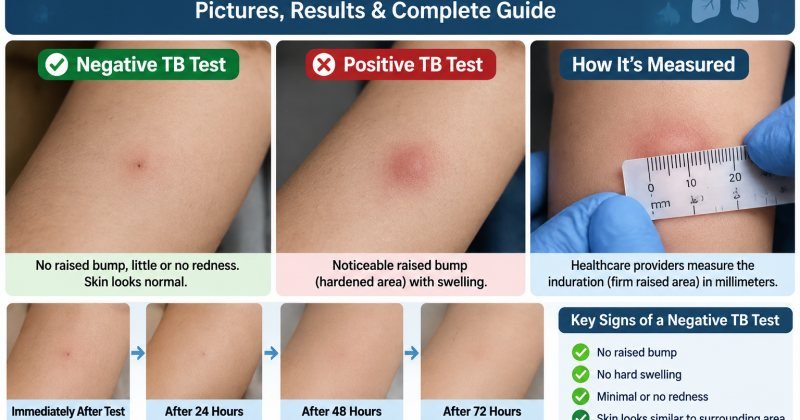
Positive TB Test vs Negative TB Test
| Feature | Positive TB Test | Negative TB Test |
|---|---|---|
| Induration | Meets the cutoff for the person's risk group | Below the cutoff |
| Redness | May or may not be present | May or may not be present |
| Raised area | Usually measurable | None or too small to meet criteria |
| Meaning | TB infection may be present | TB infection is less likely |
| Next step | Further evaluation often needed | Usually no further action unless symptoms or exposure exist |
Positive TB Test Pictures: Can Images Confirm the Result?
Many people search for positive TB test pictures to compare their reaction with online examples.
Pictures can help show what induration may look like, but they cannot confirm whether a test is positive.
Why?
- Skin tone differs
- Lighting changes appearance
- Induration may be easier to feel than see
- Risk-based cutoffs differ
- Redness does not equal positivity
A professional measurement is more reliable than comparing your arm with a photo.
When Should You Seek Medical Advice After a Positive Test?
Contact a healthcare provider if your TB test is positive or if you have TB symptoms such as:
- Cough lasting several weeks
- Fever
- Night sweats
- Unexplained weight loss
- Persistent fatigue
- Chest pain
- Coughing up blood
You should also seek medical advice if you recently had close contact with someone diagnosed with active TB.
Frequently Asked Questions
What does a positive TB test look like?
A positive TB skin test usually has a firm, raised or hardened area called induration at the injection site. The size of the induration determines whether the result is positive.
How big is a positive TB test bump?
A reaction may be considered positive at 5 mm, 10 mm or 15 mm depending on the person's TB risk factors.
Is redness a sign of a positive TB test?
Redness alone does not make a TB test positive. Healthcare professionals measure induration, not redness.
What does a positive TB test look like after 48 hours?
A positive test may show firm, raised induration at 48 hours. The reaction should be measured by a healthcare professional.
What does a positive TB test look like after 72 hours?
At 72 hours, a positive result may still show measurable hardened swelling. The test is generally read during the 48–72 hour window.
Can a TB test be positive without symptoms?
Yes. Many people with latent TB infection feel well and do not have symptoms.
Does a positive TB test mean active TB?
No. A positive test indicates possible TB infection, but further testing is required to determine whether the infection is latent or active.
Can the BCG vaccine cause a positive skin test?
Yes. Previous BCG vaccination may affect TB skin test results in some people.
Can a positive TB test be wrong?
Yes. False-positive and false-negative results can occur.
What happens after a positive TB skin test?
A healthcare provider may recommend a chest X-ray, medical evaluation and additional testing to check for active TB disease.
Final Thoughts
If you are asking what does a TB positive test look like, the clearest answer is this:
A positive TB skin test usually has a firm, raised or hardened area called induration at the injection site. The result is based on the size of that induration—not the amount of redness.
Depending on your risk factors, a reaction of 5 mm, 10 mm or 15 mm or more may be considered positive.
A positive skin test does not automatically mean active tuberculosis. It means further medical evaluation may be needed to determine whether you have latent TB infection, active TB disease or another explanation for the reaction.
Always have a TB skin test read by a trained healthcare professional within the recommended 48–72 hour window.
This article is for general educational purposes and is not a substitute for professional medical diagnosis or treatment.
This guide is general education and is not medical, legal or career advice. Entry rules, fees, training lengths and treatment guidance change, so confirm them with the official body in your country or with your own doctor or pharmacist. Read our disclaimer. Found an error? Tell us.