Home / Guides / Medical Tests
TB Shot Positive vs Negative: Bump Size & Results Guide
Compare TB shot positive vs negative results, including bump size, redness, induration, 5/10/15 mm cutoffs, 48–72 hour readings, and next steps.
On this page (38 sections)
- TB Shot Positive vs Negative: Quick Comparison
- What Is a TB Skin Test?
- What Does a Positive TB Test Look Like?
- What Does a Negative TB Test Look Like?
- TB Test Redness vs Induration: What Actually Matters?
- TB Test Bump Size: 5 mm, 10 mm and 15 mm
- TB Skin Test Size Chart
- What Does a TB Test Look Like After 48 Hours?
- What Does a TB Test Look Like After 72 Hours?
- Positive vs Negative TB Test Pictures: What Should You Look For?
- Can a TB Test Be Red and Still Negative?
- Can a Negative TB Test Have a Small Bump?
- Does a Positive TB Test Always Mean Active Tuberculosis?
- What Happens After a Positive TB Skin Test?
- What Happens After a Negative TB Skin Test?
- Can a TB Skin Test Be False Positive?
- Can a TB Skin Test Be False Negative?
- How Soon After TB Exposure Can a Skin Test Become Positive?
- TB Skin Test vs TB Blood Test
- BCG Vaccine and TB Test Results
- How Is a TB Skin Test Measured?
- Can You Measure a TB Test at Home?
- What If There Is No Bump After a TB Test?
- What If the Bump Gets Bigger After 72 Hours?
- Symptoms That Need Medical Attention Even With a Negative Test
- Frequently Asked Questions
- What is the difference between a positive and negative TB test?
- What does a positive TB test look like?
- What does a negative TB test look like?
- How big is a positive TB test bump?
- Is a red TB test positive?
- Can a negative TB test have a small bump?
- Does a positive TB test mean I have active tuberculosis?
- How long after a TB test should it be read?
- Can BCG vaccination cause a positive TB skin test?
- Can a TB test be wrong?
- What happens after a positive TB test?
- Final Thoughts
If you recently had a TB skin test, you may be wondering how to tell a TB shot positive vs negative result.
The main difference is not how red the skin looks. A healthcare professional checks the test by measuring the induration, which is the firm, raised or hardened area under the skin, usually 48 to 72 hours after the test is placed.
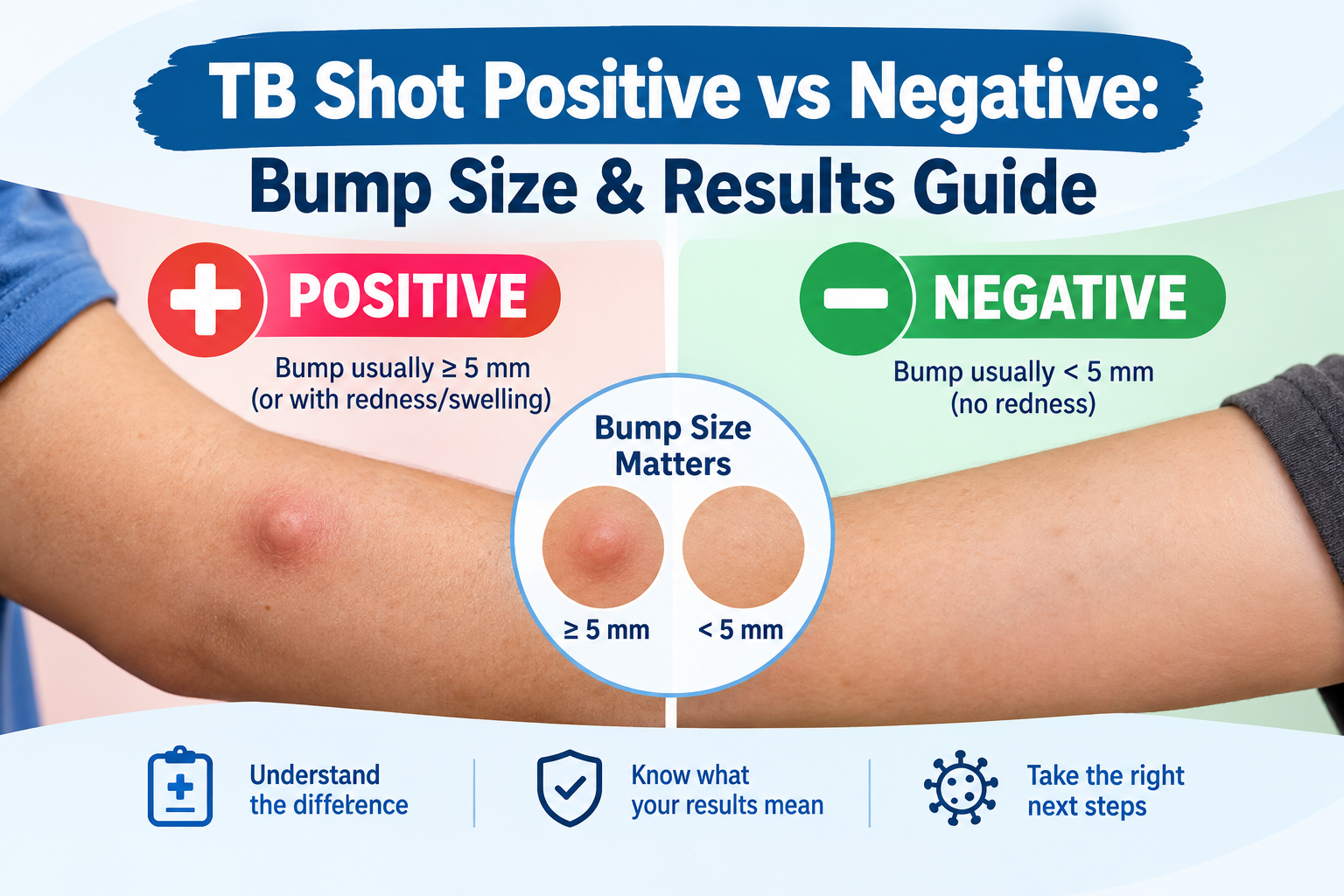
A negative TB skin test may show no hardened bump or a reaction below the positive threshold for your risk category. A positive TB skin test has enough measurable induration to meet one of the recognized cutoff points, commonly 5 mm, 10 mm or 15 mm, depending on your health history and TB risk factors.
This guide explains what a positive and negative TB test may look like, how the bump is measured, why redness does not determine the result, and what usually happens after a positive or negative reading.
TB Shot Positive vs Negative: Quick Comparison
The following table gives a simple overview.
| Feature | Negative TB Skin Test | Positive TB Skin Test |
|---|---|---|
| Raised hardened area | None or below the positive threshold | Measurable induration that meets the cutoff |
| Redness | May be absent or present | May also be absent or present |
| What matters most | Induration size | Induration size |
| Reading time | 48–72 hours | 48–72 hours |
| Meaning | TB infection is less likely | TB infection may be present |
| Next step | Usually no further action unless symptoms or recent exposure exist | Further evaluation is usually required |
The result cannot be determined accurately from redness alone.
What Is a TB Skin Test?
A TB skin test is used to help determine whether your immune system has reacted to bacteria that cause tuberculosis.
It may also be called:
- Tuberculin skin test
- TST
- Mantoux test
- PPD test
- Purified protein derivative test
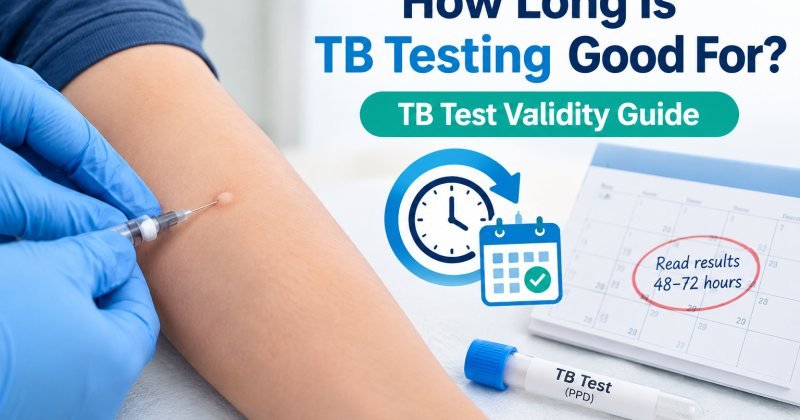
During the test, a small amount of testing material is injected just under the skin of the forearm.
A small raised area usually forms immediately after placement. That immediate bump is not the final result.
The test must be checked later, generally within 48 to 72 hours.
What Does a Positive TB Test Look Like?
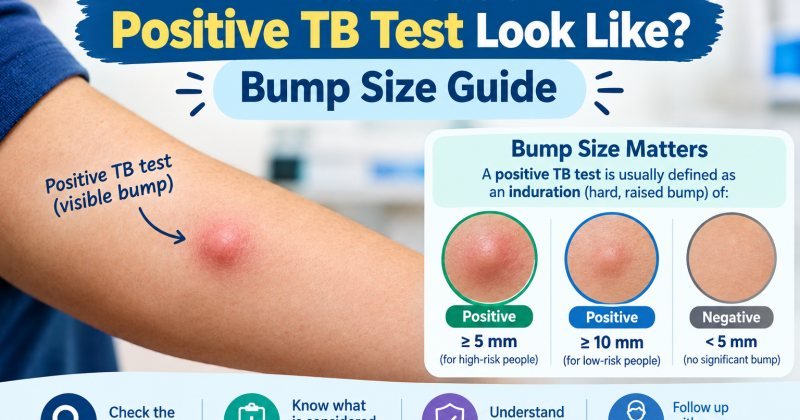
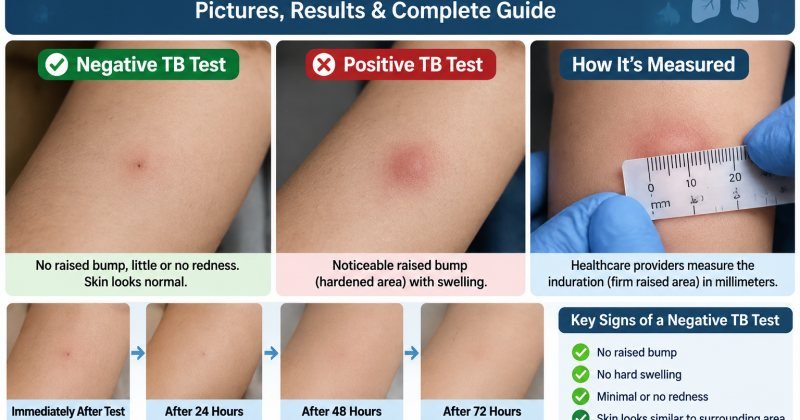
A positive TB skin test usually has a firm, raised or hardened area at the injection site.
The important feature is the hardened area, not redness around it.
A positive reaction may:
- Feel firm when touched
- Appear slightly raised
- Have clearly defined induration
- Measure 5 mm, 10 mm or 15 mm or more depending on the person's risk level
The skin may also look red, but redness by itself does not make a test positive.
A healthcare professional measures the induration across the forearm in millimeters.
What Does a Negative TB Test Look Like?
A negative TB skin test often shows:
- No firm bump
- No measurable induration
- A very small hardened area below the positive threshold
- Skin that looks nearly normal
- Mild redness without significant induration
Some people assume that any bump means the test is positive, but that is not correct.
A small reaction can still be considered negative if it does not reach the cutoff that applies to your risk category.
TB Test Redness vs Induration: What Actually Matters?
This is one of the most important differences to understand.
Redness
Redness is simply a change in skin color around the injection site.
It can happen after many injections and does not automatically indicate a positive TB test.
Induration
Induration is the firm, raised or hardened area beneath the skin.
This is what healthcare professionals measure.
The result is based on the width of the induration in millimeters, not the size of the red area.
So, a TB skin test can look red and still be negative.
TB Test Bump Size: 5 mm, 10 mm and 15 mm
TB skin test interpretation depends on both the bump size and the person's risk factors.
5 mm or More
A reaction of 5 mm or more may be considered positive in certain high-risk people.
This may include some people with:
- HIV
- Recent close contact with someone who has infectious TB
- Certain chest X-ray findings suggestive of previous TB
- Significant immune suppression
10 mm or More
A reaction of 10 mm or more may be considered positive in people with certain additional risk factors.
Examples can include:
- People from countries where TB is more common
- Certain healthcare or institutional workers
- People who live or work in some high-risk settings
- People with particular medical conditions
- Young children with specific risk factors
15 mm or More
A reaction of 15 mm or more may be considered positive in people with no known TB risk factors.
The correct cutoff depends on the individual's situation, so the test should always be interpreted by a healthcare professional.
TB Skin Test Size Chart
| Induration Size | Possible Interpretation |
|---|---|
| 0–4 mm | Often considered negative |
| 5 mm or more | May be positive in high-risk individuals |
| 10 mm or more | May be positive in moderate-risk groups |
| 15 mm or more | May be positive in people without known risk factors |
This chart is only a general guide.
The same bump size may be interpreted differently in two different people.
What Does a TB Test Look Like After 48 Hours?
At 48 hours, the injection site may show:
- No visible reaction
- Mild redness
- A small raised area
- Noticeable induration
This is within the recommended time window for professional reading.
Do not judge the result based only on how red the skin appears.
What Does a TB Test Look Like After 72 Hours?
At 72 hours, the induration is still evaluated in the same way.
A negative test may show little or no firm swelling.
A positive test may have a clearly measurable hardened area that meets the appropriate threshold.
If the test is not checked within the recommended time window, it may need to be repeated.
Positive vs Negative TB Test Pictures: What Should You Look For?
People often search for positive vs negative TB test pictures to compare their arm with examples online.
Images can help demonstrate the difference between:
- Flat skin and raised induration
- Redness and actual swelling
- Small reactions and larger measurable reactions
However, pictures cannot confirm a TB test result.
Lighting, skin tone, angle and individual immune response can all affect appearance.
A trained healthcare professional should physically measure the induration.
Can a TB Test Be Red and Still Negative?
Yes.
Redness alone does not make a TB skin test positive.
A test can appear:
- Pink
- Red
- Slightly irritated
and still be negative if there is not enough induration.
The hardened area is what matters.
Can a Negative TB Test Have a Small Bump?
Yes.
A small bump does not automatically mean the test is positive.
The healthcare professional compares the size of the induration with your risk category.
For example, a reaction that does not reach the applicable cutoff may still be read as negative.
Does a Positive TB Test Always Mean Active Tuberculosis?
No.
This is one of the most important distinctions.
A positive TB skin test suggests that your immune system has reacted to TB-related antigens.
It does not automatically mean you have active tuberculosis disease.
A person may have:
Latent TB Infection
The bacteria are in the body but are not causing active disease.
People with latent TB:
- Usually do not feel sick
- Do not have typical TB symptoms
- Cannot spread TB to others
- May be offered treatment to reduce the risk of developing active TB later
Active TB Disease
The bacteria are actively multiplying and causing illness.
Depending on where the infection is located, a person may have symptoms such as:
- Persistent cough
- Fever
- Night sweats
- Unexplained weight loss
- Fatigue
- Coughing up blood
Further testing is needed to distinguish latent infection from active disease.
What Happens After a Positive TB Skin Test?
A positive skin test is usually followed by additional medical evaluation.
This may include:
- Health history
- Physical examination
- Chest X-ray
- TB blood test in some cases
- Sputum testing if active pulmonary TB is suspected
The purpose of further testing is to determine whether the person has latent TB infection or active TB disease.
A positive skin test alone does not answer that question.
What Happens After a Negative TB Skin Test?
A negative TB test often means TB infection is unlikely.
However, more testing may still be recommended if you:
- Have symptoms suggestive of TB
- Were recently exposed to someone with active TB
- Have a weakened immune system
- Were tested too soon after exposure
In these situations, a healthcare provider may recommend repeat testing or a TB blood test.
Can a TB Skin Test Be False Positive?
Yes.
A false positive means the test appears positive even though the person does not have TB infection.
Possible causes can include:
- Previous BCG vaccination
- Exposure to certain non-tuberculosis mycobacteria
- Test administration or interpretation issues
People who received the BCG vaccine may be offered a TB blood test because BCG does not generally cause a false-positive IGRA blood test.
Can a TB Skin Test Be False Negative?
Yes.
A false negative means a person has TB infection but the skin test does not react strongly enough to meet the positive threshold.
This may occur with:
- Very recent TB infection
- Weakened immune system
- Certain serious illnesses
- Some medications that suppress immune function
- Very young age
- Improper test administration or reading
This is why symptoms and exposure history remain important even when the test is negative.
How Soon After TB Exposure Can a Skin Test Become Positive?
It can take time for the immune system to respond after infection.
If you are tested too soon after exposure, the result may still be negative.
In some circumstances, healthcare professionals recommend repeat testing several weeks after the most recent exposure.
The exact timing should be determined by your healthcare provider.
TB Skin Test vs TB Blood Test
There are two main types of tests used to detect TB infection.
TB Skin Test
Also known as:
- TST
- PPD test
- Mantoux test
Advantages:
- Widely available
- Relatively simple
- Commonly used in occupational screening
Limitations:
- Requires a return visit
- Can be affected by BCG vaccination
- Must be interpreted within a specific time window
TB Blood Test
Also called an interferon-gamma release assay (IGRA).
Common examples include:
- QuantiFERON-TB Gold
- T-SPOT.TB
Advantages:
- Requires one blood draw
- Does not require a return visit for skin measurement
- Often preferred for people who received the BCG vaccine
Your clinician can decide which type of test is most appropriate.
BCG Vaccine and TB Test Results
The BCG vaccine is used in many countries to help protect against severe forms of tuberculosis.
People who received BCG may sometimes have a positive TB skin test even if they are not currently infected.
That is one reason TB blood tests may be preferred for BCG-vaccinated individuals.
How Is a TB Skin Test Measured?
A healthcare professional checks the test by:
- Looking at the injection site
- Feeling the skin for induration
- Identifying the edges of the hardened area
- Measuring the width of the induration across the forearm
- Recording the measurement in millimeters
Redness is not included in the measurement.
Can You Measure a TB Test at Home?
It is not recommended.
Even if you use a ruler, it can be difficult to correctly identify the edge of induration.
The reading should be performed by a trained healthcare professional.
Self-reading can lead to incorrect results.
What If There Is No Bump After a TB Test?
No bump or no measurable induration usually suggests a negative result.
However, if you:
- Have symptoms of TB
- Had recent exposure
- Have severe immune suppression
your healthcare provider may still recommend additional testing.
What If the Bump Gets Bigger After 72 Hours?
The standard reading window is 48–72 hours.
A reaction that changes after this period should not be self-interpreted.
Contact the clinic or healthcare provider that performed the test for guidance.
Symptoms That Need Medical Attention Even With a Negative Test
Seek medical evaluation if you develop symptoms such as:
- Cough lasting several weeks
- Coughing up blood
- Fever
- Night sweats
- Unexplained weight loss
- Chest pain
- Persistent fatigue
A negative skin test does not replace clinical evaluation if symptoms strongly suggest TB.
Frequently Asked Questions
What is the difference between a positive and negative TB test?
A positive TB skin test has enough measurable induration to meet the threshold for the person's risk category. A negative result has no induration or a reaction below that threshold.
What does a positive TB test look like?
A positive test usually has a firm, raised or hardened area at the injection site. Redness may occur, but the hardened area is what is measured.
What does a negative TB test look like?
A negative TB test may show no bump, a very small bump or mild redness without enough induration to meet the positive cutoff.
How big is a positive TB test bump?
A positive reaction may be 5 mm, 10 mm or 15 mm or more depending on the person's risk factors.
Is a red TB test positive?
Not necessarily. Redness alone does not determine the result. Healthcare professionals measure induration.
Can a negative TB test have a small bump?
Yes. A small reaction may still be negative if it remains below the threshold that applies to your risk category.
Does a positive TB test mean I have active tuberculosis?
No. A positive test may indicate latent TB infection or active TB disease. Additional testing is required to determine which is present.
How long after a TB test should it be read?
A TB skin test is generally read 48 to 72 hours after placement.
Can BCG vaccination cause a positive TB skin test?
Yes. Previous BCG vaccination can affect TB skin test results in some people. A TB blood test may be preferred.
Can a TB test be wrong?
Yes. False-positive and false-negative results can occur, which is why exposure history, symptoms and additional testing may be important.
What happens after a positive TB test?
A healthcare professional may order a chest X-ray, perform a clinical evaluation and request additional tests such as sputum testing or a TB blood test.
Final Thoughts
When comparing a TB shot positive vs negative, the most important feature is the size of the induration, not the amount of redness.
A negative TB skin test usually has no hardened bump or a reaction below the relevant cutoff. A positive TB test has enough induration to meet a threshold such as 5 mm, 10 mm or 15 mm, depending on the person's risk factors.
A positive result does not automatically mean you have active tuberculosis, and a negative result does not completely rule out infection in every situation.
Always have the test read by a trained healthcare professional within the recommended 48–72 hour window.
This article is for educational purposes only and is not a substitute for professional medical diagnosis or treatment.
This guide is general education and is not medical, legal or career advice. Entry rules, fees, training lengths and treatment guidance change, so confirm them with the official body in your country or with your own doctor or pharmacist. Read our disclaimer. Found an error? Tell us.